
Why Are USC’s 3D Printed MRI Sensors Important for Infant Imaging?
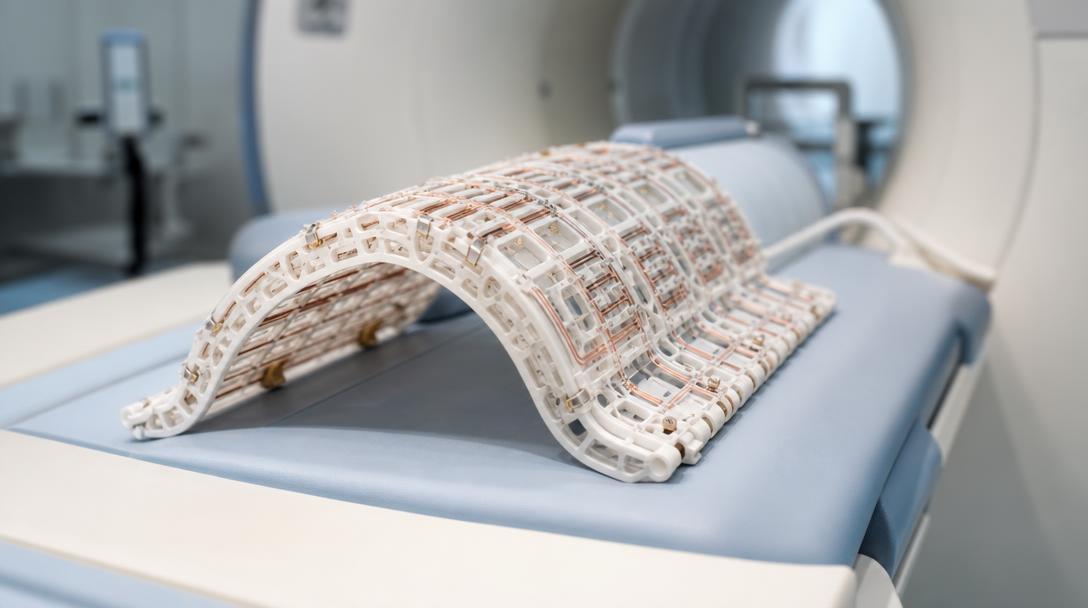
Researchers at the University of Southern California (USC) developed flexible, patient-adaptable 3D printed sensors for use in MRI imaging of infants and children. According to VoxelMatters’ report dated 31 August 2026, the team stated that it could produce the sensors in less than 10 minutes at a cost of about 30 dollars; in tests, it also reported achieving approximately four times higher image contrast compared with standard commercial solutions.
Why is the problem important?
Sensors called coils, used in MRI machines, work like antennas that receive the signals generated by the device. Since standard solutions on the market are mostly sized for adult bodies, there may be a gap between the sensor surface and the skin in infants. This gap can make signal capture more difficult and reduce image quality. Moreover, even a sensor that fits a child well may lose its ideal fit within a short time as growth continues.
The USC team’s approach is based on the idea of designing the sensor so that it sits closer to the patient’s body area and remains flexible. In this way, imaging equipment can be transformed from a one-size-fits-all adult-standard component into one that can be re-produced according to the use scenario.
What does the 3D printing approach provide?
In the process developed in Yasser Khan’s laboratory at the USC Viterbi School of Engineering, conductive silver ink is 3D printed onto a stretchable thermoplastic elastomer. The report states that this elastomer can stretch by 5 to 10 percent and helps the coil structure bend along with the body. This value does not mean the part is made of solid metal; rather, it involves the joint design of a conductive structure and a flexible polymer layer.
For the ucuz3D reader, the main importance of this approach is that 3D printing can be applied not only to large and complex prototypes, but also to support equipment whose dimensions vary according to the patient or the area of use. The short production time can make iteration across different body sizes and in-hospital research workflows easier. However, for clinical use, issues such as manufacturing repeatability, sterilization, safety, quality control, and the relevant regulations must also be verified separately.
Through whose collaboration was the research carried out?
The project brought together Khan’s laboratory with the USC Dynamic Imaging Science Center and clinical expertise at Children’s Hospital Los Angeles. Clinical input helped ensure that MRI sensors were evaluated not only for laboratory performance, but also in relation to the real imaging needs of pediatric patients. The researchers aim to make it possible to produce coils in different sizes over time for growing children.
Takeaway for the Ucuz3D reader
This development shows how valuable it can be to shorten the time between design and production in personalized manufacturing. The same logic could also inspire ergonomic accessories, custom-sized protective parts, and small-batch prototypes outside the medical device field. Still, the success of a medical part cannot be attributed only to printing speed or low production cost; material compatibility and the validation process are decisive.
You can visit our 3d printing service page to evaluate a custom-made or functional part. Review available materials through the engineering materials 3D printing options; when making a production decision, consider the price per gram logic together with prototype iterations. If your file is ready, you can get an instant quote using the online 3d printing tool.




 Türkçe
 العربية
 Русский
 فارسی
فارسی Deutsch