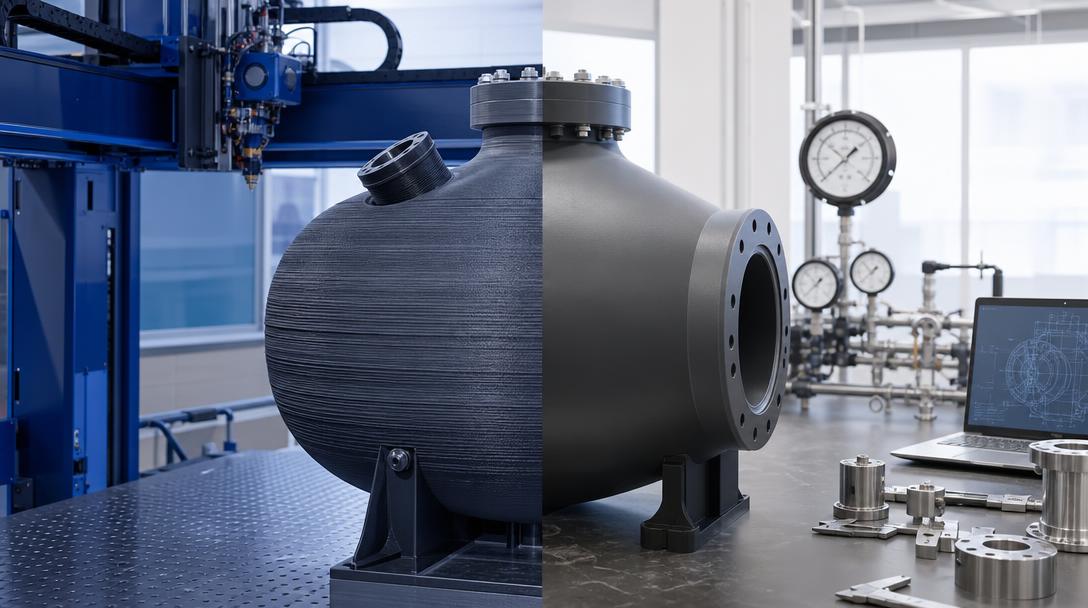

Why Does the ORNL and INL Collaboration on 3D-Printed Pressure Vessels Matter?
Oak Ridge National Laboratory (ORNL) and Idaho National Laboratory (INL) brought their collaboration on 3D-printed pressure vessels into focus. Reported in American Nuclear Society (ANS) news dated 27 August 2026, this development shows that additive manufacturing is being explored not only for prototype or visual model production, but also for high-responsibility engineering components.
This type of pressure vessel is a structural part that holds the fluid or gas inside at a certain pressure. Therefore, in the design, it is not enough just to produce the shape; material behavior, continuity between layers, sealing, dimensional stability, and post-production validation must all be considered together. This is exactly where the real value of the ORNL and INL collaboration emerges: evaluating 3D printing not merely as a machine capability on its own, but as part of the design, process, and testing chain.
Why are 3D-printed pressure vessels attracting attention?
In traditional manufacturing, complex internal channels, custom geometries, or low-volume designs often require molds, tooling, and additional assembly steps. When the right validation conditions are met, the additive manufacturing approach offers the potential to produce some geometries with fewer parts and to accelerate design iterations. This is especially important in research facilities for quickly testing new designs.
However, the statement “it could be produced with 3D printing” does not mean that the part is automatically ready for use. In a component operating under pressure, print orientation, layer structure, voids, surface quality, and connection regions can all affect performance. For this reason, in engineering applications, non-destructive inspection, pressure testing, and traceable process data become just as important as sample production.
What this means in practice for Ucuz3D readers
This news does not directly mean that you should produce a pressurized vessel with your desktop FDM printer. Parts printed with desktop filaments such as PLA, PETG, or similar materials can be useful for enclosures, mounting fixtures, low-risk prototypes, and test jigs. But if the application involves pressure, temperature, or safety-critical use, it is not appropriate to use the part without a material data sheet, a design safety margin, and expert validation.
The pressure vessel example also reminds us why the intended use must be defined from the very beginning in FDM part design. It may not be enough for a part to simply match the dimensions; the direction of the load, whether the part will operate continuously or for a short period, and the ambient temperature can all change the material choice. For this reason, when requesting service, it is helpful to clearly share the part’s operating conditions on the 3d printing service page.
What should be considered in material and production decisions?
- Type of load: Pressure, tension, impact, or vibration do not require the same material decision.
- Heat and environment: Temperature, UV light, and chemical contact can change the part’s lifespan.
- Print orientation: Strength between layers should be evaluated together with design orientation.
- Validation: In critical parts, measurement, sealing, and load tests are an inseparable part of production.
After clearly determining whether the part is only a prototype or a functional product for repeated use, you can review our printing materials. To evaluate material quantity and geometry together in the production decision, also keep the price per gram logic in mind. If your file is ready, the instant quote tool can help you see the initial feasibility for prototypes and low-volume production.
Conclusion
The ORNL and INL collaboration focused on pressure vessels shows that the value of 3D printing does not come only from fast production. The real leap happens when complex design, suitable material, controlled process, and reliable test methods come together in the same workflow. This development also carries an important lesson for desktop FDM users: defining the usage risk before printing the part is often a more critical step than choosing the filament.



 Türkçe
 العربية
 Русский
 فارسی
فارسی Deutsch