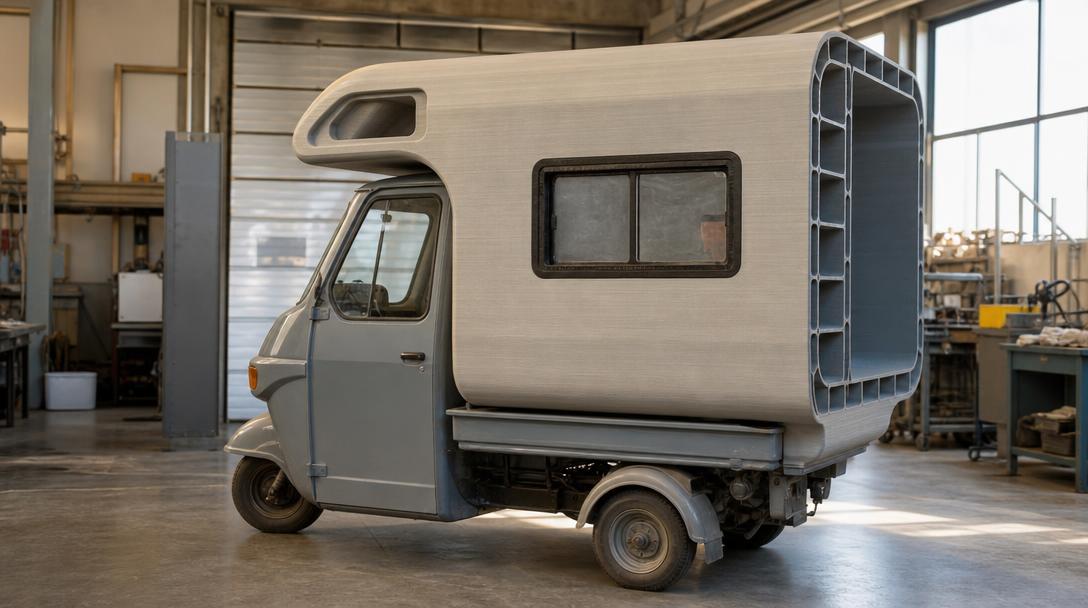

Why Is a 70-Kilogram 3D Printed Camper Shell Important? The Piaggio Ape Project Turns Lightweight Design Into Reality
The journey of more than 4,500 kilometers from Italy to the Nordkapp region of Norway showed what large-format thermoplastic 3D printing can deliver not only for prototypes, but also for a real vehicle body. Francesco Furlani’s three-wheeled Piaggio Ape TM 703 completed this route with a camper shell produced by 3D printing. The critical result of the project was weight: the printed shell weighed about 70 kilograms, while a comparable fiberglass structure was around 200 kilograms.
For a small vehicle with limited carrying capacity, this difference is not just a technical achievement, but something that directly changes real-world usability. The gain of about 130 kilograms created room for actual travel needs such as a bed, kitchen, batteries, food, and water. The news was published by 3D Printing Industry on August 29, 2026; the source bases the material and production details of the project on statements from Nugae and DCab.
How was the lightweight structure achieved?
The project used a thermoplastic foam called CoreLight3D, developed by Nugae from recycled polypropylene. The raw density of the material is reported to be about 300 kg/m³. However, when thin walls, hollow geometries, and reinforcements focused on load-bearing areas are used in the print design, the effective density of the finished structure can drop to around 100 kg/m³.
The approach here is to distribute the material according to load paths instead of filling every point of the part with the same amount of material. Nugae calls this method UL-LFAM. The process combines a special extruder, six-axis industrial robots, reinforcement strategies, and NU-Slice software. The printed parts are not the final product directly; they are structural semi-finished components that are turned into a vehicle body through steps such as lamination, bonding, surface treatment, and painting.
Does lightweight construction solve the durability problem?
Lightweight design alone is not enough. A camper shell must withstand rain, vibration, impact, temperature changes, and long-term use. While thin and hollow structural design reduces weight, it also creates new engineering decisions in terms of stiffness, sealing, and surface durability. In Nugae’s approach, the printed core can be reinforced where needed with fiberglass or carbon fiber surfaces. In this way, the goal is to increase stiffness while avoiding the weight increase that would come from making the entire structure thicker.
DCab’s role was also important here. The company adapted the printed geometry to match the connection points, weight distribution, and mechanical constraints of the Piaggio Ape platform. As a result, the shell was integrated to function not as a simple shelter added later to the chassis, but as a body suitable for the actual use of the vehicle.
A practical takeaway for Ucuz3D readers
This example does not mean that every filament used in desktop FDM printing is directly suitable for a vehicle body. On the contrary, it shows that large and load-bearing parts must be developed by evaluating material selection, layer orientation, internal geometry, connection design, and post-processing together. If you are looking for the right material choice for small fixtures or prototypes, you can review our printing materials.
When preparing a similar part for production, a safer path is to first define the service loads and environmental conditions, and then check the connections and deformation with a sample print. If you want to have the part you need produced professionally, you can look at the 3d printing service option. When evaluating the project as a whole, it is necessary to consider the price per gram logic together with the effect of part design on production cost. Uploading your file and seeing an instant quote can also speed up the initial feasibility check.
Where is the limit of large-format printing?
The Piaggio Ape project shows that low weight can be especially valuable for small vehicles, mobile living spaces, and special-purpose bodies. Still, results like these cannot be explained by printer volume alone. The behavior of the material, the structure formed during printing, the reinforcement layout, and the final assembly must all be designed together. For this reason, the real message of the news is not “produce every body with a 3D printer,” but rather that with the right material and structural design, some parts previously seen as heavy and dependent on molds can be reconsidered.



 Türkçe
 العربية
 Русский
 فارسی
فارسی Deutsch