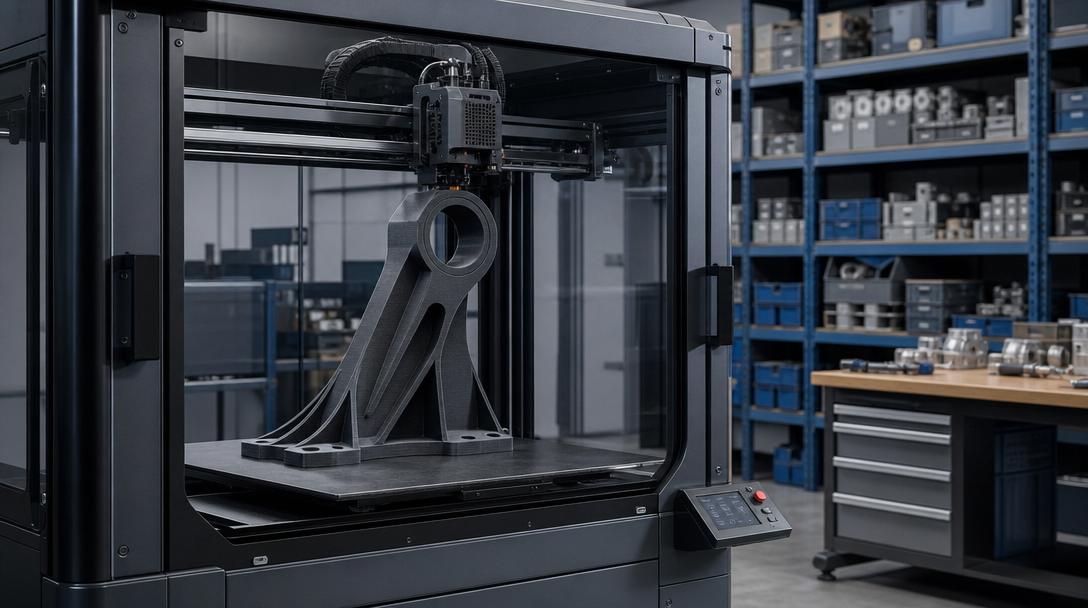

Siemens Mobility and the Henkel–Würth Partnership: A New Industrial Threshold for FDM 3D Printing
As FDM 3D printing moves from prototyping toward serial production, a new industrial application emerges almost every day. This week, two major developments revealed just how far industrial FDM 3D printing has come in maintenance, repair, and material certification: Siemens Mobility standardizing the use of FDM spare parts in its maintenance workshops, and the Henkel–Würth partnership taking a new step in industrial material certification.
Siemens Mobility: FDM Becomes Standard in Maintenance Workshops
Siemens Mobility has announced that the use of FDM 3D-printed spare parts has become a standard procedure across its train maintenance centers throughout Europe. Instead of relying on centralized inventory, the company has begun producing low-volume parts on site with FDM printers, from passenger information panels to cable-channel covers.
The main materials used in this application:
- PC-ABS: Durable cabin parts and console components
- PETG-CF: Carbon-fiber-reinforced control-box brackets
- ASA: Signaling enclosures exposed to outdoor conditions
This step cuts spare-part lead times in rail systems from weeks to days while also significantly reducing inventory costs. The path that FDM 3D-printed spare-part production follows in industrial maintenance operations sets an important benchmark, especially for sectors that need low-volume, customized parts.
The Henkel–Würth Partnership: A New Step in Industrial Material Certification
Henkel and the Würth Group have entered a partnership to develop a material family specifically certified for use in industrial FDM 3D printing. The first product was announced as a carbon-fiber-reinforced PETG filament designed for automation equipment that requires high mechanical strength and chemical resistance.
Under the partnership, every filament batch will pass through Würth’s industrial quality-control infrastructure and be certified on a lot-by-lot basis. This guarantees consistent quality for the parts produced via FDM, particularly for companies working in automation and robotics. Making FDM 3D printing with engineering materials standardized in this way is seen as a critical milestone in the sector’s transition from prototyping to serial production.
What Do These Developments Mean for the End User?
These two developments show that FDM technology is no longer just for hobbyists or prototyping workshops, but has become part of large-scale industrial operations as well. Certified materials and standardized production processes increase the reliability and repeatability of FDM printing, opening the door to a far wider range of uses.
If you want to choose the right material for your own project and get a high-quality FDM print result, identifying the engineering filament that suits your mechanical requirements is the first step. To learn more about this, you can check out our PETG material guide.
If you are not sure which material is right for your project, or if you need an industrial-grade FDM print, reach out to us through our fast quote page and let’s review your project together. We’re here with transparent pricing and delivery within one business day.



 Türkçe
 العربية
 Русский
 فارسی
فارسی Deutsch