Stratasys F870: How Large-Format FDM Printing Is Changing In-House Fixture Production
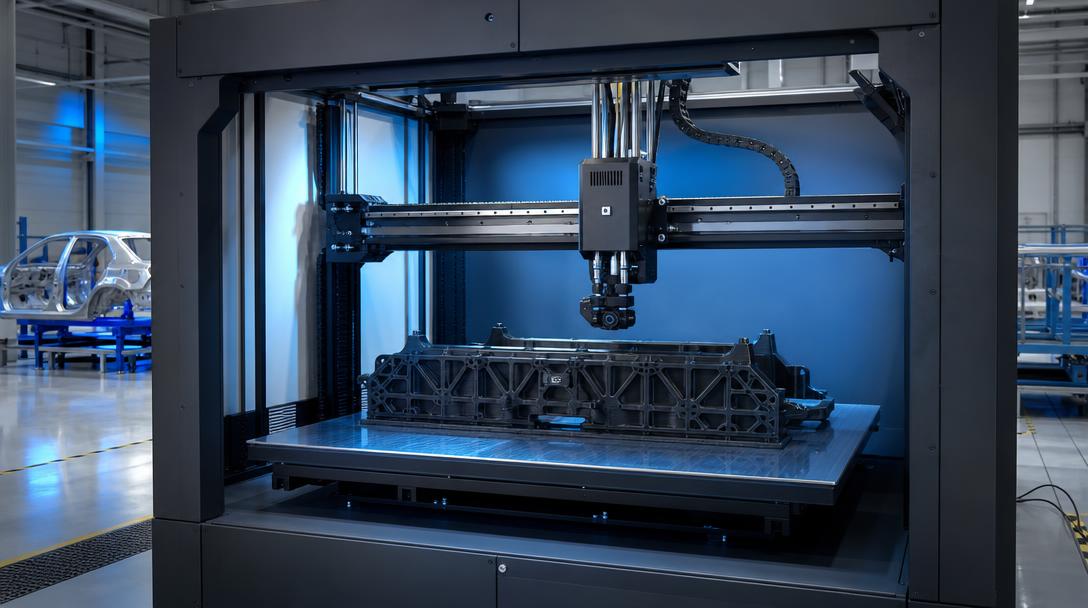
Stratasys F870 is a new industrial system designed to bring large-format FDM printing closer to automotive and aerospace production lines. According to a 3D Printing Industry report dated September 14, 2026, Toyota Production Engineering and Rivian are evaluating the printer for factory tooling and prototypes ahead of its commercial launch. This example shows how 3D printing is being used not only for samples that check form, but also for auxiliary parts that support the production process.
Key features of the F870
According to the published technical specifications, the F870 has a build volume of 1,000 × 610 × 610 mm. Its heated chamber provides an environment maintained at 95 °C by the manufacturer; temperature management is important when producing large parts, as it helps limit the risk of warping. The system was introduced with materials such as Nylon 12CF, ASA and ABS-M30, as well as a new gray FDM ABS Draft option. These materials are not identical to the options offered by Ucuz3D; this article describes the F870’s industrial use case.
The printer has three interchangeable print heads for different applications. Stratasys describes one for fine-detail gauges and tooling, another for carbon-fiber composite parts, and a third for producing fixtures at higher speeds. The manufacturer says the high-speed head can deliver approximately twice the output speed of standard FDM production when printing ASA; in practice, this figure should be considered in light of the part geometry, settings and quality requirements.
Why it matters on the production line
Applications being evaluated by Toyota and Rivian include assembly aids, inspection gauges, large fixtures and tools. For some tooling that would traditionally need to be machined or welded, FDM production can help teams test design changes more quickly and make parts closer to where they will be used. However, this does not mean replacing every metal tool with a plastic print: load, temperature, wear, dimensional stability and safety requirements must be validated for each part.
For applications such as a lightweight gripper mounted on the end of a robot arm, an ergonomic lifting aid or a drilling guide, weight and lead time are important design considerations. The F870’s large build volume increases the size of tooling that can be printed in a single piece, while also addressing factory needs such as long production runs and material management. The investment and operating requirements of an industrial system at this scale differ from those of desktop printers, so it would not be appropriate to generalize the announced capabilities to every workshop.
Practical takeaways
When designing production tooling with FDM, first define the part’s function and actual operating conditions. Then test print orientation, wall structure, connection points and, where needed, reinforcement options. The ability to print a part at a large size does not by itself guarantee strength; prototyping and use testing should be part of the decision. Explore options for different applications on our printing materials page, and learn about our 3D printing service to have the part you need produced.
To understand the approximate cost of a model, visit our affordable 3D printing prices page; you can also upload your file to see an estimated price through our online 3D printing process. This can help you turn an industrial-scale development like this into a practical starting point for your own prototype or tooling needs.


 Türkçe
 العربية
 Русский
 فارسی
فارسی Deutsch