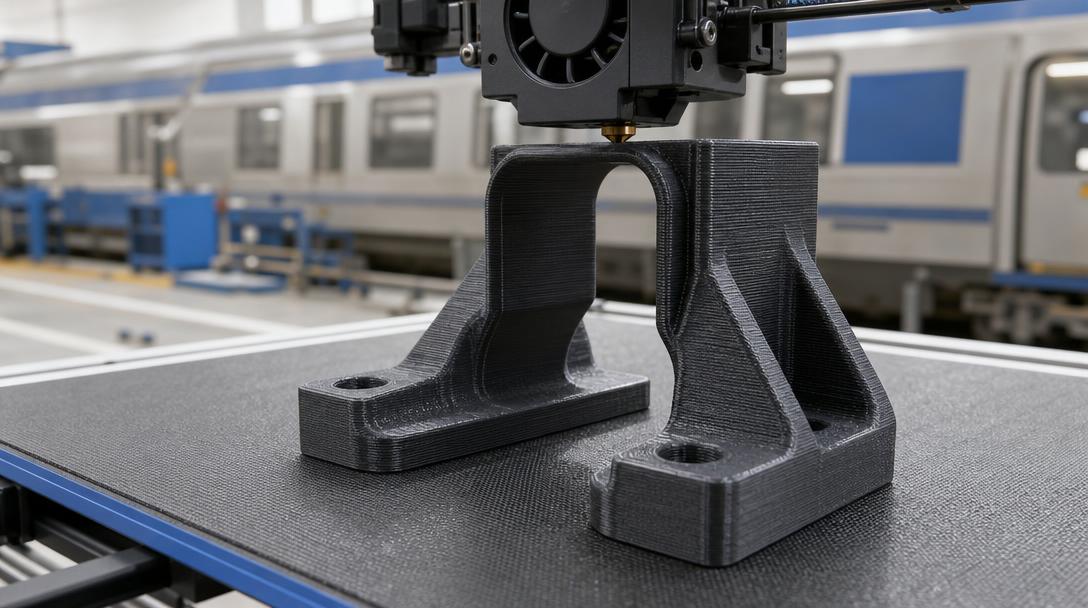
Wabtec’s 150,000 3D-Printed Train Parts Reveal a Gap in Spare-Parts Supply
3D-printed spare parts can help keep rail fleets in service when components are discontinued or difficult to source. Wabtec’s case, shared on October 6, 2026, shows that additive manufacturing is more than just prototyping: with validation and digital archiving, it can become a practical maintenance tool for long-lasting trains.
The challenge of finding parts for ageing fleets
According to Wabtec executive Henri de Chassey, more than 150,000 parts made using additive manufacturing are in use on trains worldwide. With European fleets averaging around 27 years of age and some trains remaining in service for 40–50 years, spare-parts needs become a long-term concern. Traditional sourcing can be difficult when the original supplier ceases operations, old manufacturing processes are no longer viable, or demand is very low.
Another notable point in the report is that usable 3D models are available for only around 10 percent of Wabtec’s parts. Some of the remaining data is recorded in 2D drawings or handwritten documents. The solution, therefore, involves more than printing a part: it also means digitising its existing geometry and technical information and turning them into a reliable production record.
Printing alone is not enough
For a component used on trains, testing and approval are just as important as the manufacturing method. Wabtec says it subjects parts intended for service to fatigue, vibration and salt-spray tests, and provides test reports and warranty coverage. This approach is a reminder that simply reproducing a part’s geometry is not enough; it must also be validated for its operating environment and the risk of failure.
The company uses various polymer and metal additive manufacturing processes. This report does not mean that Ucuz3D’s FDM service is equivalent to producing metal parts or railway safety components. However, the same basic principle applies to covers, enclosures, mounting brackets, fixtures and some plastic spare parts that can be made with FDM under suitable conditions: the part’s function, load, temperature and environment should be assessed before printing.
On-demand production and digital archiving
One benefit Wabtec describes is producing parts when needed, reducing the need to hold excess stock. Traditional manufacturing may require purchasing and storing more parts than necessary because of minimum order quantities. A digital parts library, in turn, helps preserve design data and makes future reproduction possible. The company says that some jobs can be completed in as little as four weeks after receiving the data, while noting that metal safety-critical parts requiring full validation may take longer.
To determine whether a part is suitable for reproduction with FDM, its dimensions, connection points, operating conditions and material requirements should first be clarified. For parts that can be made with FDM, explore 3D printing services, learn about affordable 3D printing prices, and estimate your file’s cost using the instant pricing tool. If the design is incomplete or only a physical sample is available, the guide to 3D scanning and reverse engineering can help you understand the process of creating a digital model.
The main lesson from the railway example is not that additive manufacturing is suitable for every part, but that digitisation, the right production method and validation need to be planned together when spare parts are hard to find. A simple plastic cover and a safety-critical component cannot be assessed using the same criteria.


 Türkçe
 العربية
 Русский
 فارسی
فارسی Deutsch