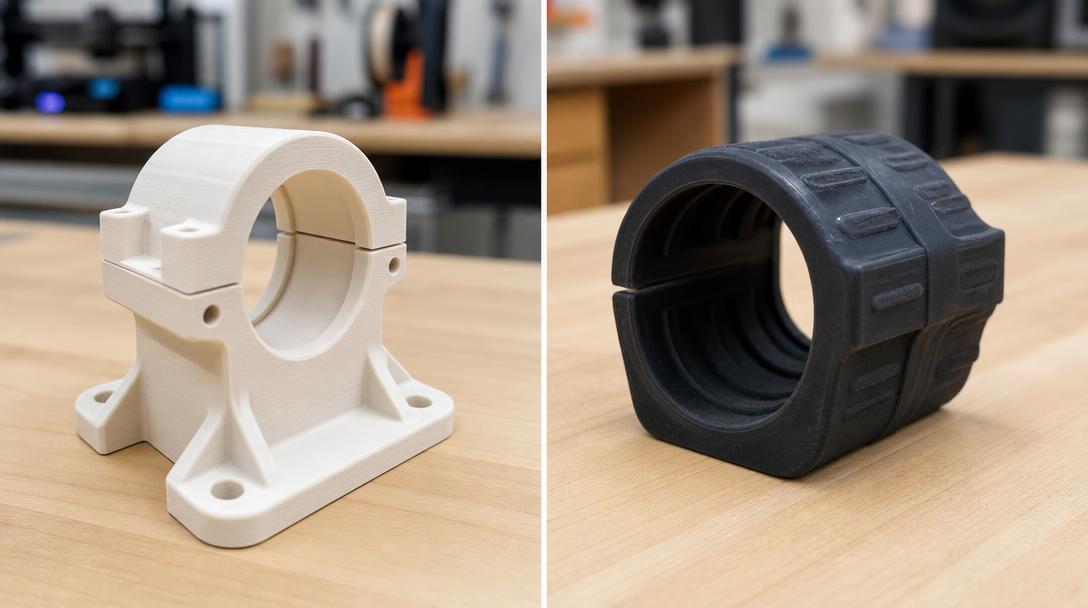
PLA+ or TPE? A Rigid Functional Part or a Flexible Protector?
The answer to whether PLA+ or TPE is right for you depends on how much the part needs to flex and what loads it will encounter. Since PLA+ can refer to products with different formulations from different manufacturers, it is not wise to assume a single strength value; TPE is also a broad family of elastomers. So choose based not just on the material name, but on the part’s function and the manufacturer’s technical data.
The key difference between the two materials
PLA+ is generally a type of filament intended to improve certain mechanical properties compared with standard PLA, while remaining rigid after printing. The exact results vary depending on the product formulation, print orientation and settings. TPE, by contrast, is a family of elastomer-based filaments that can flex; it is worth considering for protective and bumper-like parts expected to bend or compress. The hardness and printing behaviour of different TPE varieties can vary.
Which material is better suited to which job?
- A shape-retaining fixture: If the part needs to remain rigid, retain its dimensions and be easy to remove from the model, PLA+ may be a more suitable starting point.
- A flexible protector: TPE’s flexibility can be an advantage for a sleeve that moves around a cable, a vibration-absorbing bumper or a part expected to compress and spring back.
- A load-bearing connection: Don’t rely only on labels like “more flexible” or “stronger.” Load direction, connection geometry, temperature and sustained stress are all important; testing a sample under conditions close to the real application may be necessary.
- A visual prototype: A rigid PLA+ prototype can be useful for quickly checking the shape and assembly clearances. If the final part needs to flex, you should also validate the prototype in TPE.
Printability and design
In most situations, rigid PLA+ prints more predictably than elastomer filaments; however, follow the manufacturer’s profile and test settings such as cooling and bed adhesion for the specific part. TPE’s flexibility may require more careful filament routing through the feed path and a speed and settings appropriate for the printer. Designs with very thin, long features and narrow channels can be harder to produce with flexible filament. When choosing a material, check printer compatibility and the filament manufacturer’s recommendations.
Allow enough clearance in the design for TPE to flex; a closed slot that compresses the part too much can impair its function. With PLA+, rigidity alone does not mean the part cannot break: thin sections, sharp internal corners and layer orientation all affect the result. For both materials, consider how the layers are positioned relative to the load direction and the wall thickness. Learn how part orientation can affect strength in our print orientation guide.
Before you decide
First, define the part’s function: does it need to stay rigid, flex or absorb impact energy? Then consider the surfaces it will contact, the operating temperature and whether it will be used cyclically. Don’t casually substitute PLA+ for TPE or vice versa in the same part; performance depends on the product formulation and production conditions. Compare general options on our printing materials page, and learn about our 3D printing service to clarify your project requirements.
If your file is ready, use the online 3D printing price calculator to check an estimated cost based on the material and geometry. The calculator is not a substitute for choosing the right material; discussing any technical questions before printing can help you avoid selecting the wrong one.



 Türkçe
 العربية
 Русский
 فارسی
فارسی Deutsch