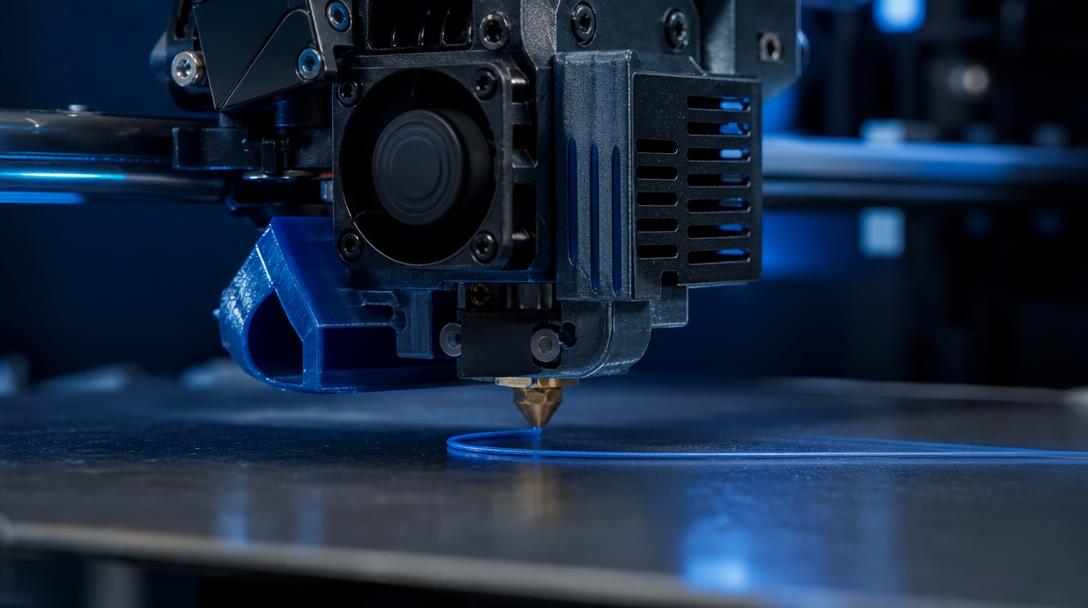
Snapmaker and Phaetus Unveil the New U1 Hotend: What’s Changing in High-Flow FDM Printing?
In FDM printing, production time is determined not only by movement speed; how quickly and consistently the nozzle can deliver molten filament also matters. The new U1-compatible hotend announced by Snapmaker and Phaetus on September 25, 2026, focuses on this aspect. Test results shared by the manufacturers suggest that the high-flow hotend design can deliver higher volumetric flow with PLA, ABS, and PETG HF. But what does this development mean for everyday printing and prototyping?
What changes does the new hotend bring?
The Snapmaker × Phaetus Liber High Flow Hotend is a hotend component co-developed for the Snapmaker U1. According to the announcement, the design combines Phaetus’s Split-Flow melt channel, a DLC-coated hardened steel nozzle, and a precision-machined heat break. The aim is to improve heat transfer while melting filament and increase material flow during long, uninterrupted extrusion.
“Volumetric flow” refers to the amount of molten plastic a printer can extrude in a given time. This value matters because even if the print head moves faster, print quality or actual production speed can hit a limit if the hotend cannot supply enough material. Large infill areas and long perimeter lines are some of the jobs where this limit becomes apparent.
How should the published test results be interpreted?
According to company tests cited in TCT Magazine’s September 25, 2026 article, compared with the U1’s stainless steel hotend, the new hotend increased volumetric flow by 66% with PLA, 87% with ABS, and 43% with PETG HF. These are manufacturer-reported results obtained under specific matched energy-use conditions; they do not mean that the same gains will be seen with different printers, filaments, print geometries, and settings.
Higher flow alone also does not guarantee a shorter, successful print. Cooling, layer adhesion, the motion system, the part’s geometry, and the target surface quality all affect the outcome. When raising the speed limit, you should verify that the material is melting sufficiently and the layers are bonding securely. That is why the benefits of a new hotend can be determined not only from its specifications, but also through controlled trials on real parts.
- For prototypes: A high-flow design may be beneficial if flow capacity is limiting print time on large, continuous extrusion paths.
- For surface quality: More material flow does not automatically mean a better surface without suitable settings; calibration is still necessary.
- For abrasive filaments: Hardened steel and a coating are design features intended to improve nozzle durability; unlimited compatibility with every material should not be assumed.
- For existing printer owners: Compatibility, installation, and the operating limits recommended by the manufacturer should be checked before purchase.
What this means in practice for FDM users
The news shows that printer ecosystems evolve not only through new machine launches, but also through upgradeable components. For U1 users, a high-flow hotend is worth considering, especially for those who frequently print large models or long production paths. By contrast, small parts, fine details, and jobs printed slowly for quality may not benefit as much from this upgrade.
When evaluating a part’s production time, it is also worth considering material volume, infill and wall structure, and print orientation together. To understand these factors, see our guide to the impact of layer height on print quality. You can explore FDM printing materials based on your project’s material and geometry requirements; if you need external production, learn more about our 3D printing service.
It is also useful to treat the budget as part of the design when preparing a part for production. Visit our affordable 3D printing prices page for an up-to-date cost estimate, or check your file with our online 3D printing price calculator. The practical value of technical announcements becomes clear through the right use case and real-world print testing.



 Türkçe
 العربية
 Русский
 فارسی
فارسی Deutsch