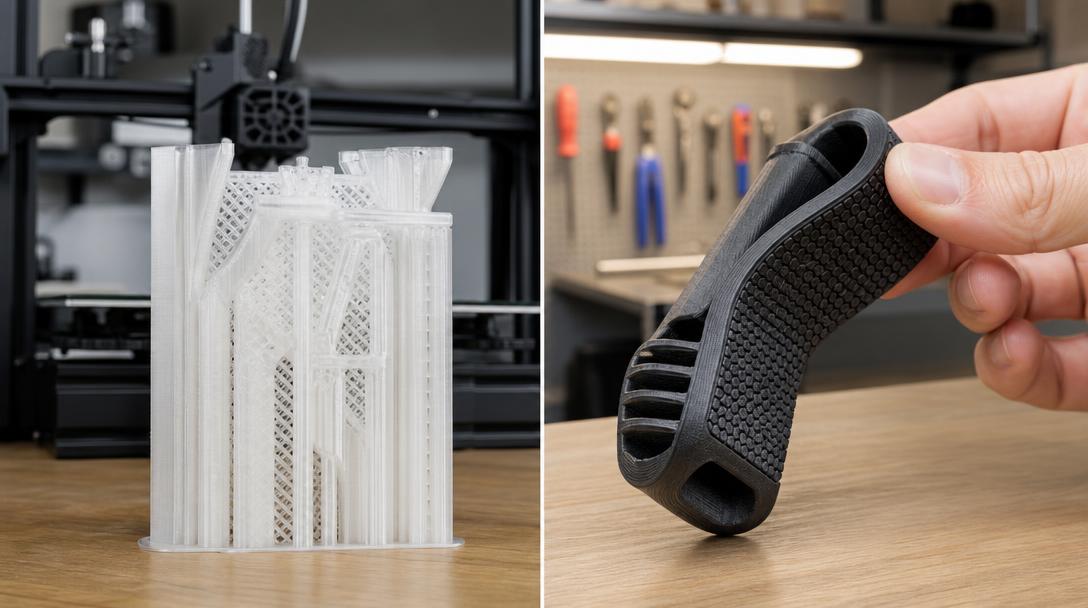
PVA or TPE? Clean Support or Flexible Functional Part?
In FDM printing, PVA and TPE are not two alternatives that serve the same need. PVA is mainly used to create clean supports for complex geometries, while TPE is intended for functional parts that flex and absorb impact. Therefore, the choice should be based less on the material’s name and more on the purpose of the part you are going to print.
What is PVA used for, and what is TPE used for?
PVA is a water-soluble support filament. In a compatible multi-material FDM workflow, it makes it easier to remove supports located underneath or inside the main part by dissolving them in water after printing. It can contribute to surface quality, especially in models with internal channels, enclosed cavities, and surfaces where supports are difficult to remove by hand. However, PVA is generally not selected for the main part itself; it requires more careful handling in terms of moisture management and printing conditions.
TPE is an elastic thermoplastic. It may be considered for applications requiring controlled flexibility, such as cable protectors, vibration-damping feet, bumpers, flexible covers, and parts similar to lightweight gaskets. If a rigid supporting body or dimensional stability is the priority, TPE may not be the right choice.
Differences in function and strength
PVA’s role is not to carry a load but to provide temporary support during printing. Once dry, it should not be considered the working material of the printed part. TPE offers advantages in impact absorption and flexibility; however, it may not behave like rigid filaments in terms of stiffness, precise dimensional consistency, and retaining its shape under long-term loads. The result with TPE varies depending on the product’s hardness rating and the printing settings.
Outdoor and temperature conditions
PVA is sensitive to moisture. If it is not kept dry before printing, surface quality, layer behavior, and feeding consistency may be negatively affected. For this reason, PVA is not a sensible choice as the outer-surface material of a part that will be used outdoors, in the rain, or in high-humidity environments.
TPE may be more functional in some applications exposed to water and impact; however, not all TPE products have the same outdoor and temperature performance. If the part will be exposed to sunlight, oil, constant pressure, or high heat, the manufacturer’s data should be checked, and the part should be validated with a prototype tested under conditions close to actual use. Neither material should automatically be considered an outdoor material simply because it is flexible or soluble.
Printability and cost considerations
The biggest challenge with PVA is moisture. Drying, enclosed storage, and, if possible, controlled feeding during printing are required. Since it is consumed as support material, it can also increase the model’s total material usage. On the other hand, it can prevent a complex part from breaking during support removal, reducing post-processing time.
With TPE, feeding the flexible filament, retraction, and speed settings may be more sensitive depending on the printer’s mechanical design. Printing may take longer, and stringing may appear on the surface. When considering cost, look beyond the spool price and also consider the risk of failed prints, the need for supports, and post-processing time. Reviewing the price per gram approach can help you make a more realistic comparison when evaluating the same part in different materials.
Which material for which part?
- A rigid model with internal cavities and complex supports: PVA support compatible with the main material may be considered.
- A foot exposed to vibration, a bumper, or a flexible cover: TPE is a more meaningful starting option.
- A rigid fixture that will be exposed to sunlight and heat for long periods: Consider engineering materials suitable for the application instead of PVA and TPE.
- When single-material, easily removable supports are sufficient: The additional drying and feeding requirements of PVA may be unnecessary.
If you are unsure about the material choice, first print a small test piece. You can compare the printing materials you need according to the conditions of use, and make the production decision based on the part’s geometry and expected load. When ordering production through a professional 3d printing service, specifying the part’s flexibility, support surfaces, and operating environment from the outset will improve the result. Before sending your model, check the material option in the online 3d printing tool to see which approach best suits your budget and the part’s intended function.


 Türkçe
 العربية
 Русский
 فارسی
فارسی Deutsch