ABS or TPC? A Rigid Technical Part or a Flexible Wear Part?
With an FDM part, you may sometimes need a rigid body, while at other times you may need a structure that absorbs impact and can move repeatedly. ABS and TPC are materials that meet these two different requirements. Rather than evaluating them only under the heading of ‘durable filament’, it is more accurate to consider how the part will function.
What is ABS used for, and what is TPC used for?
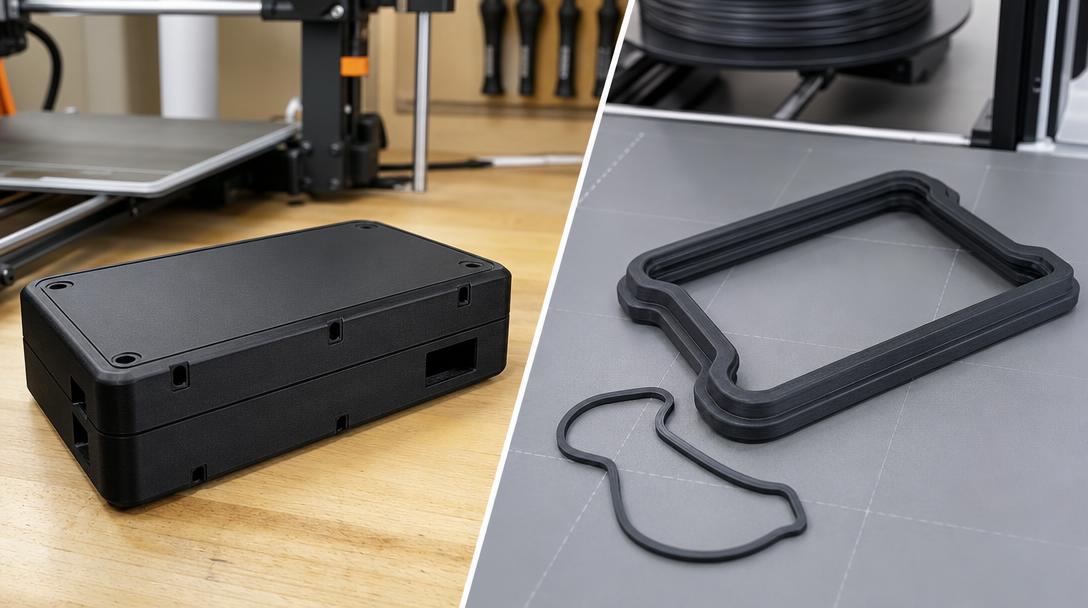
ABS is a thermoplastic preferred for rigid and functional parts, offering impact resistance along with a certain level of heat tolerance. It is a sensible choice for parts that need to retain their shape, such as boxes, housings, mounting brackets, protective covers, and prototype bodies. However, open-frame printers may experience issues such as poor bed adhesion, corner lifting, and cracking between layers; an enclosed chamber and good temperature management are advantageous for many designs.
TPC is a family of flexible materials based on thermoplastic copolyester. Although its hardness can vary depending on the product formulation, its main advantages include controlled flexibility, impact absorption, and greater suitability for repeated bending. It can be considered for seal-like parts, cable protectors, bumpers, vibration-reducing feet, and flexible connections. It should not be expected to replace a rigid supporting body.
The difference in terms of outdoor use, heat, and impact
ABS may be a more suitable candidate than PLA for direct sunlight and variable weather conditions; nevertheless, the actual product data and design conditions should be checked for long-term outdoor use. With TPC, outdoor performance depends more heavily on its chemical structure, hardness rating, and manufacturer’s formulation. Being flexible does not automatically make it UV-resistant.
For a rigid housing or machine fixture exposed to heat, ABS is a more natural starting point than TPC. TPC stands out for parts that need to retain their flexibility under low and moderate loads; as the temperature rises, the possibility of softening and dimensional change should be taken into account. For impact resistance, the result depends on the part’s wall thickness, print orientation, and infill. While ABS can offer a good balance under hard impacts, TPC can absorb energy by flexing.
Rigidity, flexibility, and ease of printing
The rigidity of ABS helps connection holes and mounting surfaces retain their form. The flexibility of TPC is an advantage for parts such as clips, straps, sleeves, or vibration isolators. Therefore, when choosing between the two materials, you should ask not ‘which one is stronger?’ but rather ‘what should the part do under load?’
In terms of ease of printing, ABS generally requires a higher bed and ambient temperature, good airflow control, and an enclosed chamber. With TPC, it is important to avoid leaving gaps in the flexible filament’s feed path, use a low and consistent speed, and adjust retraction carefully. The brand and printer profile can affect the result with both materials; a small test part is safer than moving directly to large-scale production.
Which one for which part?
- Choose ABS: For shape-retaining boxes, housings, mounting brackets, rigid covers, and heat-exposed rigid prototypes.
- Choose TPC: For flexible seal-like parts, cable pass-through protectors, bumpers, vibration feet, and connections that bend repeatedly.
- Evaluate both carefully: For applications requiring validation, such as food contact, high temperatures, critical safety, or long-term outdoor use, do not make a definitive decision without the manufacturer’s technical data.
Defining the part’s load, operating temperature, and required degree of flexibility from the outset reduces trial prints and delivers more consistent results.
By sharing your project’s dimensions and usage conditions, you can clarify together which material is more suitable as part of the 3D printing service. When planning the production quantity, reviewing the price per gram approach allows you to evaluate material selection together with the total part cost. If your file is ready, you can upload the model to the online 3D printing tool and compare the options. You can also visit the engineering materials page to view the technical properties of ABS and TPC together.


 Türkçe
 العربية
 Русский
 فارسی
فارسی Deutsch