TPU or Polycarbonate? Flexible Protection or a Rigid Part Exposed to Heat?
Is it more important for a part to absorb impact or to retain its shape under heat? TPU and polycarbonate (PC) are not materials that address the same needs. TPU is suited to protective parts thanks to its flexibility and recovery behaviour, while PC stands out in technical applications requiring rigidity, impact resistance, and high-temperature performance. The right choice depends not only on hardness but also on the part’s operating conditions.
What are TPU and polycarbonate used for?
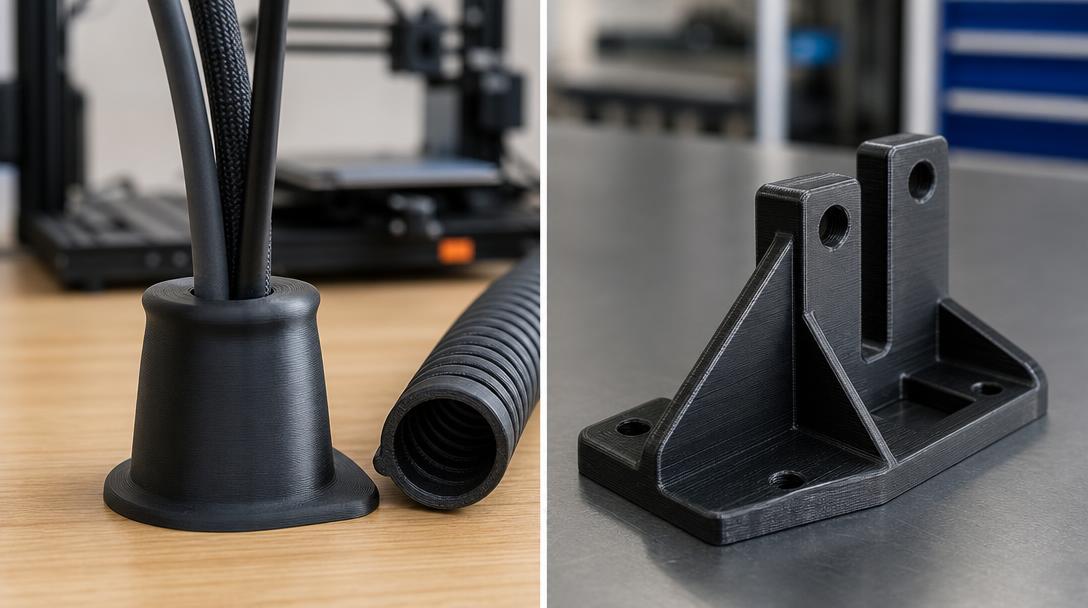
TPU is a flexible FDM filament based on thermoplastic polyurethane. It can be considered for cable protectors, vibration-damping feet, gasket-like components, gripping surfaces, and covers expected to soften impacts. If the part needs to bend, compress, or conform to a surface to some extent, TPU is a sensible starting point.
Polycarbonate, on the other hand, is considered for rigid technical parts, fasteners, fixture bodies, and load-bearing components exposed to heat. It may offer good impact resistance; however, actual performance depends on the filament formulation, print orientation, interlayer bonding, and printer settings. Therefore, a single general strength ranking should not be assumed to be correct for every part.
Comparison of outdoor use, heat, and impact resistance
- Outdoor use: TPU can provide an advantage in flexible, impact-absorbing protectors; however, product technical data should be reviewed for sunlight, rain, chemicals, and continuous load. PC can offer a more rigid solution in some technical applications, but its outdoor performance also depends on additives and surface conditions.
- Heat: PC is a more suitable candidate than TPU for parts exposed to heat. TPU’s flexibility can change with temperature; it should not be chosen at random for areas around motors or hot enclosed spaces.
- Impact: TPU attempts to absorb impact through deformation. PC, by contrast, can provide rigid body protection against impact. The direction of the impact and the part’s thickness can significantly change the result.
- Rigidity and flexibility: PC makes more sense for a rigid connecting fixture, while TPU is more suitable for a protector that needs to bend or compress.
Printing difficulty and design impact
TPU requires careful management of its flexibility during printing. The filament path, extruder design, print speed, retraction, and spool feeding all affect the result. Settings that are too fast can cause stringing, dimensional deviation, or irregular extrusion. PC requires high temperatures, good bed adhesion, and, in most cases, a controlled printing environment. For large parts, an enclosed chamber, proper bed preparation, and stress-relieving design details can be important for addressing warping and layer stress.
With both materials, part orientation, wall count, and infill ratio can become more influential than the material name itself. Do not consider a thin PC part reliable simply because it is an engineering material; likewise, do not automatically assume that a thick TPU part is suitable for every gasket or vibration-damping component.
Which material should you choose for each part?
- If you need a flexible sleeve that reduces friction and vibration around a cable passage, start with TPU.
- If you are designing a fixture or rigid body that is exposed to heat and must retain its shape, consider PC.
- If the part must both flex and withstand continuous wear, also check TPU’s hardness class and cycle life.
- When producing with PC, verify your printer’s temperature capacity, enclosure status, and the manufacturer’s print profile.
When making a cost decision, do not compare only the kilogram or price per gram; also take into account the risk of failed prints, the need for supports, post-processing, and part lifespan. If you already have a model, you can evaluate material selection together with the part’s use case through the online 3d printing workflow. For production support, visit the 3d printing service page, and to explore technical options, take a look at the engineering materials page.




 Türkçe
 العربية
 Русский
 فارسی
فارسی Deutsch