
PLA+ or HIPS? Which Makes More Sense for Visual Prototypes, Boxes, and Desktop Accessories?
Although PLA+ and HIPS may seem at first glance to serve similar use cases, in practice they address different expectations. One generally offers an easier and lower-risk production workflow, while the other can provide advantages in lightness, machinability, and certain prototype scenarios. If you are considering having a part produced through a 3d printing service, it is more accurate to evaluate the difference between these two materials on a part-by-part basis.
When does PLA+ make more sense?
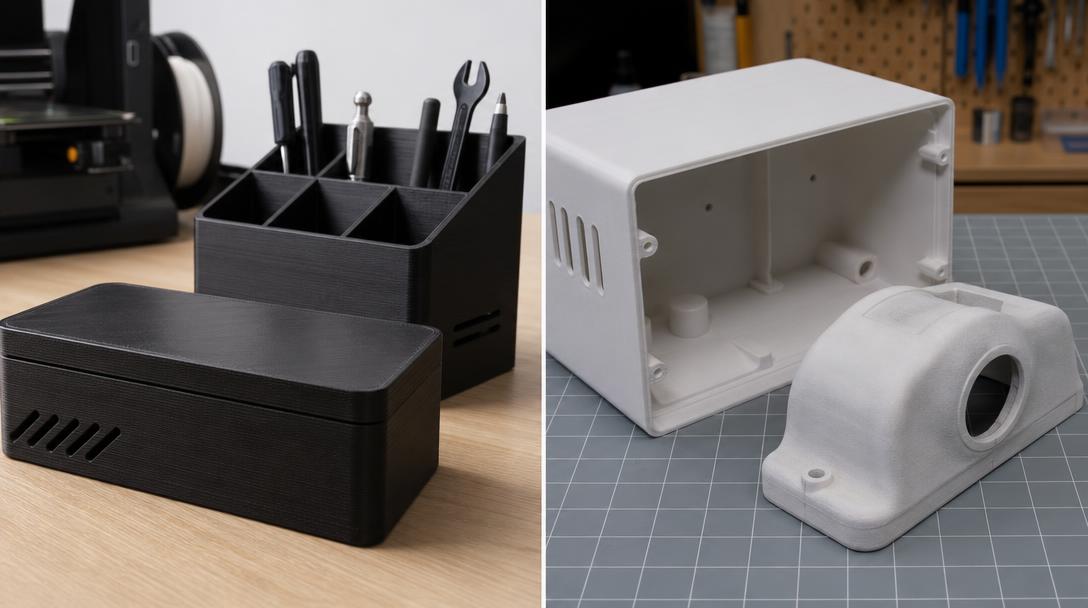
Compared with standard PLA, PLA+ is intended by most manufacturers to have a slightly tougher character that is more suitable for everyday use. For this reason, it is often preferred for desktop organizer parts, small boxes, visual prototypes, mockups, light-duty brackets, and office accessories. Since it generally delivers more predictable results during the printing process, it offers an advantage for users who want to see a sample quickly.
The strong side of PLA+ is ease of printing. The risk of warping is relatively low, surface quality is generally satisfactory, and dimensional surprises are less common. For this reason, it is a sensible option especially for first-iteration prototypes when you want to validate a design quickly. For those who want to get a fast quote on the online 3d printing side, materials that are easier to process often simplify the overall process.
When does HIPS stand out?
HIPS can be considered for relatively lightweight, machinable parts that should not behave in a brittle way under impact and that are more open to sanding. It can make sense especially for visual prototype enclosures, housings that will later be cut or drilled, and shell parts that may be exposed to light impact. It is also mentioned in some applications as a support material; however, the focus here is choosing it as a standalone part material.
The advantage of HIPS is that it gives the user more flexibility in post-processing. It can be useful for models and presentation parts that require sanding, surface correction, or preparation before painting. However, its printing behavior may not be as forgiving as PLA+; printer settings, bed adhesion, and ambient conditions can become more critical.
What changes in heat, impact, and outdoor use?
One of the most critical points when deciding between these two materials is the usage environment. PLA+ is a safer starting option for indoor use and moderate conditions; however, caution is necessary in scenarios such as hot environments, prolonged sun exposure, or inside a vehicle. HIPS should not automatically be considered the right choice for outdoor use either. For parts expected to withstand prolonged sunlight and weather conditions, other materials may generally be more suitable. For this reason, if you are having an outdoor part made, it is helpful to first consider the alternatives on the our printing materials page.
In terms of impact, PLA+ can be more forgiving than standard PLA; however, the risk of breaking under hard and sudden loads does not disappear completely. HIPS, on the other hand, may behave in a more balanced way in some light-impact use scenarios. That said, in technical parts exposed to very high temperatures, neither material is always the ideal candidate.
What is it good for, and what is it not good for?
- PLA+: suitable for rapid prototypes, desktop accessories, visual product samples, and light-duty boxes and carriers.
- PLA+: should be approached with caution for high heat, long-term outdoor use, and heavy mechanical stress.
- HIPS: makes sense for prototype covers, housings, and shell parts exposed to light impact that will be processed afterward.
- HIPS: may not always be the easiest option for users who want effortless printing and the lowest-risk workflow on the first try.
Cost logic and which one for which part?
The decision should not be made based only on spool price. The real cost is determined by whether the print succeeds on the first attempt, the scrap rate, the need for surface correction, and the total production time. That is why, as much as the price per gram, it also matters which material can produce the part more smoothly.
If the goal is a fast, clean, and predictable prototype, PLA+ makes more sense for most users. If the part is a box body, will be sanded afterward, or needs slightly more impact tolerance, HIPS can be considered. In short, PLA+ stands out for ease of printing and fast iteration, while HIPS stands out for machinable prototypes and light impact tolerance. The most accurate choice, however, should be made according to the part’s real use scenario.


 Türkçe
 العربية
 Русский
 فارسی
فارسی Deutsch