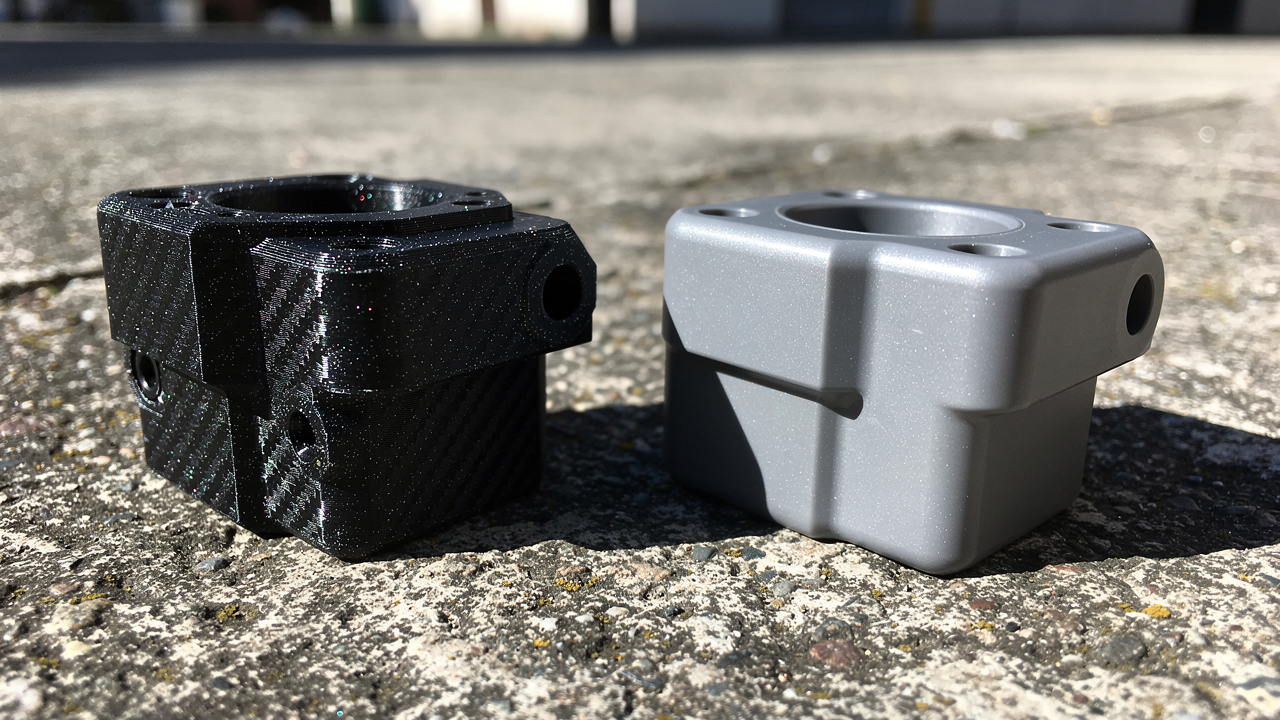

Carbon Fiber Reinforced or ASA? Which Makes More Sense for Rigid, Outdoor, and Technical Parts?
When a part needs to both look serious and perform well, material selection quickly becomes critical. Especially for brackets, covers, enclosures, fasteners, or low-volume technical production, the question often comes down to this: Carbon fiber reinforced filament or ASA? Both are more purpose-driven than standard hobby materials; however, they do not address the same need. If you are considering getting a 3d printing service for your design, the right approach is to understand the difference between these two materials based on the part’s use scenario.
Let’s start with a short summary: carbon fiber reinforced filaments stand out in parts that aim for higher rigidity, a more solid technical appearance, and in many cases more controlled deformation. ASA, on the other hand, is generally a safer choice when outdoor use, sunlight, UV, and weather conditions are involved. So the question is not simply “which one is stronger,” but under what load, in what environment, and for how long it will be working.
What is it good for, and what is it not good for?
The main strength of carbon fiber reinforced filaments is that they make the part more rigid and less flexible. They make sense for camera mounts, lightweight fixtures, structural parts that require dimensional stability, or body components that should not bend or twist. On the other hand, for clips, snap-fit tabs, or parts expected to absorb impact and flex a little before breaking, they may not always be the first choice.
ASA offers a more logical direction for applications such as outdoor enclosures, boxes exposed to sunlight, accessories used around vehicles, sign mounts, or protective covers working in open-air conditions. However, it would be wrong to see ASA as a magic solution for every mechanical problem just because it is suitable for outdoor use. In some technical parts where very high rigidity is required, carbon fiber reinforced materials may deliver a more targeted solution. This distinction becomes especially important when reviewing Ucuz3D’s engineering materials 3d printing options.
Where does the difference become clear in outdoor use and heat?
In outdoor performance, ASA usually speaks more clearly. Thanks to its UV resistance and behavior against weather conditions, it preserves its color, surface, and overall form more predictably in open-air environments. For an enclosure exposed to sunlight or a part placed on a balcony, in a garden, or around a vehicle, ASA is the more sensible choice in most cases.
With carbon fiber reinforced filaments, the result depends on which base polymer the reinforcement is combined with. In other words, “carbon fiber” alone is not enough information; the underlying material matters. For this reason, when making an outdoor-use decision, the application environment should be evaluated separately rather than relying only on the carbon fiber label. A similar logic applies to heat as well: for technical parts exposed to moderate temperatures, both materials may work; but if there is constant sunlight, a closed hot enclosure, or a demanding service environment, the choice should be considered carefully.
Which one leads in impact, rigidity, and flexibility?
If your goal is it should not flex, it should hold its form, and it should feel technical, the carbon fiber reinforced option becomes more attractive. Its rigidity advantage is especially noticeable in long and thin geometries or in parts that should not deflect under load. On the other hand, in some scenarios, higher rigidity can also result in less forgiving behavior under impact.
ASA generally offers a more balanced structure. It may not feel as stiff as a carbon fiber reinforced material, but it can provide a wider safety margin across impact, daily use, and outdoor conditions. In other words, if your part is a measuring fixture or a rigid structural support, the carbon fiber side may make more sense; if it is an outer shell, a cover flap, or a field accessory, ASA may be the more logical choice.
Printing ease and cost logic
On the printing side, neither material is as easygoing as standard PLA. ASA requires more attention in terms of temperature management and warping control. Carbon fiber reinforced filaments, on the other hand, may require a more technical approach because of nozzle wear, surface behavior, and sometimes the need for a more controlled process. For this reason, when making a decision, you should look not only at the theoretical properties of the raw material but also at the efficiency of the part during the printing process.
When evaluating cost, the healthiest approach is part success rather than the spool label alone. Fewer reprints, less warping, and a more accurate first production can sometimes reduce total cost. At this point, the price per gram logic should be considered together with the part’s requirements. If you want to make a quick initial evaluation for your file, it is possible to see at an early stage which material makes more sense through the online 3d printing system.
Which one for which part?
- Carbon fiber reinforced: Rigid bracket, lightweight but stiff structural support, technical-looking body, long part that should not deflect.
- ASA: Outdoor enclosure, UV-exposed cover, accessory used around vehicles, functional part exposed to weather conditions.
The final decision is usually very clear: if your part’s primary concern is rigidity and technical stability, carbon fiber reinforced material makes more sense. If your part’s primary concern is sunlight, weather, and outdoor durability, ASA is most often the better choice.


 Türkçe
 العربية
 Русский
 فارسی
فارسی Deutsch