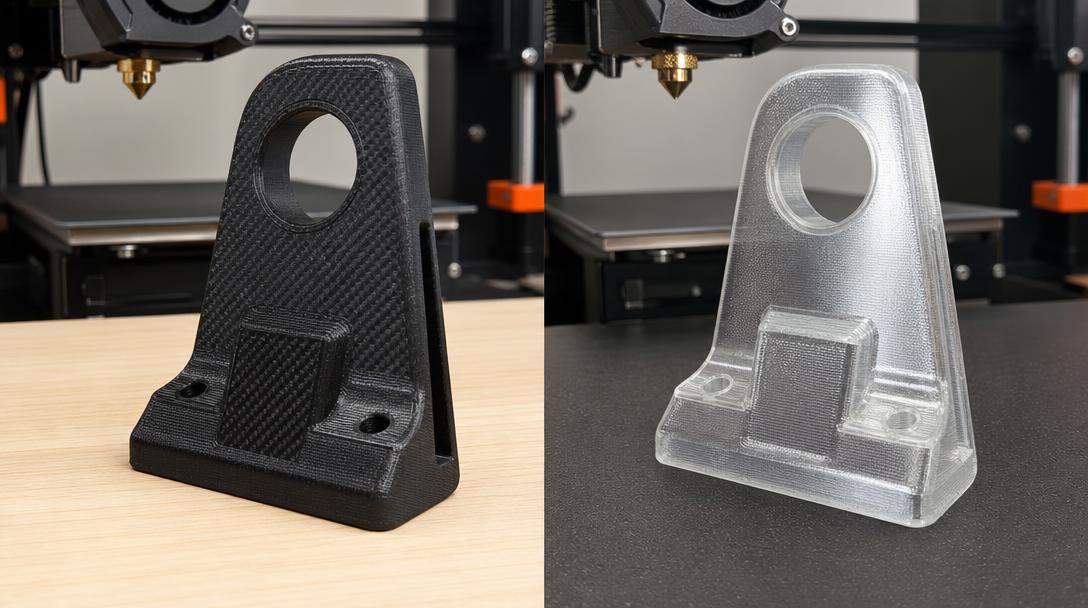

Carbon Fiber Reinforced or PETG? Which Makes More Sense Between Rigidity and Ease of Printing?
When producing a functional FDM part, one of the most commonly confused pairings is carbon fiber reinforced filament and PETG. Both are options that can go beyond everyday use; however, they do not serve the same purpose. In short, PETG is a more balanced choice with a wider range of applications, while carbon fiber reinforced materials stand out more for rigidity, dimensional stability, and more technical use cases.
If you want to clarify which material makes more sense before turning your design into production, material selection in the professional 3d printing service process often directly determines part performance. On the cost side, you should consider not only the filament name but also efficiency per function; that is why, when making a general comparison, it is healthier to look at the logic of price per gram. To upload your model and get an early idea, the online 3d printing flow can also speed up the decision process.
What is it good for, and what is it not?
PETG is a very balanced material for general-purpose functional parts. It is often preferred for boxes, fixtures, covers, support parts, fastening elements exposed to light impact, and everyday parts used indoors. It can behave more toughly than PLA, and for many users the production risk is low.
Carbon fiber reinforced filament is often thought of as “stronger in every way”; in practice, the issue is not that simple. In many scenarios, these materials can make a part more rigid and more dimensionally stable. They can be especially advantageous in load-bearing brackets that should not bend, assembly fixtures, and technical parts that must maintain their geometry. On the other hand, it cannot be said that they will automatically perform better for every part expected to flex suddenly or absorb impact energy.
The main difference in rigidity, impact, and flexibility
When deciding, the first question should be this: Does your part need to be stiff, or should it be somewhat tough and forgiving? Carbon fiber reinforced options usually feel stiffer than PETG. This can be useful in an arm that should not wobble, a stand leg adapter, a drone accessory, or an assembly part where dimensional consistency matters.
PETG, by contrast, behaves in a relatively more balanced way. It is not truly flexible, but it also generally has a lower tendency to behave in a brittle way. PETG may make more sense for parts that take light impact, are handled frequently, or need a bit of tolerance during assembly. In other words, if you want the part to “feel rock solid,” carbon fiber reinforced may be the better fit; if you want it to behave more compatibly in daily use, PETG is often the safer starting point.
Heat and outdoor use
On the heat side, actual operating conditions matter for both materials. For parts left inside a hot car, around an engine, or under the sun for long periods, choosing based only on a “durable” label is not the right approach. PETG can be a more reassuring option than PLA; however, its limits should still be considered in technical parts exposed to high heat.
With carbon fiber reinforced materials, performance can vary depending on which base polymer the reinforcement is combined with. For that reason, instead of drawing conclusions just from the phrase “carbon fiber,” you need to clarify which base material the part will actually be made from. If you want to see more technical and engineering-oriented options together, the engineering materials 3d printing page is a good place to start.
Ease of printing and cost logic
One of PETG’s biggest advantages is that it offers a good balance between performance and printing practicality. While providing sufficient strength for many parts, it does not increase process complexity too much. For this reason, it is a strong candidate in terms of overall cost logic for low-to-medium-risk functional jobs.
With carbon fiber reinforced filaments, the goal is usually to achieve a “more specialized” mechanical character. This benefit is meaningful if it is truly needed; if not, the part can become unnecessarily expensive or more niche than necessary. In addition, equipment compatibility and print strategy should be handled more carefully with this group of materials. In short, rather than choosing carbon fiber reinforced simply because it looks more technical, it is more accurate to question whether the part really needs higher rigidity.
Which one makes more sense for which part?
- Choose PETG: boxes, enclosures, covers, indoor fixtures, everyday-use parts exposed to light impact, and functional prints that need a bit of forgiveness during assembly.
- Choose carbon fiber reinforced: brackets that need to stay more rigid, load-bearing parts that should not sag, and technical fixtures where dimensional stability is important.
- Avoid PETG: if the part requires serious rigidity and flexing performance would compromise the product.
- Avoid carbon fiber reinforced: if it is being chosen only for appearance, or if some flex and impact damping are needed.
In conclusion, PETG is a more balanced choice with a wider range of uses for most users. Carbon fiber reinforced filament, on the other hand, is not for every job; it becomes meaningful especially in parts where rigidity and dimensional stability are required. If you define the part type correctly, neither material is wrong; what is wrong is expecting the same thing from both.


 Türkçe
 العربية
 Русский
 فارسی
فارسی Deutsch