
Glass Fiber Reinforced or ABS+? Which Makes More Sense for Parts That Need Rigidity and Heat Resistance?
When having a functional FDM part printed, the choice usually does not end with simply saying “it should be durable.” The part may be exposed to a somewhat warm environment, it may need to hold its dimensions, it may take impacts, or smooth progress during production may be important. At exactly this point, glass fiber reinforced filament and ABS+ become two options that are frequently compared. Both are considered for more serious work than standard hobby filaments; however, their characteristics are not the same.
If you are looking for a professional 3d printing service for your project, choosing the material according to how the part will be used is often just as influential on the overall result as the model itself. Because even if a part looks good on a desk, the wrong material can wipe out all advantages when temperature, rigidity, or impact resistance is needed.
The main difference: rigidity or more balanced toughness?
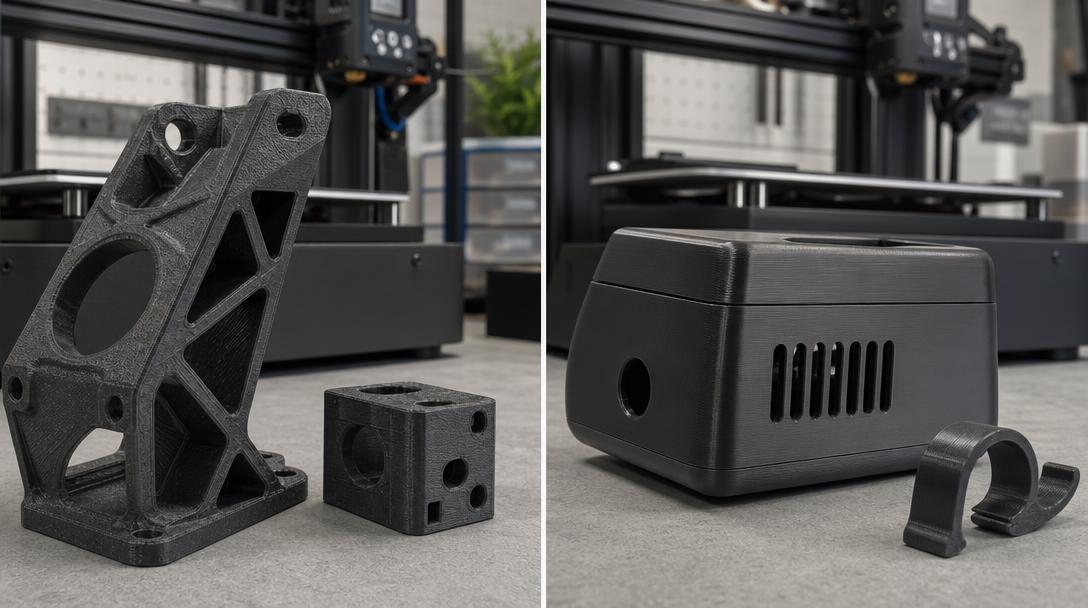
Glass fiber reinforced filament aims for a more rigid and more dimensionally stable structure by adding glass fiber reinforcement into the base polymer. For this reason, it can make sense for fixtures, fastening elements, and some engineering parts that should not flex and need to keep their shape. In contrast, ABS+ usually offers more balanced print behavior than classic ABS and a more accessible profile for everyday functional use. In general, those looking for a more practical middle ground between impact resistance and workability tend to lean toward ABS+.
In short, if you want the part to flex as little as possible and hold its geometry better, the glass fiber reinforced option may stand out. If you want the part to have some toughness, handle everyday use, and move through production with fewer problems, ABS+ may be the more sensible choice.
What is each one good for, and what is it not good for?
When does glass fiber reinforced material make sense?
- For rigid fixtures and load-bearing parts
- For jigs and enclosures where dimensional stability is important
- For parts exposed to some heat but mainly expected to keep their shape
However, this material does not always mean “more durable.” Increased rigidity can make the part behave less forgivingly in some scenarios. In other words, for a part that needs to flex and recover under sudden impact, it may not deliver the expected advantage.
When does ABS+ make sense?
- For everyday functional boxes, covers, connectors, and fixtures
- For usage parts exposed to light to medium impact
- For designs that need some toughness as well as rigidity
On the other hand, ABS+ is not the solution for every job either. If the goal is very high rigidity or lower flex, it does not always come close to the character offered by glass fiber reinforced material.
A quick decision in terms of outdoor use, heat, and impact
If long-term outdoor use is being considered, it is not right to decide based only on the material name; UV exposure, geometry, and actual usage conditions should be evaluated together. For this reason, for parts that will remain outdoors, it is useful to review the general engineering options on the engineering materials 3d printing page.
In terms of heat, both materials are considered above standard PLA level; however, the final limit may vary depending on the part design and the base resin. In practice, in a bracket, cover, or machine-surrounding part exposed to a warm environment, a glass fiber reinforced structure may offer an advantage in maintaining form. On the impact side, ABS+ usually stands out as a more balanced and forgiving option.
Printability and cost logic
The important distinction here is this: glass fiber reinforced materials are chosen for performance, not simply for easy printing. Fiber-filled materials may require more careful equipment and process control. ABS+, on the other hand, appeals to a wider range of usage scenarios on the production side. When placing an order, it is necessary to look not only at the material weight but also at print success and part repeatability. For this reason, it is more accurate to understand the overall cost approach through the logic of price per gram.
Another practical point is this: choosing the right material for each part can sometimes make the option that appears more expensive more economical overall. Because having to produce the part again with the wrong material can easily wipe out the savings you thought you made with the initial choice. To upload your model and see the production scenario, moving forward through the online 3d printing flow makes the decision easier.
Which one for which part?
- Jig, fastener, rigid fixture: Glass fiber reinforced may make more sense.
- Box, cover, everyday functional body: ABS+ may be the more balanced choice.
- Part exposed to some heat and needing to keep its shape: The glass fiber reinforced side may provide an advantage.
- Part that may take impact and involves user contact: ABS+ may be the safer choice.
In summary, the choice depends less on the question “which is better” and more on the question “how will the part work?” If you want a part that is more rigid, more dimensionally stable, and gives a stronger engineering feel, glass fiber reinforced material stands out. If you are looking for an option that can be produced more practically and delivers balanced results in everyday functional use, ABS+ offers a more sensible path for most projects.


 Türkçe
 العربية
 Русский
 فارسی
فارسی Deutsch