
Glass Fiber Reinforced or ASA? Which Makes More Sense for Rigid, Outdoor, and Dimensionally Stable Parts?
At first glance, glass fiber reinforced filament and ASA may seem to serve the same purpose; both sit on the more technical side compared to standard PLA. In practice, however, the choice usually depends on where the part will be used and which type of failure would be more critical. In short, if you want high rigidity and dimensional stability, glass fiber reinforced options may stand out; for parts that will live under sun, rain, and UV exposure, ASA is often the safer choice.
If you want to clarify your material choice before moving into production, in a professional 3d printing service process, factors such as print orientation, wall thickness, and tolerance can affect the result just as much as the part’s use scenario. So instead of only asking “which is the strongest material,” it is more accurate to think about what kind of load will be applied and in what environment.
When does glass fiber reinforced material stand out?
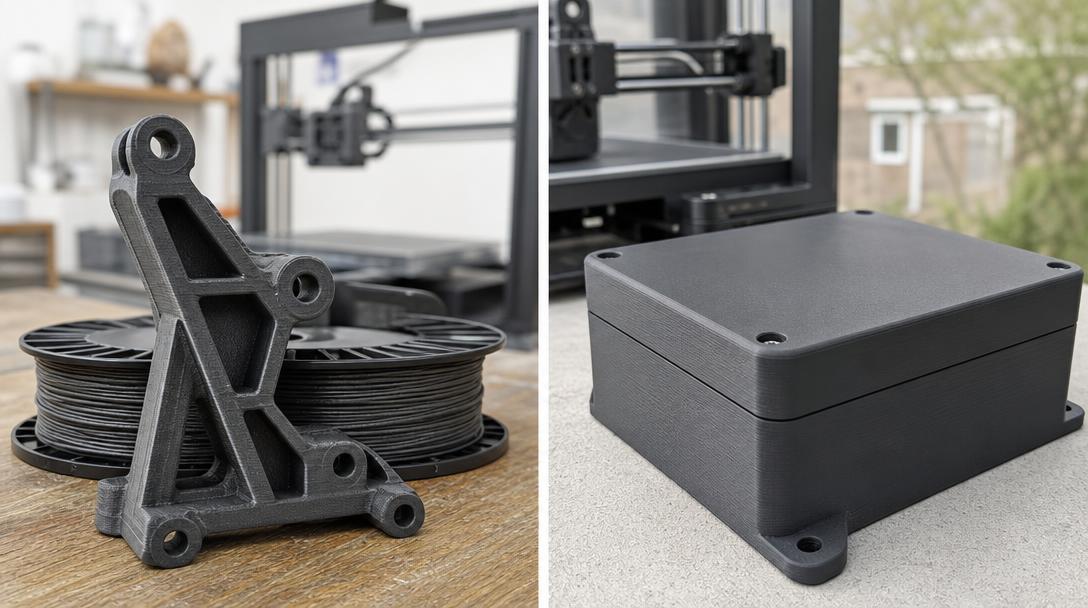
Depending on the base polymer, glass fiber reinforced filaments generally aim for higher rigidity, less flex, and in many applications better dimensional stability. In other words, if you want a part that does not bend too much under load, keeps its shape, and holds its dimensions, this group can make sense. It can be especially advantageous for jigs, support brackets, fixtures, or relatively technical enclosure parts.
But it is not the right answer for every job. Even if a glass fiber reinforced structure makes the part feel more “solid,” that does not always mean better impact resistance. In parts that take sudden hits, get dropped, or need to flex continuously, too much rigidity can sometimes become a disadvantage. It is also important to remember that within this material family, real-world performance can vary depending on the glass fiber ratio and the main polymer used.
When does ASA make more sense?
For most users, ASA’s biggest strength is outdoor durability. If sunlight, UV exposure, and weather conditions are involved, ASA is often preferred for decorative or functional outdoor parts. Not only to preserve appearance, but also for applications such as covers, enclosures, hangers, outdoor fittings, and parts used around vehicles, it can be the more balanced option.
ASA is also more reassuring than PLA-like basic materials when it comes to heat. However, there is an important nuance here: if your goal is not only heat resistance but also the highest possible rigidity and dimensional stability, glass fiber reinforced alternatives may take the lead. On the other hand, if you are looking for more predictable aging under sunlight and long service life outdoors, ASA is often the more sensible choice.
Which one is stronger in which area?
- Outdoors: In terms of UV and weather conditions, ASA is generally the safer choice.
- Rigidity: Glass fiber reinforced options offer a stiffer structure with less flex in most scenarios.
- Impact: It depends on the geometry of the part; a very rigid structure does not always mean the toughest result.
- Heat: On both sides there are formulation-based differences; however, in the technical class, glass fiber reinforced solutions may have an advantage in maintaining shape under temperature.
- Ease of printing: ASA can be more demanding because of warping and the need for an enclosed environment; glass fiber reinforced materials, on the other hand, require attention in terms of nozzle wear and setting sensitivity.
What is it good for, and what is it not good for?
Glass fiber reinforced filament can perform very well in technical parts where you want “no flex, no wobble, no dimensional drift.” In contrast, it is not suitable for designs that require continuous flexing, such as living hinge-like structures. ASA, meanwhile, makes sense for outdoor enclosures, connectors exposed to sunlight, and functional prints where a clean surface is desired; however, for certain fixture jobs that require maximum rigidity, it may not be the first choice on its own.
On the cost side, looking only at the spool price is not enough. In the overall decision, print success rate, reprint risk, end-use lifespan, and nozzle consumption if relevant should also be taken into account. To see the bigger picture, it is useful to look at the logic of price per gram; for quick quoting, the online 3d printing page gives a part-based estimate.
Quick decision by part type
- Outdoor box, cover, sensor enclosure: Usually ASA.
- Rigid fixture, bracket where dimensional accuracy is critical: Usually glass fiber reinforced.
- Auxiliary part for vehicle interior/exterior exposed to sunlight: In most cases, ASA is the safer starting point.
- Technical support part that needs to keep its shape rather than flex: Glass fiber reinforced may make more sense.
In summary, this pair should not be judged as “which one is higher quality?” but rather as “what is the main problem this part needs to solve?” If outdoor use and UV are the top priority, ASA stands out; if rigidity, dimensional stability, and a technical feel matter more, glass fiber reinforced options come forward. If you want to explore a broader range of engineering-class alternatives, the engineering materials 3d printing page is also a good place to start.


 Türkçe
 العربية
 Русский
 فارسی
فارسی Deutsch