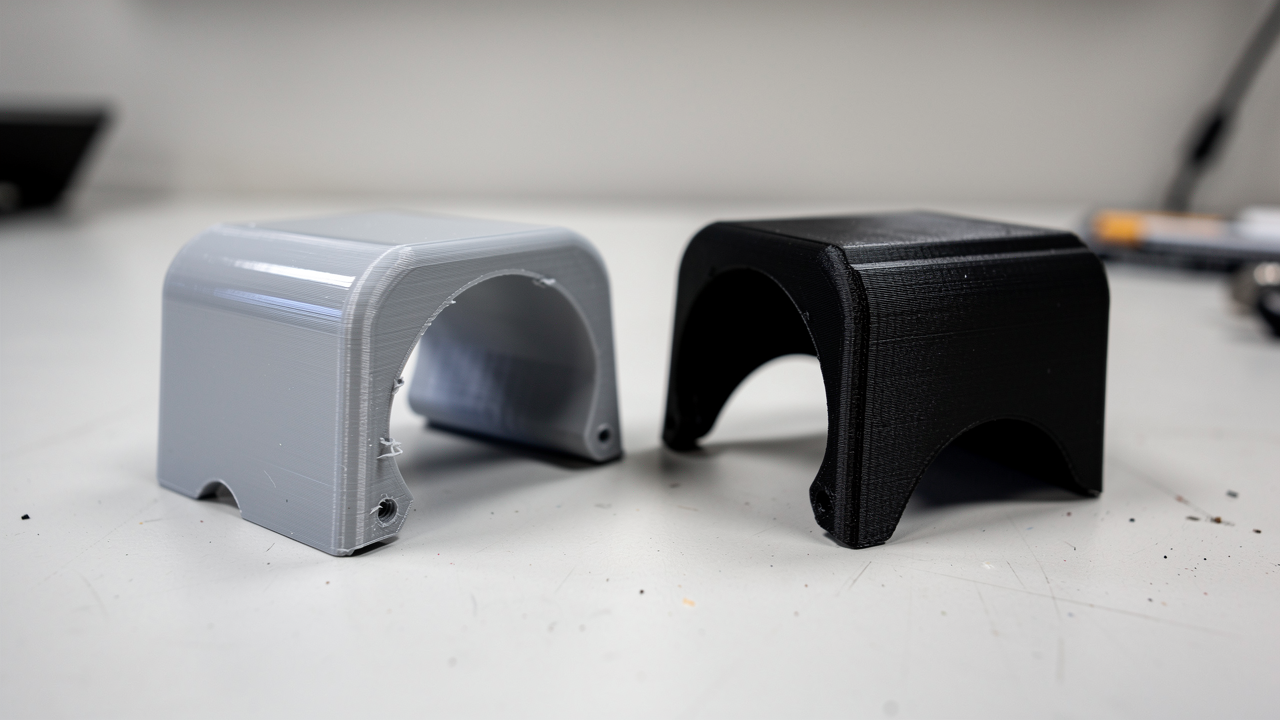

PLA or ABS+? Which Makes More Sense for Prototypes and Everyday Functional Parts?
One of the most common decisions in FDM production is whether the part should be printed quickly and trouble-free, or whether it makes more sense to choose a slightly more demanding but more functional material. At this point, PLA and ABS+ often come up together. Both are widely used; however, they may not be the right choice for the same job. If you want to clarify your material selection when getting 3d baskı hizmeti, this comparison makes the decision easier.
In short, PLA stands out for its ease of printing and smooth surface quality. ABS+, on the other hand, is an option that behaves more predictably than standard ABS and is generally chosen for more functional use. The best way to understand the difference is to look not only at how the part looks today, but also at what it will go through during use. If you want to see the general material options at Ucuz3D in one place, the baskı malzemelerimiz page is also a good place to start.
What is it good for, and what is it not?
PLA makes a lot of sense for visual prototypes, desktop organizers, scale models, covers, presentation pieces, and fixtures used in low-heat environments. It is generally easy to achieve dimensionally clean prints. However, if the part will be exposed to warm conditions, remain in places that heat up in summer such as inside a car, or if a more solid long-term use is expected, PLA is not always the safest choice.
ABS+, on the other hand, may make more sense for boxes, connectors, workshop fixtures, enclosures exposed to light impact, and functional everyday parts. That said, if very high UV resistance or long outdoor life is the goal, alternatives such as ASA may sometimes be a better choice than ABS+. In other words, ABS+ is not the only answer for every demanding job; but it often comes into play when you move beyond the limits of PLA.
Heat and outdoor environment differences
One of the clearest differences between these two materials is how they behave under heat. Since PLA can begin to soften at relatively low temperatures, caution is needed for applications such as car interior accessories, areas around hot machinery, or parts exposed to direct sunlight. ABS+ generally offers a more comfortable working range in this respect. Still, if the part will be used outdoors continuously, or if long service life under rain and UV exposure is expected, choosing ABS+ simply because it is “more heat resistant” may not be enough.
Impact, rigidity, and feel in use
PLA is a material that feels hard and solid; that is why it seems strong when you hold it in your hand. However, in some geometries it can behave in a brittle way. This can be important for thin clips, snap-fit features that work by flexing, or parts that may be dropped. ABS+, by contrast, is generally more forgiving against impact in most situations. The part can flex slightly and distribute the energy; this creates an advantage especially in daily use.
In terms of rigidity, PLA satisfies many users at first glance. But “it looks rigid” and “it is safer in real use” are not the same thing. In scenarios such as a box lid, a handheld tool body, or an enclosure that is frequently removed and reinstalled, ABS+ may deliver a more sensible result.
Ease of printing and cost logic
PLA’s biggest advantage is that it makes the production process easier. Clean results can be achieved with less risk, which reduces trial and error. With ABS+, printing conditions need to be managed more carefully; depending on the geometry, shrinkage, corner lifting, or surface control can become more critical. For this reason, when choosing a material, you should think not only about kilograms, but about the overall production logic.
When placing an order, it is important to look not only at the raw material itself, but also at the likelihood of the part being produced successfully on the first attempt. From this perspective, just as gram başı fiyat matters, it is also important to choose the right material according to the geometry of the part and its intended use. If you want to make a quick comparison for your model, you can get an instant quote through the online 3d baskı system and evaluate it based on your part type.
Which one should be chosen for which part?
If PLA makes more sense:
- If a visual prototype is the priority
- If the part will be used indoors
- If surface quality and fast delivery are important
- If mechanical stress is limited
If ABS+ makes more sense:
- If the part will be exposed to impact in daily use
- If a box, lid, fixture, or enclosure will be produced
- If some degree of heat resistance is required
- If there is a scenario where PLA may remain too brittle
Final decision
If the part is a presentation model, concept prototype, or desktop helper equipment, PLA is often the most practical choice. But if the part will be under some stress during use, exposed to heat, or is expected to feel more durable, ABS+ may be the better option. In short, PLA stands on the side of “easy and clean production,” while ABS+ stands one step closer to “more functional use.” The right decision depends on where, how long, and how the part will be used.


 Türkçe
 العربية
 Русский
 فارسی
فارسی Deutsch