
ASA or HIPS? Are You Printing an Outdoor Fixture or a Lightweight Prototype?
Even though both materials may seem to serve the same purpose, ASA and HIPS usually stand out for different needs. In short, if sun exposure, temperature changes, and outdoor conditions are involved, ASA is usually the safer choice. For lightweight, visual, easy-to-process prototypes or certain support applications, HIPS may be the more sensible option. If you want to determine the right material for your part, making this distinction from the start when getting a professional 3d printing service reduces the risk of breakage, warping, or unnecessary costs later on.
When does ASA stand out, and when does HIPS?
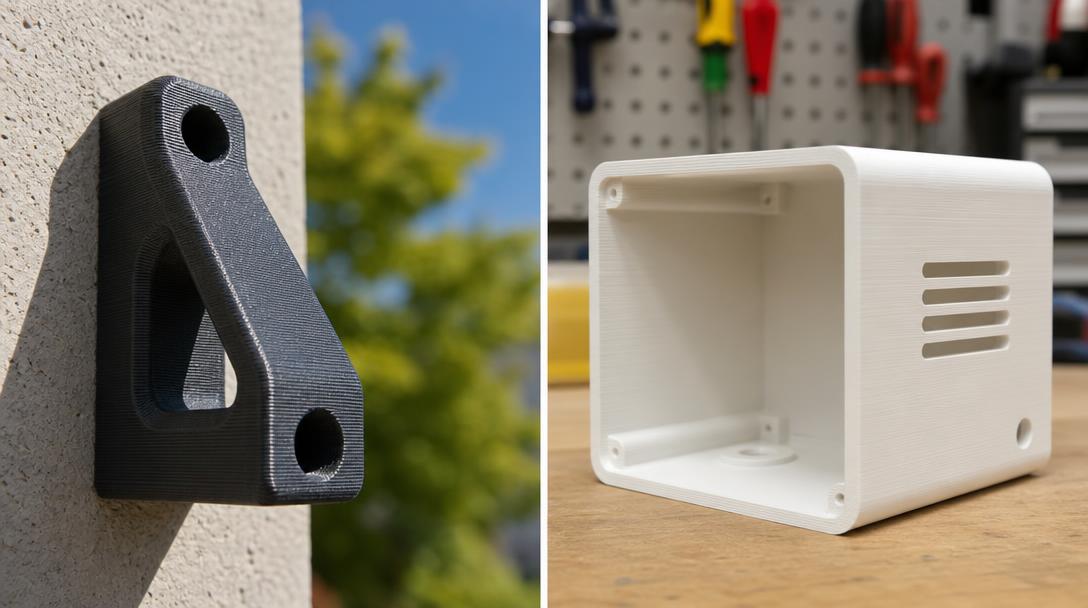
In FDM printing, ASA is often considered especially for outdoor parts, sun-exposed fixtures, auxiliary machine-side components, and applications that may face temperature fluctuations. In terms of UV resistance, it is generally more reassuring than HIPS. That is why ASA is a more logical starting point for jobs such as garden equipment clips, outdoor enclosures, sensor covers, or sun-exposed mounting fixtures.
For many users, HIPS makes sense as a lightweight, matte-looking, and relatively easy-to-process material. It can be preferred for visual prototypes, indoor boxes, demo parts, and models that will later be sanded and painted. It is also known in some workflows for its role as a support material; in other words, it does not always have to be an end-use part. By checking Ucuz3D’s general our printing materials page, you can quickly compare which parts are closer to which material family.
Where is the difference in outdoor use, heat, and impact?
The clearest distinction in this comparison is outdoor durability. ASA is clearly the stronger candidate for outdoor use. Under sunlight, UV, and summer heat, it is expected to preserve its form and appearance better than HIPS. If you place HIPS outdoors, it may do the job in the short term; however, it is generally not the first recommendation for long-term outdoor use.
The picture is similar when it comes to heat resistance. We are not talking about extremely high-temperature applications, but a decorative desktop model and a fixture that may stay inside a vehicle are not the same scenario. ASA is the more cautious choice for parts exposed to moderate heat loads and parts that may be stressed in summer conditions. HIPS, on the other hand, is better suited to indoor and more controlled environments.
It is difficult to give a one-sentence answer about impact behavior, because geometry, wall thickness, and infill ratio seriously affect the result. Still, in general use logic, ASA is associated with harsher environmental conditions, while HIPS is more suitable for parts that take light impact or are aesthetics-focused. If rough use, sun, and heat are all present at the same time, the balance again shifts toward ASA.
Rigidity, printability, and cost logic
In terms of rigidity and surface feel, HIPS often provides a pleasant matte appearance. This advantage is noticeable in presentation models, product shells, or indoor housing parts. However, printability should not be confused with end-use performance expectations. HIPS may be practical for some jobs, but choosing it just because it is easier may not be the right long-term decision for applications that require outdoor performance.
ASA, on the other hand, can be seen as a more demanding material. Part design, printer conditions, and environmental control become more important. In return, when used for the right job, it delivers more value. On the ordering side, instead of memorizing exact figures, it is more accurate to evaluate using the logic of price per gram, because part geometry, support requirements, and print time change the overall picture. Likewise, during the quotation stage, uploading your model to the online 3d printing system and comparing material scenarios can speed up the decision process.
Which one should you choose for which part?
- Choose ASA: outdoor fixture, UV-exposed mounting part, housing that may face high temperatures, auxiliary equipment that will work under the sun.
- Choose HIPS: indoor prototype, lightweight box, visual model, presentation part that will receive surface finishing later.
- Do not choose ASA: if you are only looking for the easiest and most economical first test part.
- Do not choose HIPS: if the part will stay outdoors for a long time or if heat and UV resistance raise concerns for you.
In summary, the question is not “which one is better?” but where and how will the part work? If outdoor use and environmental durability are your priorities, ASA is the better choice in most cases. If you want a lightweight, indoor, visual, or trial-purpose part, HIPS may be the more sensible option.


 Türkçe
 العربية
 Русский
 فارسی
فارسی Deutsch