
ABS+ or Nylon (PA)? Which Makes More Sense for Impact, Wear, and Mechanical Parts?
When having a functional FDM part printed, one of the most critical questions is this: Should the part feel solid and trouble-free in everyday use, or should it resist wear and load under more demanding mechanical conditions? At this point, ABS+ and Nylon (PA) are often compared. Both are considered for more serious applications than standard visual prototype filaments; however, their characteristics are not the same.
In short, ABS+ is a more balanced and accessible option for practical functional parts. Nylon, on the other hand, is often a stronger candidate for mechanical parts that operate under friction, wear, and repeated load. If you are unsure which is the right path for your part, the healthiest approach is to evaluate the material choice according to the part’s use scenario through a 3d printing service.
What is ABS+ used for, and what is Nylon used for?
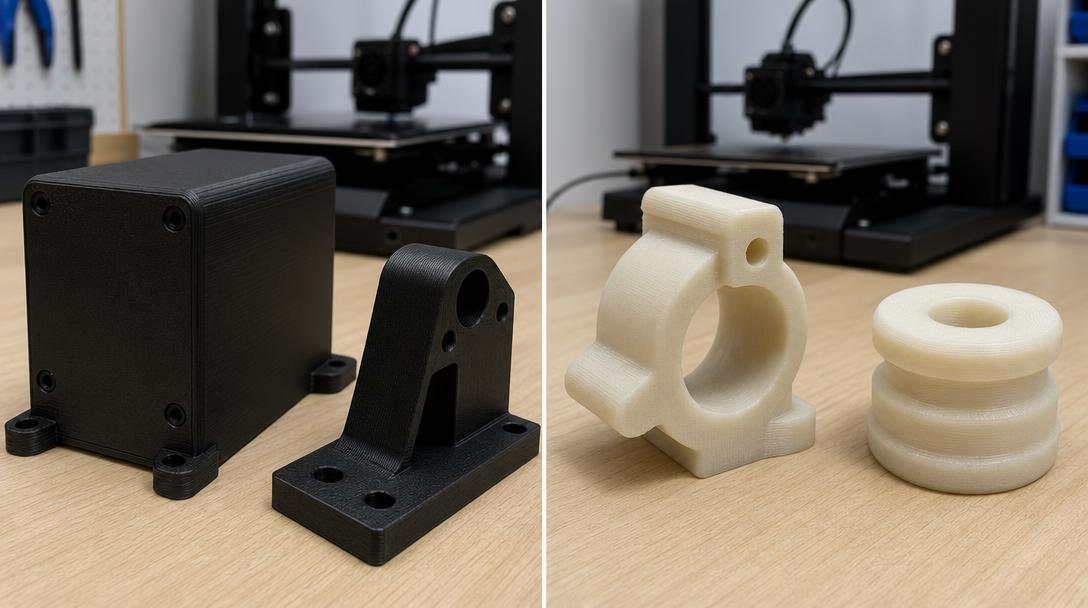
ABS+ generally makes sense for boxes, enclosures, fixtures, connectors, desktop helper parts, and jobs exposed to moderate mechanical stress. Because it is expected to offer more balanced printing behavior than standard ABS, it is frequently preferred for functional parts. If you want a part that feels somewhat solid, somewhat durable, and reasonably strong for daily use, ABS+ creates a good balance.
Nylon stands out in a very different area. It can be a more logical choice for bushing-like parts, components operating under friction, cable chain elements, clips, gear-like low-speed applications, and load-bearing technical parts. Its ability to flex and return to shape, along with its good wear behavior, makes Nylon stand out for moving mechanical parts.
What it is not good for: it is important to eliminate the wrong expectations from the start
ABS+ is not the automatic answer for every demanding mechanical application. For parts that operate under constant friction, where wear matters as much as impact, Nylon is often more suitable. On the other hand, Nylon is not ideal for every project either. If you want a very rigid part with clear dimensions, easy assembly, and relatively predictable surface quality, Nylon can sometimes be more technical than necessary.
In other words, while ABS+ sits more on the general-purpose functional material side, Nylon leans more toward applications where mechanical behavior advantages are the priority.
The difference in terms of impact, rigidity, and flexibility
In terms of impact, both materials are more reassuring options than the PLA class; however, they behave differently. ABS+ often gives a solid feel and is less likely to act brittle under everyday impacts. Nylon, by contrast, generally shows a more flexible character; this can help it absorb energy instead of breaking under sudden loads.
If you are looking for rigidity, ABS+ may give the feel of a more firmly seated part. Nylon provides an advantage in mechanical parts that need slight flexibility. For this reason, a fixed enclosure and a clip expected to show a spring effect do not call for the same material.
The issue of heat and outdoor use
In terms of heat, both materials are considered above the basic PLA level; however, the difference becomes important depending on the application. For parts near a motor, around equipment that heats up in an enclosed space, or left inside a vehicle in summer heat, ABS+ is generally considered a safer choice than PLA in most cases. Nylon is also mechanically strong; however, its moisture behavior and service conditions should be evaluated together.
For outdoor use, however, this pair is generally not the first comparison recommended. If constant sun, UV, and weather exposure are involved, ASA is the more natural candidate for many projects. Still, for short-term or controlled outdoor use, if you are thinking purely in terms of load and impact, ABS+ or Nylon can be considered.
Ease of printing and cost logic
For most users, ABS+ is a more predictable choice than Nylon. Nylon, on the other hand, can be more demanding in terms of moisture management and process discipline. That is why it is necessary to look not only at material properties, but also at the stability of the production process. Reviewing the price per gram logic before ordering is useful for understanding how material selection affects the budget.
Choosing the right material on the first try, rather than focusing on a single part alone, often reduces the total cost. Especially for parts that will work under load, if you want to make a quick comparison, you can upload your model through the online 3d printing page and evaluate the options.
Which one is more suitable for which part?
- ABS+: boxes, enclosures, workshop fixtures, connecting parts, functional products used in daily life
- Nylon (PA): wearing parts, elements working under load, flexing clips, friction-based mechanical components
If the main need of your part is trouble-free functional use, starting with ABS+ is often the sensible choice. If the main need is mechanical operation, wear, and behavior under load, Nylon may be the better candidate. Ucuz3D’s engineering materials page is also a good reference for positioning this distinction more accurately.
The final decision should always be made according to the part’s real use. Because the same word, durability, means completely different things for an enclosure and for a moving mechanical part.


 Türkçe
 العربية
 Русский
 فارسی
فارسی Deutsch