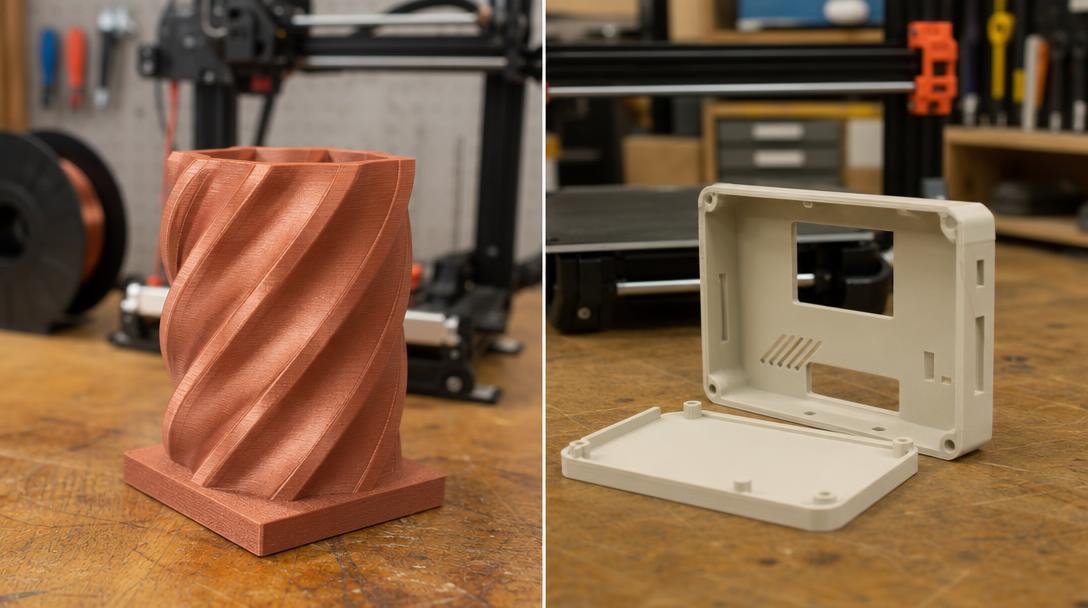

Copper PLA or HIPS? Are You Printing a Decorative Display Piece or a Lightweight Prototype?
At first glance, Copper PLA and HIPS may seem like materials that belong in the same basket; both usually come up more in visual prototypes, presentation models, and light functional prints than in final high-load parts. However, their use cases are quite different. In short, Copper PLA stands out more for appearance, surface feel, and decorative effect, while HIPS makes more sense on the lightweight, machinability, and prototyping side. Before choosing which path is right for you, you need to clearly define what the part will actually do.
If you want to clarify the right material for your own project, defining the part’s usage scenario from the start in a professional 3d baskı hizmeti workflow significantly reduces the risk of making the wrong choice. If you want to see material alternatives together, the baskı malzemelerimiz page is also a good starting point.
What is Copper PLA for, and what is HIPS for?
Copper PLA is sometimes misunderstood because of its name. This material does not produce real metal parts; in FDM logic, it is a plastic-based filament printed with a copper-like appearance or an enhanced metallic feel. For that reason, it makes sense for desktop objects, awards, decorative models, concept presentation pieces, or product samples intended to attract attention in a display. Its surface character and visual effect can create a different perception compared to standard PLA.
HIPS, on the other hand, is a less flashy but more pragmatic option for most users. It can be preferred for lightweight prototypes, boxes, test parts, mockup-like bodies, and prints that will later be sanded or painted. In some workflows, it is also known as a support material; however, it also works quite well as a standalone model material.
What is it not suitable for?
Copper PLA should not be the first choice for parts exposed to high impact, carrying continuous loads, or facing serious heat. Although its visual aspect is strong, mechanical expectations should not be exaggerated. In particular, the expectation that it “looks like metal” is valid, but the expectation that it “behaves like metal” is not.
HIPS is not a perfect solution in every scenario either. For outdoor fixtures that will remain under the sun for a long time, technical parts that will be exposed to high temperatures, or engineering components requiring very high rigidity, more suitable alternatives are generally available. The strength of HIPS lies more in lightweight prototyping and machinability.
Differences in outdoor use, heat, and impact
For outdoor use, neither of these two materials is usually considered among the first recommended options. For parts exposed to sun, UV, and summer heat, it is generally better to look at more suitable material families. Therefore, if you are printing a balcony fixture, an outdoor box, or a fixed part that will get hot inside a vehicle, limiting yourself to only these two options may not be the right approach.
A similar level of caution is required regarding heat as well. Copper PLA-based structures may have limitations in maintaining their form in hot environments because of the general character of the PLA family. HIPS may behave more consistently in some scenarios; however, it should not be considered a high-heat material either.
When it comes to impact, geometry is the determining factor. HIPS can be a more sensible choice for prototypes exposed to light impact and for everyday-use boxes. On the Copper PLA side, since the priority is usually appearance rather than impact resistance, it is wise to be cautious with parts that have a high risk of being dropped or knocked.
Rigidity, surface feel, and printability
If you want a part that feels rigid and solid and attracts attention in a display, Copper PLA can be appealing. It leaves the impression of being “different from standard plastic,” especially in gift objects, desktop accessories, and client presentations. In contrast, HIPS is lighter and more neutral in character; it does not show off, but it quietly does its job.
As for printability, not every printer and profile gives the same result. Still, in general user experience, Copper PLA is chosen more for surface aesthetics, while on the HIPS side, settings and usage discipline may become slightly more important. If you plan to sand or paint the final surface, HIPS is often the more sensible prototype material.
Cost logic and which one for which part?
On the cost side, the right question is not only the spool price; it is also the risk of having to reprint the part because the wrong material was chosen. If decorative effect matters, the difference offered by Copper PLA can be meaningful. But if the goal is quick testing, lightweight prototyping, and form validation, HIPS can provide a more rational result. Before ordering, reviewing the logic of ucuz 3d baskı fiyatları and especially the per-gram approach helps clarify whether you are paying for visual appeal or for testing.
- Choose Copper PLA: for decorative objects, presentation models, visually striking desktop parts, and projects where you want a “metal feel but still FDM.”
- Choose HIPS: for lightweight prototypes, box bodies, test prints, and form studies that will later be processed or painted.
If you want to upload your part and compare options quickly, you can have your model reviewed in the online 3d baskı workflow and understand the logic of different materials more clearly through an instant pricing approach. Let’s finish with a short decision sentence: if visual character is your priority, Copper PLA is the better choice; if your priority is a lightweight and machinable prototype, HIPS makes more sense.


 Türkçe
 العربية
 Русский
 فارسی
فارسی Deutsch