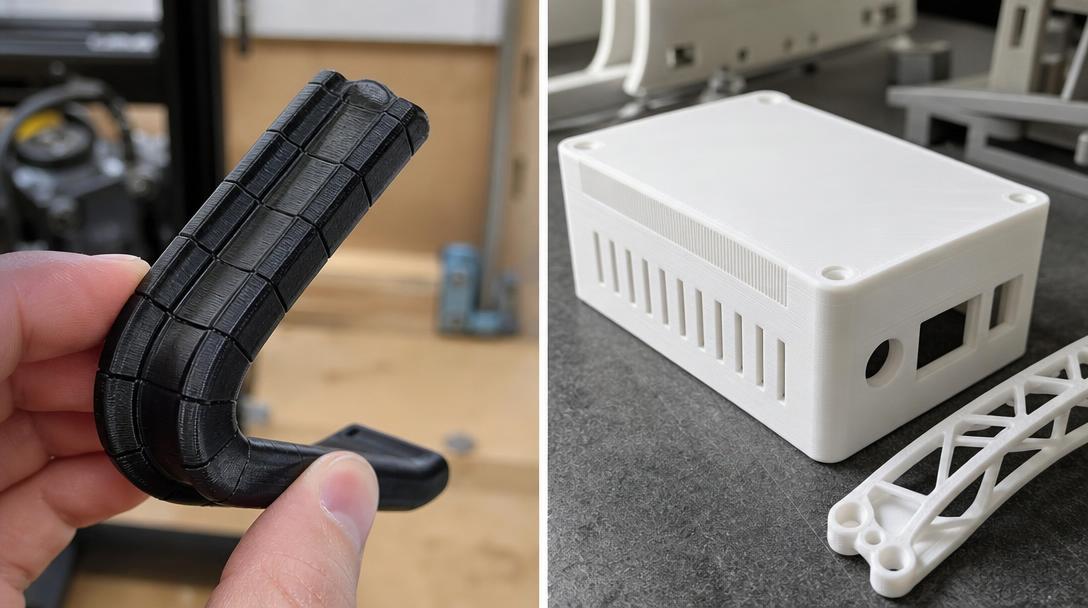

TPC or HIPS? Are You Printing a Flexible but Wear-Prone Part or a Lightweight Prototype?
In some 3D printing projects, the real question is not “which material is the strongest”; it is how the part will work. A part that must bend continuously, rub against surfaces, or absorb impact does not need the same material as a lightweight prototype produced only for form validation. At this point, TPC and HIPS offer two different characters: while one stands out as a more flexible option suited to fatigue, the other behaves in a stiffer, lighter, and more prototype-focused way.
If you want to clarify which material makes more sense for your part, material selection is often just as decisive as the design itself in a professional 3d printing service process.
What is TPC used for, and what is HIPS used for?
TPC can be considered for applications where flexibility is needed but you do not want an ordinary soft part. It may make sense for cable guides, bumper-like intermediate parts that need slight flex, connection elements exposed to vibration, or some protective parts that work under repeated load. Especially if you want the part to flex a little and then largely recover its shape, TPC points in the right direction.
HIPS, on the other hand, stands out more in lightweight prototyping, visual validation, box-type parts, and some support printing scenarios. It can be advantageous for enclosures without high mechanical demands, demo parts, or handheld mock-ups. In short, TPC is closer to parts that flex during use, while HIPS is better suited to scenarios where you want to show the form or produce a light, rigid part.
When is it not a good idea?
TPC may not be the right choice for parts where you want very high rigidity. In rigid technical parts where screwed joints must work very tightly, or in structures expected to maintain sharp dimensional stability, flexibility can become a disadvantage. HIPS is also usually not the first candidate for jobs that require long-term outdoor use, high heat, and serious mechanical stress. More suitable alternatives may be available, especially for conditions approaching automotive interior temperatures or for parts exposed to constant sunlight.
Differences in heat, impact, flexibility, and rigidity
The main distinction between these two materials should be read through the flexibility-rigidity balance. TPC can make more sense for parts that manage some of the impact energy by flexing. That is why it can deliver more reassuring results in functions such as feet, covers, bumpers, and cases. HIPS feels more rigid; when you hold it in your hand, it does not behave like a flexible part and carries the perception of form well in a prototype.
On the heat side, however, the final decision between TPC and HIPS should definitely be made according to the real operating temperature. Neither material should be assumed to be “trouble-free in every hot environment.” If the project will be seriously exposed to heat, it is healthier to evaluate it together with the other options on Ucuz3D’s our printing materials page.
Outdoor use and wear scenarios
Outdoors, not only rain but also UV exposure, temperature fluctuations, and the risk of becoming brittle over time matter. TPC may make more sense than HIPS in some applications involving repeated bending and surface contact. HIPS, on the other hand, is generally a material that should be approached with caution for parts expected to last a long time outdoors. In short, if you are considering something like a balcony clip, cable protector, or a slightly flexible foot, TPC may be the better fit; if you are thinking of a lightweight desk model or concept box, HIPS may be more suitable.
Printability and cost logic
For most users, HIPS can offer a more familiar and more predictable printing character than TPC. Since TPC is closer to the flexible-material class, printer setup, filament path, and speed settings become more important. In other words, not only the final part but also the smoothness of the production process should be taken into account.
On the cost side, it is more accurate to look at the logic of price per gram rather than memorized numerical prices. Because with materials that have a special character like TPC, not only the cost per kilogram but also print time, error risk, and part geometry affect the overall decision. If your file is ready, it is also possible to quickly see a suitable material scenario through online 3d printing.
Which one for which part?
- TPC: Protectors that need slight flex, parts expected to provide a bumper effect, cable guides, and flexible components exposed to repeated movement.
- HIPS: Lightweight prototypes, boxes, visual presentation parts, geometry validation models, and rigid parts under low load.
In summary, the choice should be made less by asking “which is better” and more by asking “should the part stay rigid during use, or should it flex a little?” If flexibility and wear during use are the priority, TPC is the more sensible candidate. If you are looking for a light, rigid-feeling, prototype-focused solution, HIPS is often the more practical option.


 Türkçe
 العربية
 Русский
 فارسی
فارسی Deutsch