
ABS+ or HIPS? Which Makes More Sense for Lightweight Prototypes and Everyday Functional Parts?
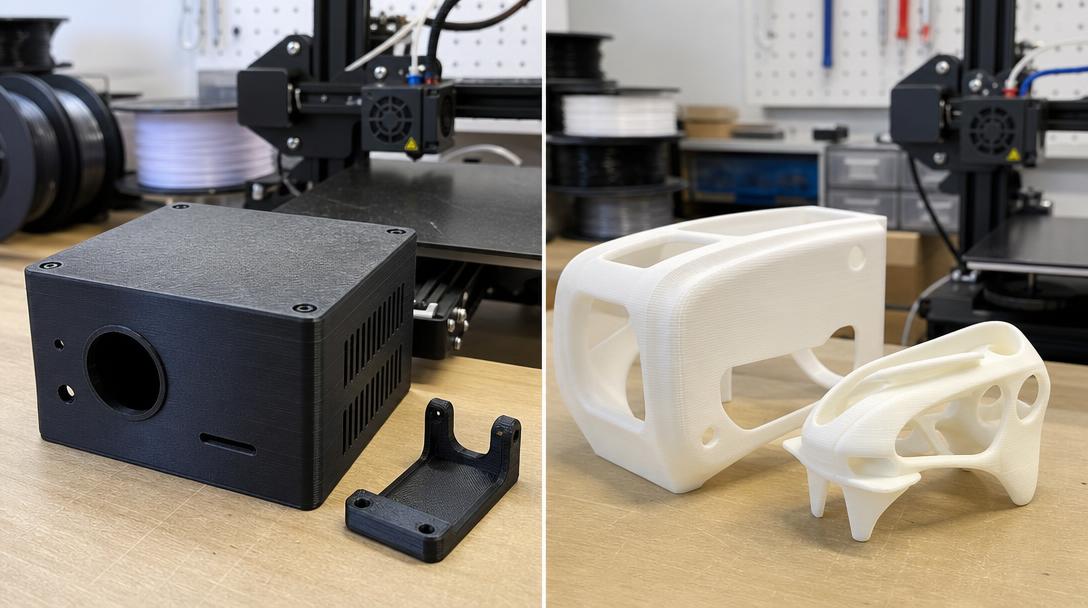
At first glance, ABS+ and HIPS may seem like two similar FDM materials; both offer a more technical character than PLA, and both can work well for lightweight prototypes. But once the intended use becomes clear, their paths diverge. Put simply, ABS+ is more often considered for everyday functional parts, enclosures, fixtures, and light mechanical use, while HIPS usually stands out on the side of easier-to-process, lightweight, and economical prototyping.
If you are considering having a part produced directly, choosing the material based on the model’s real use case through a professional 3D printing service gives more accurate results than simply looking at the catalog name.
What is it good for, and what is it not?
ABS+ is generally a class of material designed to offer more balanced printing behavior than standard ABS. Although the exact formula varies by manufacturer, what users typically expect is more practical durability, a tougher structure, and more confidence in everyday use performance. For this reason, it is often the more sensible choice for electronics boxes, small connector parts, covers, mounting fixtures, and functional parts exposed to moderate loads.
HIPS, on the other hand, can be advantageous in terms of lightness, machinability, and prototyping comfort. It makes sense for visual mockups, presentation parts to be painted, lightweight enclosure trials, and parts with low end-user load. However, for parts that are constantly stressed, exposed to warmer environments, or subject to more impact, HIPS may not always be the first choice.
Differences in heat, impact, and everyday use
When deciding between these two materials, the most critical distinction is whether the part will stay on the workbench or actually function in real use. In most scenarios, ABS+ offers a more reassuring balance for everyday use than HIPS. Its advantage becomes noticeable in parts exposed to light impact, frequent assembly and disassembly, screw-mounting areas, or occasional hand force.
HIPS is not a weak material by any means; however, it is safer to position it more on the “prototype and light-duty work” side when making a decision. In terms of heat as well, if the part will not remain on a desk and harsher scenarios such as a car interior in summer are being considered, ABS+ is usually the more sensible option. Rather than giving an exact threshold value, it is more accurate to say that as operating temperature increases, the safety margin of HIPS may become narrower.
Printability and surface expectations
This is where HIPS becomes stronger. For many users, HIPS feels like a more comfortable prototyping material than the ABS family. It can deliver good results when lightweight, clean parts suitable for sanding and painting afterward are needed. ABS+, by contrast, aims more at functional performance, so during printing it may require controlled settings, an enclosed build volume, or good environmental management. In other words, if you are looking for the least troublesome test piece, HIPS makes more sense; if you are looking for a more useful end-use part, ABS+ is the better choice.
If you want to see the general framework of material options, the our printing materials page is a good starting point for evaluating these two materials alongside other alternatives.
Outdoor use, rigidity, and which one for which part?
Neither material is the strongest candidate for outdoor use. If long-term UV exposure and weather resistance are required, options such as ASA are usually evaluated separately. For this reason, in an ABS+ vs HIPS comparison, outdoor use should be seen not as the deciding factor but as a limiting one.
- ABS+: everyday covers, small enclosures, workshop fixtures, connector parts under moderate load
- HIPS: lightweight prototypes, presentation mockups, form-validation parts, demo products to be painted
- Do not choose ABS+: if the goal is only a quick and low-risk visual test
- Do not choose HIPS: if the part will be regularly stressed, exposed to heat, or require tougher behavior
How should cost logic be considered?
Here, instead of deciding based only on the filament name, it is better to look at the overall production logic. A material that seems cheaper may end up costing more overall if the part breaks or has to be printed again. For that reason, it is important to consider not only the list price but also whether the material is suitable for the part. For a healthier comparison, it makes more sense to review the price per gram approach.
If your file is ready and you want to decide between the two materials based on a real production scenario, you can quickly see which route makes more sense for your geometry by getting an instant quote.
Final decision
In summary, if you want lightweight prototyping, visual validation, and easy processing, HIPS is the right choice; if you want everyday use, somewhat tougher behavior, and a functional-part mindset, ABS+ is the better option. Although they may appear to be in a similar class on the same printer, one is closer to a test piece, while the other is closer to a real-use part.


 Türkçe
 العربية
 Русский
 فارسی
فارسی Deutsch