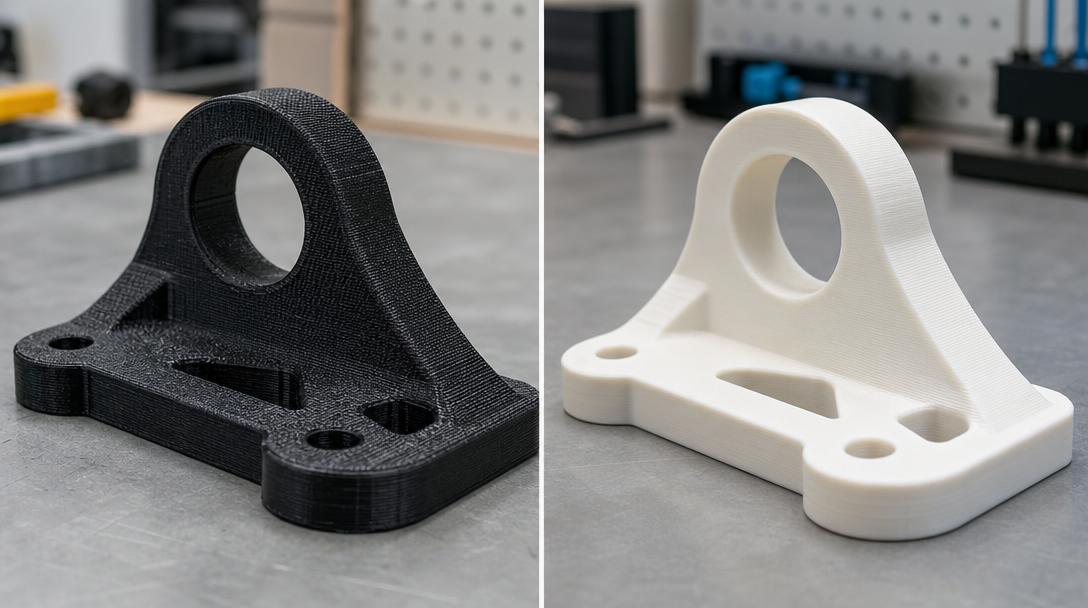

Carbon Fiber Reinforced or PLA? Which Makes More Sense for Rigidity, Printability, and Technical Parts?
One of the most commonly confused pairings at the decision stage is carbon fiber reinforced filament and PLA. That is because both are widely discussed in FDM printing; however, they do not serve the same need. Put simply, PLA is a practical starter material for a wide range of uses, from rapid prototyping to visual mockups, while carbon fiber reinforced options stand out when higher rigidity and more technical part performance are expected.
If you are looking for direct production support for your project, you can review the process on the 3d printing service page. To understand the cost side of the part, it is also useful to look at the price per gram logic. If your file is ready, you can quickly get a rough idea through the online 3d printing system.
What is PLA good for, and what is carbon fiber reinforced material good for?
PLA generally makes sense for visual prototypes, desktop fixtures, test parts used for dimensional checks, and light-duty products. The printing process is relatively easy, and the surface quality is satisfying for most projects. That is why it saves time during the first iterations.
Carbon fiber reinforced filament stands out for a different reason here: it is preferred when the part is expected to behave more rigidly, when bending should be reduced in certain designs, and when a more technical feel is desired. However, it would not be correct to think of this material as “superior to PLA in every way.” Carbon fiber reinforcement does not always make a part tougher or more forgiving under impact; in some cases, it can also create a character that is stiffer but less forgiving.
When is PLA sufficient?
- If you are printing a presentation model, mockup, or concept prototype
- If the part will not be exposed to a consistently hot environment
- If you want form verification before assembly
- If low risk and fast repetition are important during the printing process
For this type of work, PLA is often a more sensible and economical starting point. Especially on a first attempt, moving straight to an expensive technical material is not necessary for every project.
When does carbon fiber reinforced material make more sense?
- For structural or connection parts that should not bend
- When a more technical, more rigid body is expected
- In applications where dimensional stability is more important
- In designs where PLA feels too “soft”
For example, PLA may be perfectly sufficient for a cover, a visual prototype, or a desktop organizer. In contrast, for a fixture, mounting tab, drone/robotics connection part, or a geometry where maintaining shape under load is important, a carbon fiber reinforced option may be a more accurate choice. If you would like to see engineering-focused materials as a whole, the engineering materials 3d printing page is a good place to start.
What is the difference in outdoor use, heat, and impact?
Heat is one of the main areas where PLA falls short. Interior car parts exposed to sunlight, applications near windows, or areas exposed to heat can be risky for PLA. Depending on which base polymer it is made with, a carbon fiber reinforced material can become a more sensible option than PLA for technical-use expectations. Still, you should not look at the phrase “carbon fiber” alone and assume it guarantees outdoor or high-heat performance.
There is a similar nuance on the impact side as well. PLA is often rigid, but it can behave brittly under sudden impact. Carbon fiber reinforced filament may feel more rigid, but it should not be assumed to respond better to impact in every application. If flexibility or impact absorption is the priority, it may be necessary to turn to completely different material families.
Which has the advantage in terms of printability and cost logic?
When it comes to ease of printing, PLA is clearly more comfortable. It appeals to a broader user base, reduces trial-and-error time, and delivers visual quality more quickly. With carbon fiber reinforced filaments, however, printer compatibility, wear considerations, and the part target need to be evaluated more carefully. In particular, nozzle and process durability may become important.
From a cost logic perspective, the question is this: does the part truly need this level of rigidity? If the answer is no, proceeding with PLA may be more rational. If, on the other hand, the part bends on every repeat print, fails to hold its shape, or is expected to feel more technical, then the added cost of a carbon fiber reinforced option becomes meaningful. At this point, the best choice is to select the material according to the part’s real function, not simply because it is “more premium.”
Short decision summary
PLA is a strong choice for rapid prototyping, visual quality, low-risk production, and everyday light-duty use. Carbon fiber reinforced filament, on the other hand, can offer advantages in parts that need to be more rigid, more technical, and more critical in shape retention. If your part works under load, is expected not to flex, and PLA feels too soft, a carbon fiber reinforced option is worth considering. On the other hand, if the goal is fast, clean, and economical iteration, PLA is still one of the most sensible options in many cases.


 Türkçe
 العربية
 Русский
 فارسی
فارسی Deutsch