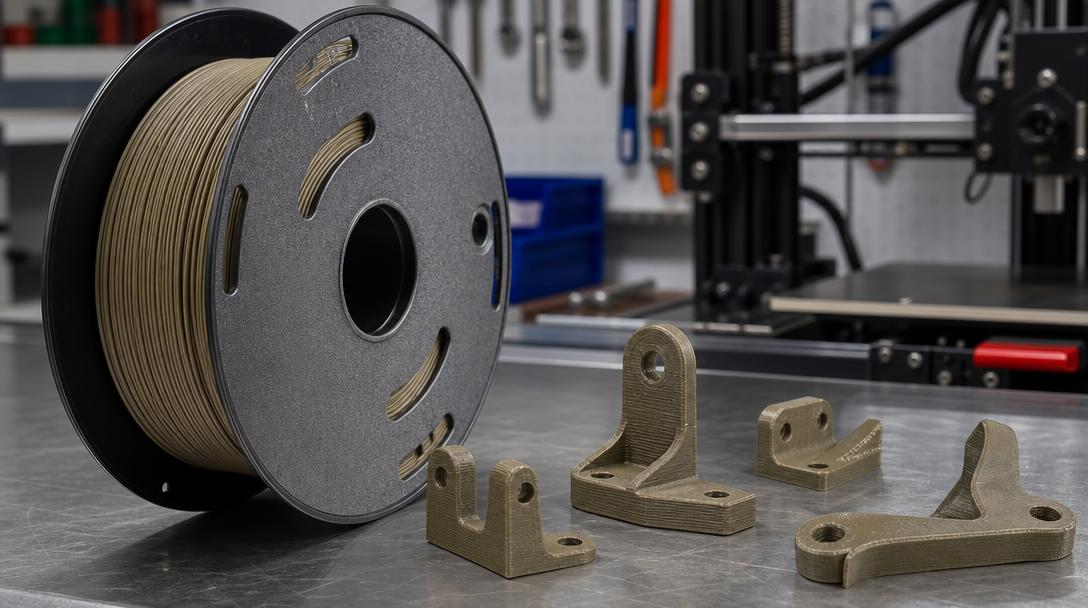

Why Is Polymaker HT-PLA Pro Drawing Attention? More Heat-Resistant PLA Opens New Possibilities for FDM Prototypes
For FDM users, PLA is still the easiest entry-level material; however, in parts exposed to heat or expected to behave a bit tougher, standard PLA often reaches its limits early. That is why the Polymaker HT-PLA Pro launch, reported by TCT Magazine on July 24, 2026, stands out as a noteworthy development for desktop and semi-professional manufacturing. According to the report, the material aims to reduce the brittleness and weak layer adhesion commonly seen in traditional high-temperature PLA types.
The important part of this news goes beyond a simple new filament announcement. For a long time, what users have been looking for is an intermediate-class material that is less troublesome than ABS or PC, yet more functional than standard PLA. HT-PLA Pro targets exactly this gap. According to the technical data shared by Polymaker, the material offers higher impact resistance and stronger Z-axis layer adhesion compared to standard HT-PLA. It is also particularly notable that it can maintain its heat performance on standard FDM printers, without requiring an enclosed chamber or a hardened nozzle.
Why is this not just a technical detail?
For Ucuz3D readers, this is where the real value begins. In many projects, people first want a part that prints easily, but they also expect it not to quickly lose its shape on a desk, inside a vehicle, next to a device, or under light mechanical load. Standard PLA performs very well in visual prototypes; however, when a hot environment, light impact, or repeated use comes into play, its limits become visible quickly. Materials like HT-PLA Pro, on the other hand, can shorten the distance between a functional prototype and an end-use part without completely giving up the printability of PLA.
This could be meaningful, for example, for electronic enclosures, workshop fixtures, measuring jigs, desktop mechanisms, light support brackets, or custom holding parts partially exposed to heat. Of course, it would not be correct to say that this material will replace ABS, ASA, Nylon, or PC in every scenario. Still, the rise of a practical alternative is an important signal for those on the FDM side looking for “more serious parts with the comfort of PLA.”
What is the practical meaning for Ucuz3D customers?
Which material a part should be produced from is often determined not only by strength, but also by print risk and total process cost. More challenging engineering materials may be strong in theory; however, because of warping, moisture sensitivity, the need for an enclosed chamber, or processing time, they may not be the most logical choice for every project. That is why, when getting a 3d printing service, material selection should be based not only on a catalog, but also on the actual conditions in which the part will be used.
Especially in low- and medium-volume functional prototypes, the print success of the material directly affects the total cost. If the target performance can be achieved without moving to a complex engineering filament, this often creates a more efficient result. At this point, the logic of price per gram should not be evaluated on its own, but together with the likelihood of reprinting, scrap risk, and part lifespan.
Likewise, instead of simply looking for “the strongest material” at the ordering stage, it is more accurate to clearly define what the part will actually face: Will it be exposed to sunlight, receive device heat, take impacts, or require dimensional stability? For decisions like these, adding a note when getting an instant quote helps make the material recommendation more reliable. For those who want to compare the general options, the engineering materials page is also a good starting point.
The main takeaway from this news
Recently, the most interesting developments in the FDM ecosystem have not been only new printers, but also new materials that lower the barrier to printing. HT-PLA Pro is a good example of this. The market is now investing not only in faster printing, but also in filaments that print easily yet behave more functionally. This is making material decisions more nuanced both on the service side and within product development teams.
In short, Polymaker’s HT-PLA Pro move, announced on July 24, 2026, shows that the PLA class still has room to evolve. If the part to be produced is too demanding for standard PLA, but not yet serious enough to justify more difficult engineering materials, these new-generation high-temperature PLA options may appear more frequently in the near future. Source: TCT Magazine, July 24, 2026.


 Türkçe
 العربية
 Русский
 فارسی
فارسی Deutsch