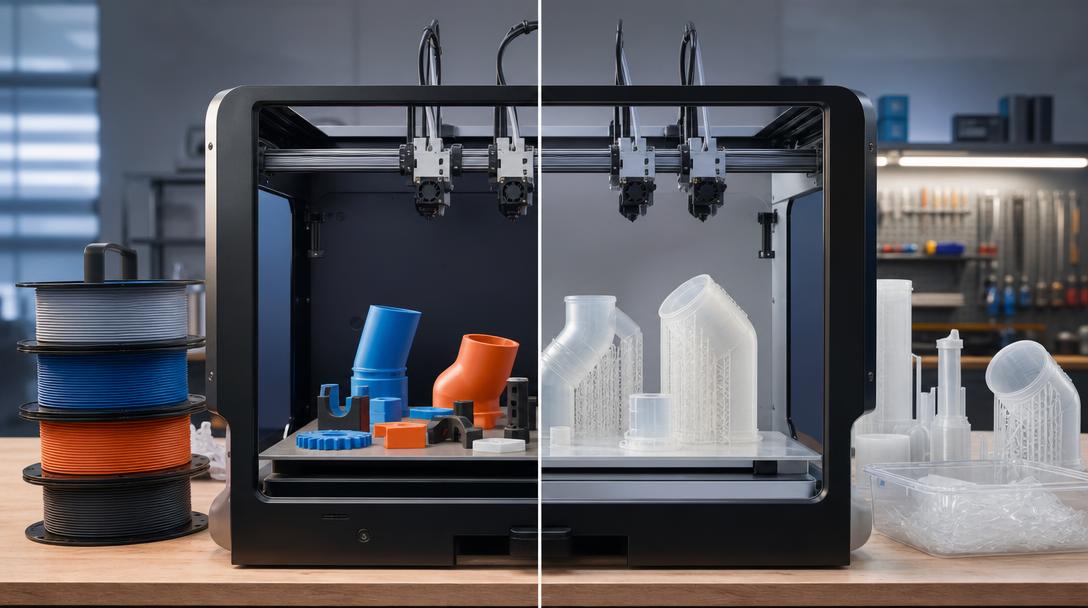

Why Is the Sovol M1D Getting Attention? The Open-Source FDM Printer with 7 Toolheads Aims to Reduce Waste in Multi-Color Printing
As the race for multi-color and multi-material printing accelerates on the desktop FDM side, Sovol’s new M1D platform offers a noteworthy middle-ground formula. According to CNX Software’s report dated July 29, 2026, the M1D combines an independent dual extruder (IDEX) architecture with automatic toolhead changes. On paper, the meaning is clear: while trying to reduce the purge waste seen in conventional multi-color workflows, it also brings together workflows such as duplication, mirroring, and multi-material production in a single machine.
For Ucuz3D readers, the importance of this news does not come only from the announcement of a new printer. The real point is that more efficient systems, going beyond the “single nozzle + more colors” approach, are now becoming more visible in the FDM world. This approach could eventually influence decisions on the 3d baskı hizmeti side, especially for prototypes, short production runs, and parts that require support material.
What stands out about the M1D?
According to the technical outline shared by CNX Software, the Sovol M1D can operate with a total of seven toolheads, one fixed and six interchangeable. The company claims that automatic toolhead changes take around five seconds. Unlike systems that continuously switch colors through a single nozzle, this structure theoretically means less cleaning waste and more controlled material transitions.
The report also highlights a build volume of 300 x 300 x 350 mm, a hotend temperature of up to 300°C, and open/enclosed body options depending on the material. The presence of an enclosed cabin and a heated chamber in the advanced version brings not only more accessible materials such as PLA, PETG, TPU, and PVA into the picture, but also options closer to engineering applications such as ABS, ASA, PA, and PC. This is a detail that makes material transitions especially more meaningful in functional prototypes.
Why could it matter for the industry?
In multi-color FDM printing, the real issue is not only visual appearance. Being able to use materials with different hardness levels or different functions in the same workflow, manage support material more cleanly, and reduce operator intervention during printing can create real production advantages. For example, achieving cleaner internal geometry with water-soluble supports or planning rigid and flexible regions within the same body can shorten the prototyping process.
That is why systems like the M1D do not directly fall into the “everyone should buy this right away” category; however, they are important in showing where desktop FDM is heading. When deciding which material makes more sense for a part today, it can be useful to review the basic options on our baskı malzemelerimiz page. For more technical parts, the material selected with an engineering approach determines performance in the final result more than the print time does.
What is the practical takeaway for Ucuz3D?
This news shows that three topics will become even more important in FDM services in the near future: material combinations, waste management, and part-based workflow selection. A customer simply saying “I want it to be multi-color” is usually not enough; the real question is whether that is a functional need or a visual preference. If the goal is a functional prototype, the right material and the right printing strategy are often more critical than the number of colors alone.
At this point, a healthier decision is to upload the model in the online 3d baskı workflow to review the options for the specific part, and then compare the gram başı fiyat logic. This is because in multi-material or support-focused jobs, cost is affected not only by filament, but also by the printing strategy and processing time.
A point that should be read with caution
There is one important note here: CNX Software presents the M1D as a crowdfunding launch. In other words, although the system’s technical claims are interesting, independent user experience will still be needed to evaluate production maturity and long-term field performance. Even so, by bringing together an open-source approach, fast toolhead changes, and IDEX architecture under the same roof, the Sovol M1D becomes one of the standout FDM printer stories of 2026.



 Türkçe
 العربية
 Русский
 فارسی
فارسی Deutsch