
What Does 3D-Printed Spare Parts Deliver in the Field? The US Marines Coastal Boat Part Example
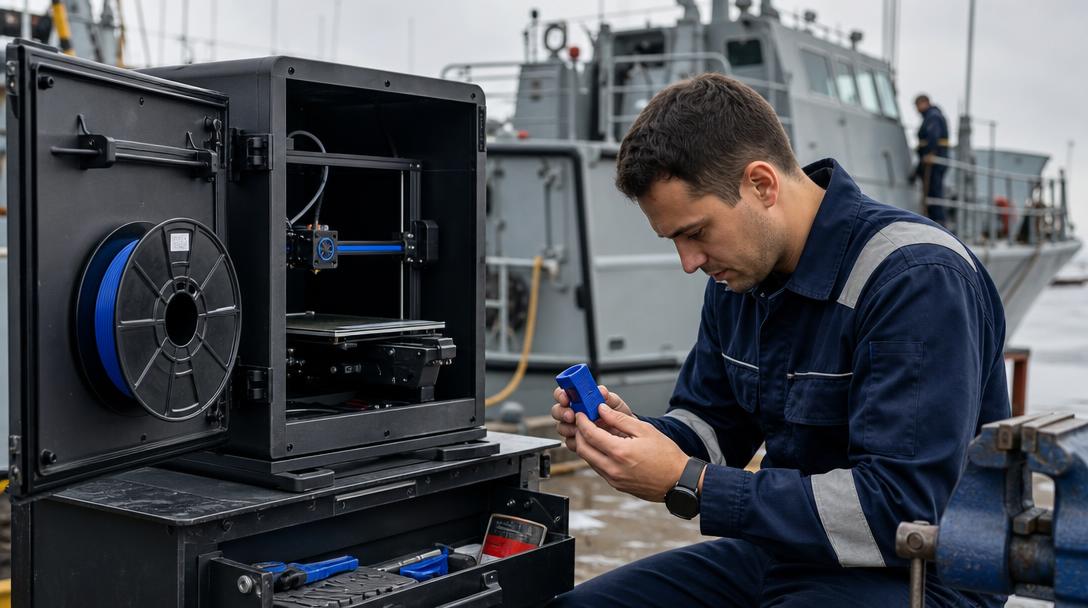
The topic of 3D-printed spare parts is moving beyond a theoretical promise of speed and becoming a maintenance method validated in the field. According to a 3Druck.com report dated July 30, 2026, during the Combined Joint Logistics Over-the-Shore 26 exercise in South Korea, a US Marines team reproduced on-site a missing plastic part for a US Coast Guard boat. The important part of the story is not only that the part was printed; it is that a delay that could have stretched over weeks in a conventional supply chain was overcome on the same day with mobile production infrastructure.
According to the report, the reproduced part was a strainer/strainer-like plastic component used on the rigid-hulled inflatable boat. The team used the existing part as a reference, remodeled it digitally, made small adjustments, and produced a functional equivalent through 3D printing on the mobile X-FAB production infrastructure. The first prototype was installed on the boat within half a day and passed a practical use test during the exercise. For Ucuz3D readers, the main message here is this: for low-complexity plastic parts that can still stop an operation, FDM-based production is now not just for prototyping, but a real tool for reducing lead time.
This example gives a clear answer to one of the most frequently asked questions on the 3d printing service side: “Can we recreate a discontinued or unavailable part?” In many cases, the answer is yes; however, only with the right geometry, the right material, and the right definition of usage limits. Because not every spare part is the same. Reproducing a cover, retaining clip, channel guide, protective cap, or a lightly loaded plastic component used in flow control is one thing; reproducing a part that works under constant high impact, high temperature, or safety-critical load is another.
The meaning of the US Marines example becomes even clearer when translated into the commercial world. In factories, on boats, in service vehicles, in field equipment, and in old machines, the most expensive failure is often not the part itself but the waiting time. In other words, the value of 3D printing shows up not only in material consumption but in reducing downtime. That is why many companies today do not look only at the logic of price per gram; they also calculate how quickly the part can be put back into service.
Material selection is decisive here. If the part works under a light load, even PLA may be sufficient for prototype validation. However, for real use, in most scenarios PETG, ABS, ASA, TPU, or more technical engineering-grade filaments make more sense. Especially when outdoor conditions, sunlight, heat, or impact are involved, part selection should not be made with a simple “let it be printed” mindset. For this reason, in more demanding applications it is a healthier approach to think through engineering materials 3d printing options.
The second striking point in the report is the idea of digital inventory. Once a part has been modeled, there may be no need to take measurements again or search for a supplier the next time it is needed. This provides a major advantage especially for old equipment, low-volume service parts, and products with weakening OEM support. If you have a suitable file, the correct tolerances, and a tested print profile, it becomes possible to produce the same part in different locations with similar results. This is exactly why many businesses today are showing interest in online 3d printing infrastructures: the transition from file to production becomes faster.
Even so, the story should not be romanticized too much. A part being printed in half a day does not mean every part can be safely produced in half a day. Layer orientation, infill rate, connection zones, aging behavior, and real operating loads must all be evaluated. In components that are safety-critical, exposed to high heat, or under constant mechanical stress, the validation step should never be skipped. But for parts with a clear function, limited load, and geometry suitable for printing, this report points to a very important threshold.
In short, this case published by 3Druck.com on July 30, 2026 shows that 3D-printed spare parts are moving beyond being a “promise for the future” and becoming a real field logistics tool. From the Ucuz3D perspective, the conclusion is clear: when the right FDM workflow is established for hard-to-source, low-volume, plastic-type parts, 3D printing can build a very strong bridge between maintenance, prototyping, and operational continuity.


 Türkçe
 العربية
 Русский
 فارسی
فارسی Deutsch