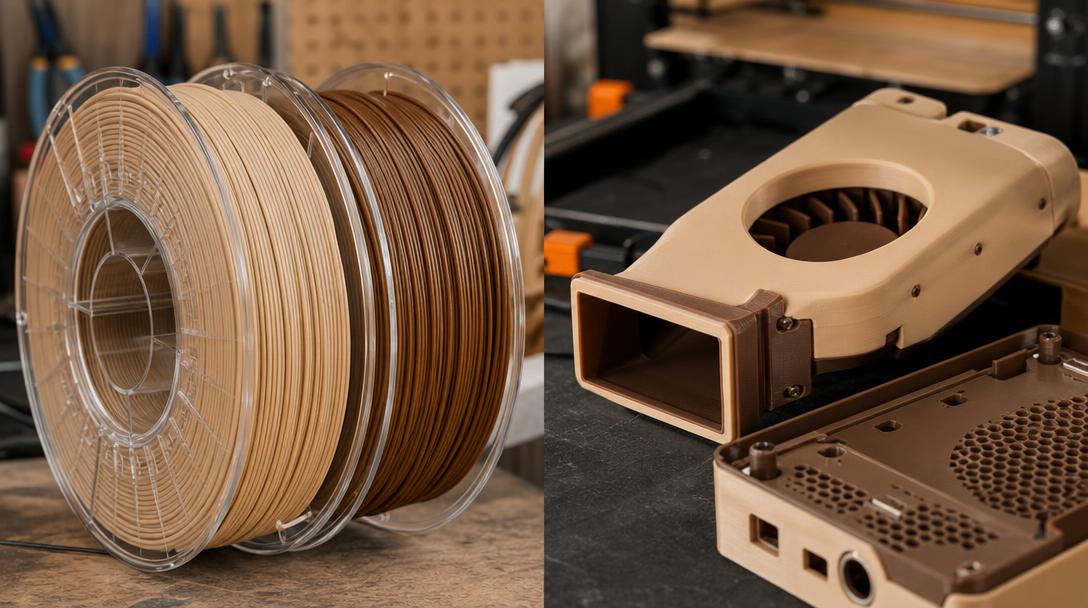

Why Is PETG Filament in Noctua Colors Drawing Attention? The Prusa Collaboration Highlights More Heat-Resistant Prints
The new PETG filaments announced by Noctua and Prusa Research at the end of July may look at first glance like a simple color-matching release. In fact, the most important part of the news is that it offers a clearer answer to a common need in desktop FDM printing: moving parts that are easy to print with PLA but quickly reach their limits because of heat and real-world use into a safer range with a material that is still relatively accessible. According to TechPowerUp’s July 28, 2026 report, the new PETG Prusament series released in Noctua colors adds a tougher and more heat-resistant alternative on top of the earlier PLA series.
This development is especially meaningful for applications such as PC airflow ducts, fan mounts, electronic enclosures, and custom connector parts operating close to warm environments. That is because PETG, while not quite as effortless as PLA, is still a manageable FDM material for a broad user base. Igor’sLab’s July 30, 2026 evaluation also interprets the main value of this shift not as color, but as the added safety margin it provides in terms of heat and impact resistance.
Why is this news important?
For Ucuz3D readers, the issue is not only about Noctua-themed mod parts. The bigger message here is this: manufacturers are no longer positioning FDM filaments simply as “colorful consumer products,” but according to specific use scenarios. In other words, material selection in 3D printing is becoming increasingly application-focused. It is no longer enough for a part to look good on a desk; what matters more is how well it keeps its shape and function inside a case, near electronics, or in a sun-exposed environment.
That is why, when planning a prototype or an end-use part, you should consider not only appearance, but also operating temperature, stiffness requirements, and impact risk from the very beginning. If you want a part not just to be printed, but to be matched with the right material for its actual use case, it is much healthier to evaluate materials based on the part’s purpose within the scope of 3d printing service.
What does PETG offer here compared with PLA?
The key point highlighted in the news is that PETG provides higher heat tolerance and better toughness compared with PLA. This is especially important for thin brackets, airflow-guiding parts, cable management components, small enclosures, and accessories that are handled regularly. PLA is still a strong option for many desktop prototypes, but in places such as a hot car interior, a sunny windowsill, or areas around electronics, the risk of deformation can appear much sooner.
PETG usually offers a sensible middle ground in this transition zone: before moving up to ABS or more advanced engineering materials, it gives you a chance to achieve a more durable result without making print difficulty dramatically harder. If you want to see similar material differences together, the our printing materials page is a good starting point.
What is the practical takeaway for Ucuz3D?
This news says more than a single brand expanding its color range: demand is growing in the FDM world for materials that are “easy to print but more functional.” PETG-class materials may become even more prominent, especially in electronics, maker projects, personal product development, and low-volume custom parts. This distinction also matters on the ordering side, because users are no longer just sending an STL file; they are also asking where the part will actually be used.
At this point, cost should not be considered only in grams, but in terms of part success. A first print that performs well reduces the need for rework caused by choosing the wrong material. For this reason, when reviewing affordable 3d printing prices, you should consider not only volume, but also the effect of correct material selection on the total workload. Likewise, the online 3d printing flow helps shorten the decision process by letting the file be uploaded and the production scenario be viewed quickly.
Conclusion
The new PETG filaments released through the Noctua and Prusa collaboration are a small-looking but well-targeted development on the FDM side. That is because they help close the gap a little more between the desktop user and the need for functional parts. PETG is not necessary for every part; however, for prints exposed to heat, requiring a bit more toughness, or intended for long-term use, this kind of material move directly affects decision-making. In short, the core of the news is not color, but the growing visibility of better material matching based on real use scenarios in FDM parts.



 Türkçe
 العربية
 Русский
 فارسی
فارسی Deutsch