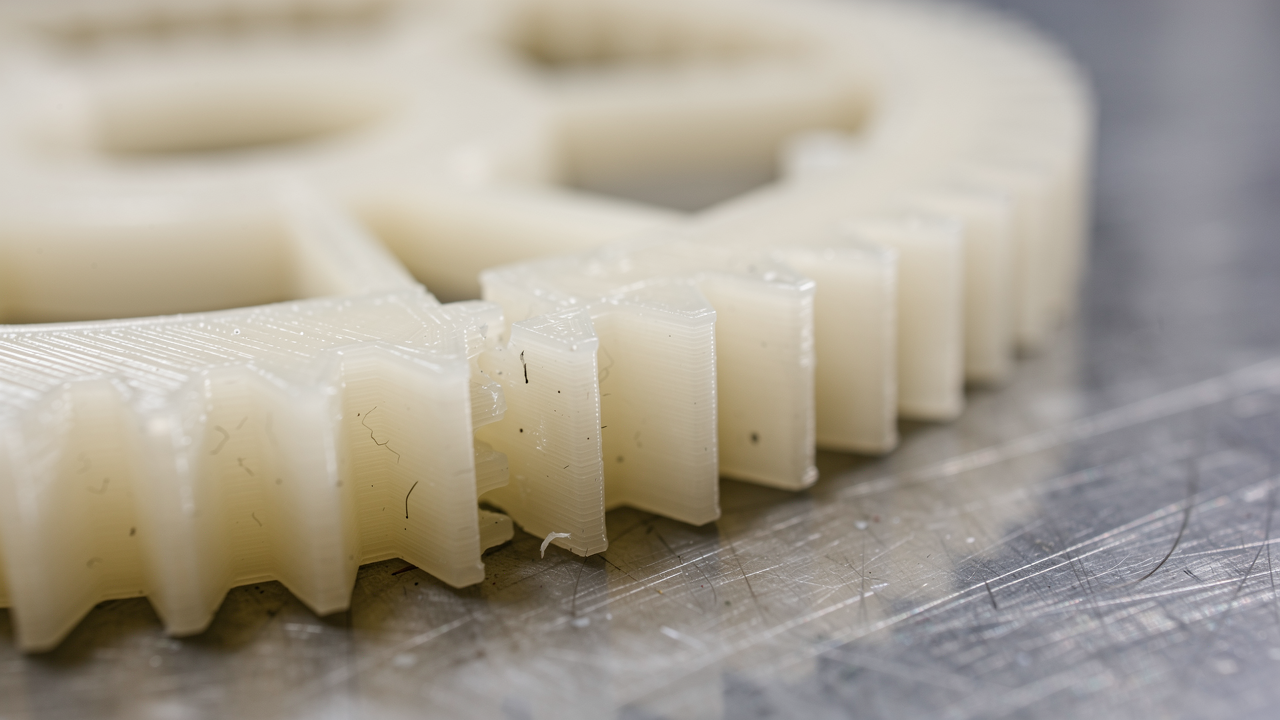

Why Is Prusament PA11 Natural Attracting Attention? Pure Nylon Is Expanding Its Role in Gears and Moving Parts
With Prusament PA11 Natural, announced by Prusa Research on the Original Prusa 3D Printers blog on July 23, 2026, pure nylon is back in focus on the FDM side. This is not just another filament announcement on its own; the real point is not simply to offer a stiffer material, but to create a more sensible option for moving parts, gears, wear-prone contact surfaces, and functional parts used outdoors. This is exactly where the key point begins for Ucuz3D readers: instead of automatically defaulting to PETG, ABS, or carbon-fiber-reinforced options for every technical part, it becomes clearer when pure PA11 should actually be considered.
Why is this news important?
The main distinction highlighted by Prusa is that PA11 Carbon Fiber and pure PA11 do not serve the same need. While the carbon-fiber-reinforced version stands out for higher dimensional stability and rigidity, PA11 Natural draws attention with its interlayer adhesion, impact resistance, and sliding/friction behavior. That makes it a more meaningful choice especially for gears, bushings, hinge-like moving parts, and mechanical components where some flexibility can be tolerated.
Prusa states that the material offers high impact resistance, wear resistance, toughness even at low temperatures, and good UV resistance. These may sound like nice features on paper, but their practical meaning is more valuable: PA11 is now becoming a much more serious candidate for parts that do not rotate continuously under load but are exposed to friction, outdoor connectors, and applications with the possibility of limited contact with chemicals.
Why can it stand out in gears and moving parts?
One of the best-known advantages of pure polyamides is their sliding performance, and Prusa emphasizes this in particular. In FDM printing, many users look for a material with high rigidity, but sometimes the real need is not a stiffer part, but a better-working part. In gears, sliders, rollers, guides, or wear-prone connection points, low friction and a tough structure are often more valuable than high stiffness alone.
That is why this news does not concern only users within the Prusa ecosystem. In Turkey, it gives a clearer answer to the question of “which material actually works?” across many applications, from prototypes to short-run functional parts. If the goal is not a visual prototype but a working mechanism, pure nylon is back on the table.
What does it say about heat and outdoor use?
According to the data shared by Prusa, there is a serious difference between the material’s direct heat resistance after printing and its resistance after annealing. In the as-printed state, the heat deflection value under load is more limited, whereas it is said to rise much higher with the correct annealing procedure. This point matters, because PA11 should not be read as a “straight out of the box solution for every hot environment.” Annealing, drying, and controlled printing conditions have a major effect on the final result.
For outdoor use, the combination of UV resistance and mechanical toughness is especially notable. That does not automatically mean it will replace ASA, because ASA is still a very strong option in terms of outdoor printability and surface stability. However, for outdoor parts that carry load or experience friction, PA11 is becoming a material that deserves much more serious consideration.
Is it an easy filament for every user?
The short answer: no. Prusa clearly states that PA11 is a moisture-absorbing material and recommends drying it before printing. It also emphasizes the need for an enclosed chamber, stable temperature, and ideally a suitable print surface. In other words, it would not be right to expect a user experience as easy as PLA. On the other hand, when the right preparation is done, the mechanical benefits can make that extra effort worthwhile.
- The easy side: It offers a more natural use case for moving and wear-prone parts
- The difficult side: It requires more attention to moisture control, an enclosed chamber, and printing discipline
- The commercial outcome: It is not for every job, but in the right job it becomes a much more logical engineering material
Practical takeaway for Ucuz3D
The real value of this news is that it helps break the perception that “nylon is just a niche filament that is difficult to print.” It especially encourages a fresh look at material selection for gears, friction-contact connections, mechanical clips, lightly flexible load-bearing parts, or functional prototypes exposed to chemical contact. If you want to get a 3D printing service for such a part, the best starting point is to first define the use scenario clearly. On the cost side, instead of relying on fixed memorized figures, the logic of price per gram provides a healthier framework. If your file is ready, you can proceed through the instant quote flow. If you want to review PA, PC, ASA, and similar technical options together, the engineering materials page is also a good reference.


 Türkçe
 العربية
 Русский
 فارسی
فارسی Deutsch