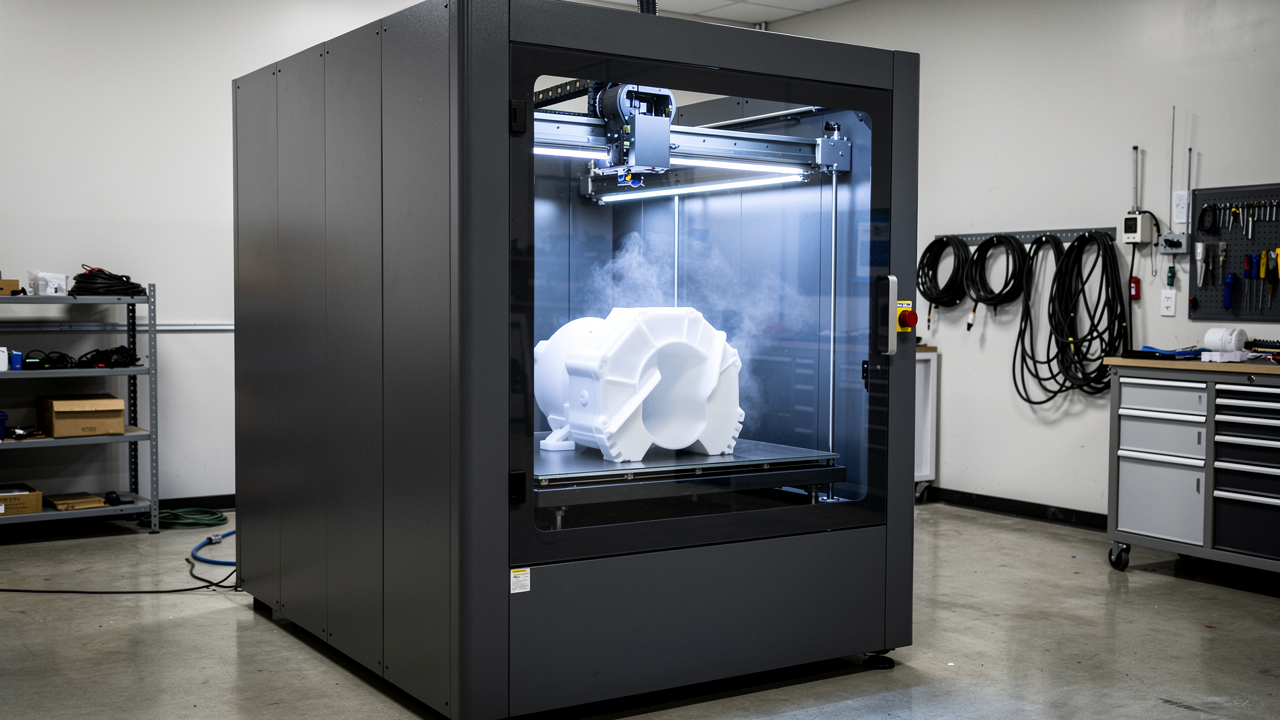

Why Is the Kentstrapper Mille Drawing Attention? Its 1 Cubic Meter Enclosed Build Volume Aims to Print Large FDM Parts in One Piece
With large-volume FDM printers, the real question is no longer just ‘how big can it print’; it is shifting toward how controllably, how repeatably, and with how little assembly it can produce a large part. According to 3D Printing Industry’s August 5, 2026 report, Italian manufacturer Kentstrapper announced a new large-format FDM system called Mille to address this need. The report is especially notable for its focus on one-piece production of large parts, an enclosed build volume, and workflow continuity during long prints.
From a Ucuz3D reader’s perspective, this development matters because in large-format FDM, the cost is determined not only by the machine itself, but also by the need to split the part, assemble it afterward, correct the surface, and spend time on rework. That is why, when getting a 3d printing service, you should look not only at the build volume but also at whether the part will be produced as a single piece or in segments. Likewise, when evaluating the overall job logic, labor, assembly, and error risk should be considered alongside the price per gram.
Why does Mille have news value?
The first highlight in the report is that the printer is an enclosed FDM platform with an approximately 1 cubic meter build volume. That alone is not entirely new; however, Kentstrapper combines it with an actively heated chamber, a zoned heated bed, and a quick-change extruder structure. According to the information shared by the company, the chamber temperature can reach up to 60°C, while the bed can heat up to 120°C and is divided into six independent zones.
This combination could be especially important for filaments that can be more demanding, such as ABS, ASA, and reinforced engineering materials. In large parts, corner lifting, internal stress, and layer separation are felt much more severely than in small desktop prints. For this reason, when selecting materials for engineering applications, it is necessary to think through the application scenario, not just the technical datasheet, much like the approach on the engineering materials page.
Details that strengthen the one-piece production logic
The second notable point in the report is the high-flow extruder called Mantis and nozzle options ranging from 0.4 mm to 1.4 mm. In practice, this range serves two different worlds: prototypes that require finer surfaces and large functional parts that require faster material deposition. The stated layer height range of 0.1 mm to 1.2 mm also shows that the system is targeting not just showcase-scale large prints, but actual production pace.
Kentstrapper also says that thanks to its magnetic extrusion system, toolhead changes can be made without tools and in a short time. During long prints, the ability for the second extruder to take over and continue with the same material is also theoretically useful for workflow continuity. Especially for large parts that run into the night or carry over into the weekend, these kinds of continuity features mean not just convenience in practice, but also a way to reduce scrap.
What is the main takeaway for the Ucuz3D user?
This news does not mean everyone needs a 1 cubic meter printer. Smaller systems are still sensible for most fixtures, enclosures, prototypes, or spare parts made at desktop scale. However, for mold-like large fixtures, display elements, bulky enclosures, large prototypes, or parts where the number of joints should be kept low, the game changes. Producing a part in one piece instead of dividing it into several sections can reduce assembly errors, alignment problems, and post-process workload.
That is why, when moving a part from digital design to production today, the question should not only be ‘can it be printed,’ but also ‘at what scale and with what segmentation can it be printed more correctly.’ Especially in quotes for large parts, seeing an early price in the online 3d printing flow is useful, but the real decision is often clarified by the material, print orientation, the need for one-piece production, and the end-use conditions.
What should be read cautiously for now?
As with every new system announcement, it is necessary to separate catalog specifications from real-world field performance. A heated chamber, large bed, and dual extruder are strong in theory; however, real production success depends on software stability, ease of maintenance, material profiles, and print repeatability. Even so, the trend we have seen recently in large-format FDM is clear: manufacturers are now trying to offer systems that require less cut-and-glue work, run more continuously, and support more engineering materials, not just larger build volumes.
In short, the Mille announcement is a good example showing that large-format FDM continues to evolve from a demonstration machine into a working machine. Source: 3D Printing Industry. Date: August 5, 2026.



 Türkçe
 العربية
 Русский
 فارسی
فارسی Deutsch