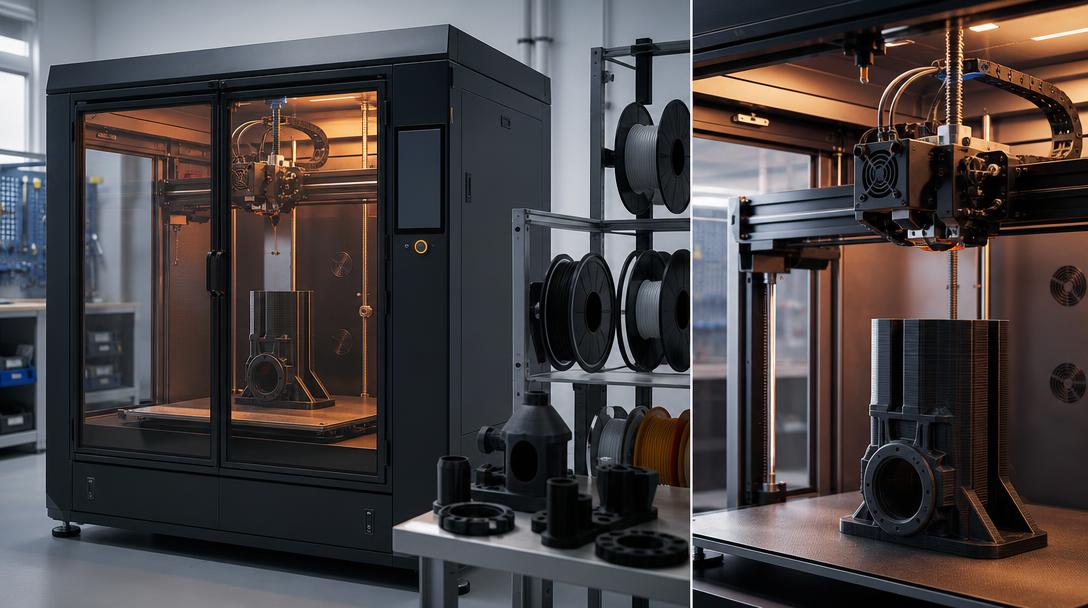

Why Is the QIDI Plus5 Drawing Attention? Larger Volume and a 65°C Active Chamber Target Technical FDM Printing
QIDI has updated its Plus series with the new Plus5 model. According to the 3Druck.com report dated August 5, 2026, the device arrives with a larger build volume, stronger active chamber heating, and an updated motion system compared with the previous Plus4 platform. From the perspective of a Ucuz3D reader, the key point is this: in many technical FDM jobs that remain close to desktop limits, printing larger parts and processing engineering-grade materials with more control are now being targeted in the same package.
The new model offering a 320 x 320 x 300 mm build volume should not be read simply as a piece of news saying it has “grown.” In large boxes, housings, mounting fixtures, protective covers, and low-volume functional prototypes, this difference directly affects part strategy. Producing a part as a single piece instead of splitting it into two and assembling it later can reduce both assembly risk and surface alignment problems. Especially for teams developing prototypes in-house, this can mean less post-processing and shorter iteration cycles.
Why is active chamber heating important?
One of the most critical technical details highlighted in the report is that the third-generation active chamber heating reaches 65°C. This value can make temperature differences during printing more manageable, especially in ABS, PC, and some glass-fiber-reinforced materials. Of course, chamber temperature alone does not guarantee perfect results; part geometry, bed adhesion, and cooling management are still decisive. Still, a more active and more powerful chamber approach can be seen as a serious step toward reducing the risk of warping and layer separation in large-part technical FDM printing.
Teams considering outsourced production for this type of work should look not only at the printer model, but also at material selection and actual part requirements. When proper process planning is needed, it may be possible to validate prototype, fixture, or low-volume production scenarios faster with a professional 3d printing service.
What is changing in the motion system and sensor side?
According to 3Druck.com, QIDI has moved to linear rails on the X axis and also updated the belt structure to behave in a more controlled way during high-speed direction changes. Improvements like these should not be read directly as a promise of “better print quality”; however, mechanical stability is always critical in the combination of high speed, large volume, and technical materials. In addition, the nozzle measuring level by directly contacting the bed could be a practical advantage for users working with different bed surfaces.
In addition, the manufacturer says the new extruder cooling system is designed to reduce the risk of heat creep and clogging. This is especially important in long-duration prints and with filaments that require high temperatures. Because in large-part FDM jobs, the cost of a failed print is not only time, but also direct material loss. For this reason, users should look not only at the device price tag in their total cost calculation, but also at reprint rates and material consumption. Those planning part-based outsourced production, on the other hand, can build a healthier decision process by examining the logic of price per gram.
Who benefits from cloud slicing and camera monitoring?
The QIDI Maker platform that comes with the Plus5 strengthens the approach of cloud slicing and remote sending with ready-made parameters depending on the model. While this feature provides convenience on the hobby side, its real value may emerge in small teams and in education/workshop environments. Standardizing certain workflows without teaching every user separate slicer discipline can be a factor that reduces errors. AI-supported camera monitoring is also not a miracle on its own; however, it can provide the advantage of early intervention in typical problems such as a detached line, a failed first layer, or print deviation.
If your goal is not to buy your own printer, but to produce the part directly and see the result, it may make more sense to upload the model and quickly check feasibility through an online 3d printing infrastructure. Especially to clarify which material is suitable on the technical side, such as ABS, ASA, PC, or reinforced options, the general framework on the engineering materials page is also a good starting point.
Why is it newsworthy?
Because the Plus5 is not simply in the category of “just another printer has been released.” When large volume, an active chamber, a focus on technical materials, and software ease are combined in the same product, the line between desktop FDM and semi-professional production is pushed a little lower. That means a more accessible technical printing threshold for both small businesses and product development teams. Time will show how consistently QIDI’s model performs in real-world use, but the initial technical framework looks noteworthy for users targeting large and more demanding FDM parts.


 Türkçe
 العربية
 Русский
 فارسی
فارسی Deutsch