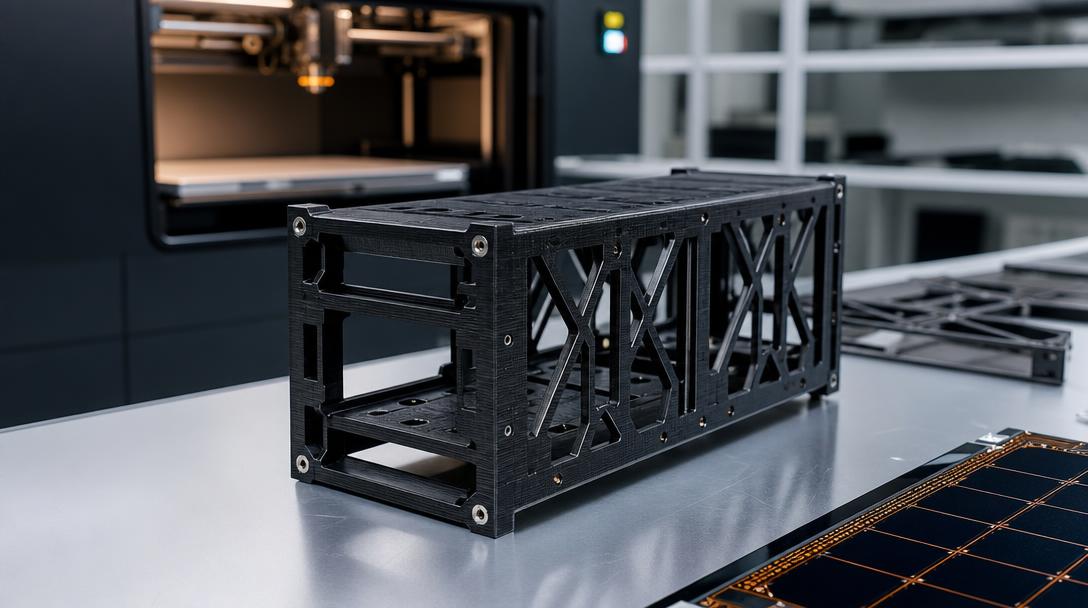

Why Is the FFF-Printed CubeSat 3U in Carbon PEEK Drawing Attention? NESST and Roboze Are Opening a New Path in Space Structures
FDM-based 3D printing is often associated with desktop prototyping; however, a recently shared application shows that it can be pushed much further. Italy-based NESST Srl announced that, במסגרת a project supported by the Italian Space Agency and the European Space Agency, it produced and validated a CubeSat 3U structure using the FFF method. According to TCT Magazine’s August 5, 2026 report, the study used the ROBOZE ARGO 500 platform and Carbon PEEK material.
For Ucuz3D readers, the truly important point is that this is not just another case of “a part was made with 3D printing.” The report shows that, with the right printer, the right process, and the right validation chain, high-performance polymers can open a new door for lightweight, complex, low-volume technical parts. This becomes especially strategic when dealing with details such as internal geometries, cable channels, or lightweight structural supports that are difficult to produce with traditional machining.
Why is this news important?
In CubeSat-class satellite structures, mass, geometric freedom, and verifiability are all critical at the same time. According to the report, NESST states that by testing structural components produced from carbon-reinforced PEEK, it demonstrated that they can deliver competitive mechanical performance compared with certain traditional aluminum alloys. It is also stated that, for outgassing behavior, which is considered sensitive in space applications, the material meets the requirements of the ECSS-Q-ST-70-02C standard.
When these two points are considered together, the issue is not simply about a “lightweight part.” The real value is that a polymer structure produced with FDM can become viable for discussion in more critical sectors after going through serious engineering validation. For teams in Turkey producing prototypes, test fixtures, unmanned system housings, electronics carriers, or custom mechanical enclosures, this news is directly inspiring.
What is the practical takeaway from Ucuz3D’s perspective?
Of course, not every project requires Carbon PEEK or space-grade standards. But the message of the report is clear: thinking about material selection together with part geometry significantly expands the limits of FDM. When questions such as whether a part really needs to be machined from metal, what loads it will face, and what temperature or chemical environment it must withstand are asked early, a more efficient production path can be found.
That is why producing a trial part through a 3d printing service at an early stage, seeing the design in the field, and then moving up to a higher material level is a sensible workflow for many teams. Likewise, cost should not be evaluated only by the number of parts; design iteration, tooling needs, and production time must also be considered. For this, reviewing the price per gram logic provides a more realistic starting point.
If your part falls into the category of a housing, carrier, fixture, custom fastener, or low-volume functional prototype, starting the process digitally can save serious time. For those who want to upload a model and see the approximate production framework, the online 3d printing workflow is valuable for exactly this reason.
Does the same conclusion apply to every FDM project?
No. This report should not be misread as meaning “FDM can now replace metal everywhere.” Success in a space application is achieved through special materials, controlled printing parameters, test infrastructure, and application-specific validation. The same approach does not transfer one-to-one to everyday PLA or standard PETG projects.
Still, this is exactly why the report matters: as the material level rises in the FDM world, the rules of the game change. Today, many engineering teams first carry out form and assembly tests with more accessible materials, then move to more advanced polymers if needed. To understand this transition, the approach on the engineering materials page provides a more accurate framework.
Conclusion
The NESST and Roboze example once again reminds us that FFF/FDM technology is not only a tool for quick mockups or simple prototypes. With the right material and proper process validation, it can also produce meaningful results in advanced sectors where lightweight design and geometric freedom matter. This is exactly where the value of this news lies for Ucuz3D: smarter part design, more accurate material selection, and more agile low-volume production are now becoming a much more concrete engineering discussion.




 Türkçe
 العربية
 Русский
 فارسی
فارسی Deutsch