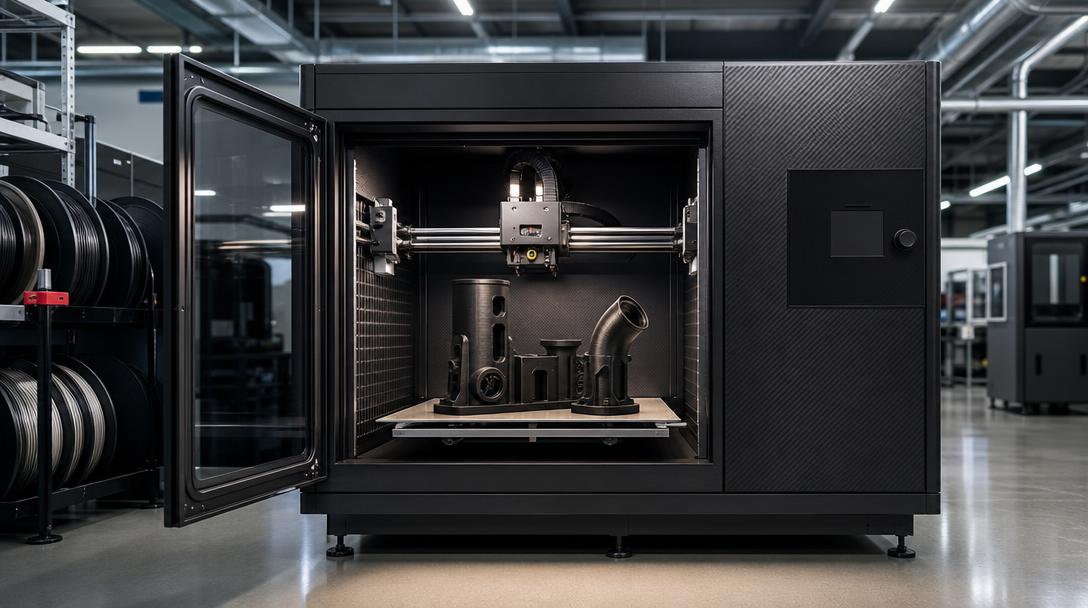

Why HP Industrial Filament 600 HT Is Drawing Attention: Bringing High-Heat Filaments Closer to the Production Line
HP had long been known as a major player in powder-based additive manufacturing; now it is taking a more serious step into filament-based production. According to a 3D Printing Industry report dated July 30, 2026, the company’s Industrial Filament 600 HT system aims to bring high-temperature engineering polymers into a more controlled and traceable FDM/FFF workflow. For Ucuz3D readers, the value of this news is that it shows what kinds of parts are now moving beyond desktop filament printing into more serious production scenarios.
The main issue here is not simply the release of a new printer. PEEK, PAEK, PEI, and certain carbon-fiber-reinforced technical materials have attracted attention for a long time; however, printing them consistently, especially for large or critical parts, was not easy. This is exactly the bottleneck HP is highlighting: processing high-temperature filaments in a more stable thermal environment and getting closer to production-grade quality.
Why is this system seen as different?
According to the technical framework shared in the report, the printer’s enclosed and actively heated build chamber can reach up to 195°C. This type of controlled chamber design is critical for layer adhesion and dimensional stability. Especially with demanding materials such as PEEK, parts can be lost in the final hours because of warping or layer separation, so stable temperature management creates value not just in theory, but in practice.
Another notable point is the modular extruder approach. Offering three interchangeable modules at 280°C, 360°C, and 500°C could make it easier to move on the same platform from more standard engineering polymers to materials in higher temperature classes. This strengthens the idea of using a single machine for different categories of work.
Why does it matter for Ucuz3D readers?
For many users in Turkey, 3d baskı hizmeti still mainly means prototypes, jigs, enclosures, or low-volume functional parts. But news like this shows that filament-based production is no longer limited to rough draft models. Examples such as ducting components in aerospace, sterilizable guides in the medical field, and lighter technical components in automotive show that, with the right material and the right process, FDM can move closer to much more demanding applications.
Of course, this does not mean every user should start printing PEEK tomorrow. On the contrary, the strongest message from the report is this: success with technical filaments does not come simply from buying the material; printer architecture, chamber control, drying, traceability, and post-annealing processes are at least as important as the material itself. This broader perspective is especially critical when discussing mühendislik malzemeleri.
Why is the open material approach standing out?
Another point that stands out in the report is that the system is not closed to third-party materials. On the industrial side, one of users’ biggest concerns is being locked into the material ecosystem of a single manufacturer after investing in expensive hardware. HP says it is offering a more open structure and support for material adaptation. If this approach performs in the field as expected, it could be important in terms of total part cost and supply flexibility.
This point is also indirectly important on the ordering side. For a part, the determining factors are not only machine hours, but also the material class, process difficulty, and validation requirements. That is why users should think about the logic of ucuz 3d baskı fiyatları not only in terms of how many grams of plastic are used, but together with the difficulty level of the process. Especially in technical jobs, pricing logic is more layered.
So what is the real takeaway from this news?
I think the most important conclusion is this: the filament-based production market is splitting into two. On one side, there is accessible and fast general-purpose printing; on the other, production-type FDM based on high heat, traceability, and process discipline is growing. HP’s 600 HT move shows that the second area is now becoming more crowded and competitive.
If you want your part not only to look good but also to perform under heat, chemical exposure, or mechanical stress, the right path usually starts with matching the right material to the right process. For this kind of work, giving the right information early on through online 3d baskı helps direct you more quickly toward the appropriate material class. HP’s announcement is a reminder of exactly that: in technical FDM, the goal is no longer simply getting a print, but getting controlled production.


 Türkçe
 العربية
 Русский
 فارسی
فارسی Deutsch