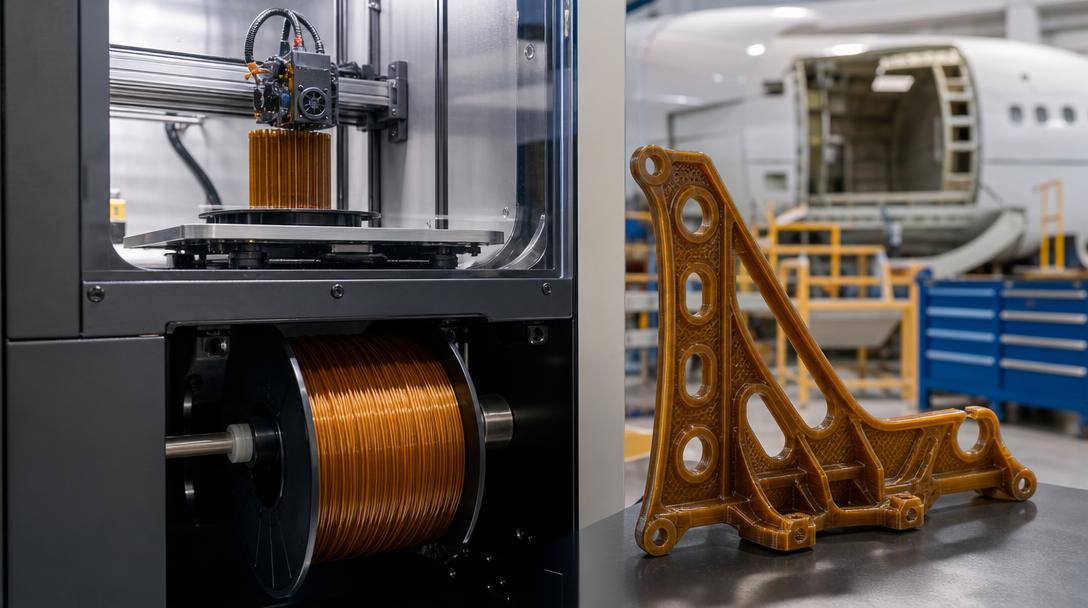

Why Did Airbus Approve the ROBOZE ARGO 500 HYPERSPEED for Flight-Ready Secondary Structural Parts?
News about 3D printing in aviation is often limited to the launch of a new machine or a material announcement. This time, however, what stands out is that a system has been approved directly against real production requirements. According to TCT Magazine’s July 27, 2026 report, Airbus qualified the ROBOZE ARGO 500 HYPERSPEED platform with ULTEM 9085 filament for the production of flight-ready secondary structural parts. This development shows that high-performance polymer printing based on FDM/FFF is gaining a more serious place not only in prototyping, but also in controlled end-use parts.
Why is this news important?
The real value here is not simply that a printer is powerful on its own; it is that a specific printer, a specific material, and a specific process chain have been validated together. According to the report, the ARGO 500 HYPERSPEED and ULTEM 9085 combination met Airbus requirements in areas such as mechanical performance, flame retardancy, repeatability, process control, and traceability. In other words, the issue is not only a filament that can withstand high temperatures; it is also the ability to produce the same part at different times and in different production environments with similar quality.
For Ucuz3D readers, the meaning is clear: in the FDM world, process reliability is becoming just as decisive as material selection. Today, when ordering a 3D printing service, most users first look at dimensions, strength, and surface quality. On the industrial side, however, traceability, process standards, and repeatable production stand out in addition to these factors. Airbus’s approval shows that high-performance filaments, when paired with the right machine and the right process, can be taken into far more serious applications.
What does a secondary structural part mean?
The term secondary structural parts mentioned in the report refers not to the main load-bearing critical fuselage elements, but rather to supporting parts inside the aircraft or on the platform that still have certain strength, heat, and safety requirements. This is exactly where polymer FDM becomes a meaningful transition point. That is because advantages such as geometric flexibility, low-volume production, reduced inventory burden, and fast supply become especially important here.
Especially in aviation, parts with a long shelf life but low consumption volumes can create a serious inventory burden. In such cases, the digital inventory approach and on-demand manufacturing logic become highly valuable. For that reason, this news is important not only for Airbus and ROBOZE, but also as a strong signal for the spare parts and low-volume technical manufacturing ecosystem in general.
Why does ULTEM 9085 stand out?
ULTEM 9085 is already one of the materials frequently mentioned on the FDM side for engineering applications because of its high temperature resistance, flame-smoke behavior, and mechanical balance. But the material’s data on paper is not enough on its own. The real issue is how reliably that material can be processed through closed-loop thermal management, a stable printing environment, and production control. This is exactly where Airbus’s approval becomes meaningful.
This development also creates a practical reference point for companies looking at high-performance polymer parts. If you are researching materials for functional prototypes, low-volume technical parts, or applications exposed to high temperatures, it may make sense to review the options on the engineering materials page. When evaluating per-part cost, it is also healthier to look at the application-based price per gram logic rather than relying on a fixed memorized price.
What does this say for real-world production from Ucuz3D’s perspective?
This news also summarizes the difference between desktop FDM and industrial production-type FDM very well. It is one thing for a part to be printable; it is another thing entirely for the same part to be produced again and again under corporate requirements. That is exactly why, for technical parts, file design, suitable material selection, and the production method should be considered together. Especially for jobs involving sensitive geometry, heat exposure, or a need for more controlled results, it is no longer enough to view a printing service simply as a way to get an output made.
That is why many users first test the prototype and then finalize the order; here, the online 3D printing flow provides a fast initial check. After that, the most suitable material for the part, the production quantity, and the usage environment become clearer. Airbus’s approval of ROBOZE says exactly this: when the right material, the right process, and the right control come together, FDM can move to a much higher level of use.
Article headline: Airbus qualifies ROBOZE ARGO 500 HYPERSPEED 3D printing platform for secondary structural parts.




 Türkçe
 العربية
 Русский
 فارسی
فارسی Deutsch