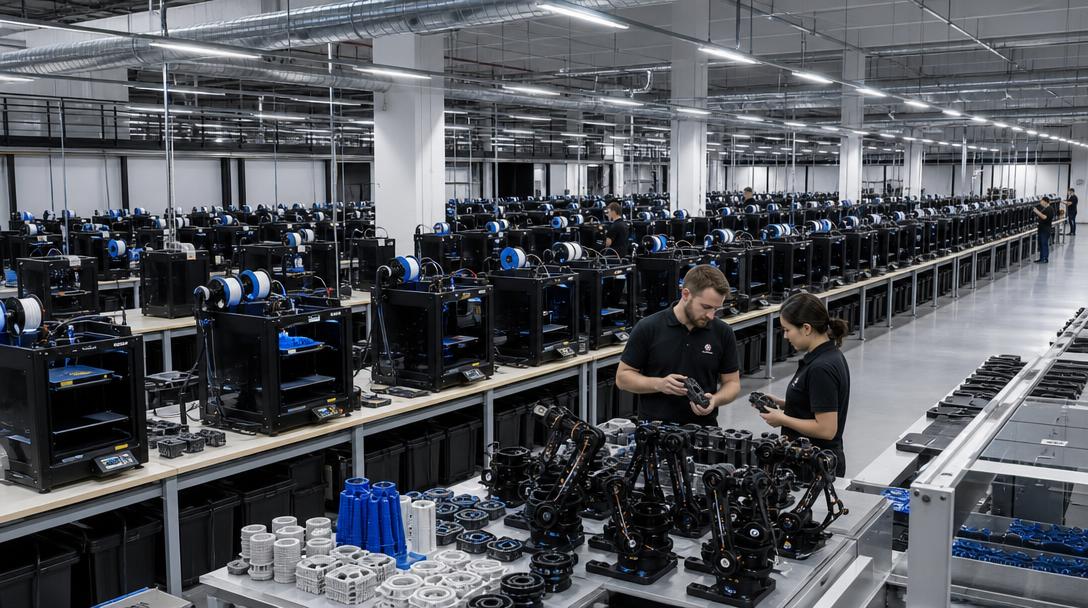

Why Fila Edge’s 3,000-Printer FDM Farm Is Drawing Attention: Serial Production and European Supply Meet in the Same Workflow
When FDM-based serial production is discussed, the focus is often on the prototype side with desktop printers. But as the scale grows, the real question becomes this: Is it possible to produce the same part in the hundreds or even thousands, with traceable quality and delivery discipline? According to 3Druck.com’s August 6, 2026 report, the Ukrainian company Fila Edge LLC has built a model that answers this question directly.
According to the report, the company brings the entire chain together within a single structure, from raw material sourcing and in-house filament production to FDM printing, post-processing and assembly, packaging, and shipping across Europe. The most striking point is that, according to the company’s own statement, it operates a print farm made up of more than 3,000 Bambu Lab P1S and P2S systems. This scale shows that FDM is increasingly being positioned not only for prototyping, but also for real part production in low- and medium-volume runs.
Why does it matter?
For Ucuz3D readers, the main value here is that a distributed production logic stands out instead of relying on a single “very large printer.” In this model, where many printers work in parallel, flexibility is especially important for parts such as enclosures, fixtures, fasteners, robotic components, and spare parts. Even if one machine goes down, the entire production line does not stop; the workload can be shifted to the other systems. This makes FDM more practical, especially for small batches and fast repeat orders.
The structure described by Fila Edge is based not only on print volume, but also on process control. The report states that the company centrally manages its printer fleet with software it developed itself, plans job queues, monitors production in real time, and handles remote management. As scale grows on the FDM side, the real competitive advantage is often created not only by hardware, but by operational software and quality standardization.
What does it say about materials?
The report says that alongside standard PLA and PETG, the company also processes ABS, ASA, TPU, and more engineering-focused plastics. Options such as PA6-CF, PC, PPS, and high-temperature carbon-fiber-reinforced materials suggest that this model is aimed not only at visual prototypes, but also at functional production. In similar applications, material selection changes depending on temperature, impact, rigidity, and environmental conditions, which is why the engineering materials side becomes especially important.
The practical lesson here is this: In FDM jobs that are close to serial production, the material name alone is not enough; moisture control, print parameter standards, dimensional control, and visual quality steps must all be considered together. This is why it stands out that the 3Druck.com report also emphasizes Fila Edge’s quality steps such as moisture testing, dimensional inspection, visual inspection, and production documentation.
What does this news mean from the Ucuz3D side?
For teams developing parts in Turkey, the message is quite clear: FDM is no longer limited to the level of “let’s print a sample.” When the right workflow is set up, it can become a production-line-adjacent tool for custom enclosures, robotic parts, functional fixtures, and certain spare parts. In particular, geometry advantages, the lack of mold investment, and the ability to make quick revisions make this approach attractive for low-volume technical parts.
If you also want to see how a part can move from prototype to small-batch production, it is useful to first clarify the right production approach on the 3D printing service side. To see how factors such as part geometry, material type, and infill affect cost, you can review the logic of price per gram. If your file is ready or you want a quick preliminary check, it is also possible to get an initial picture based on the part type through the online 3D printing workflow.
In short, the Fila Edge story shows that the future of FDM is being shaped not only by faster printers, but also by software, quality discipline, material management, and logistics integration. This 3,000-printer example clearly shows that the distributed production model now deserves to be taken much more seriously, especially for functional plastic parts.


 Türkçe
 العربية
 Русский
 فارسی
فارسی Deutsch