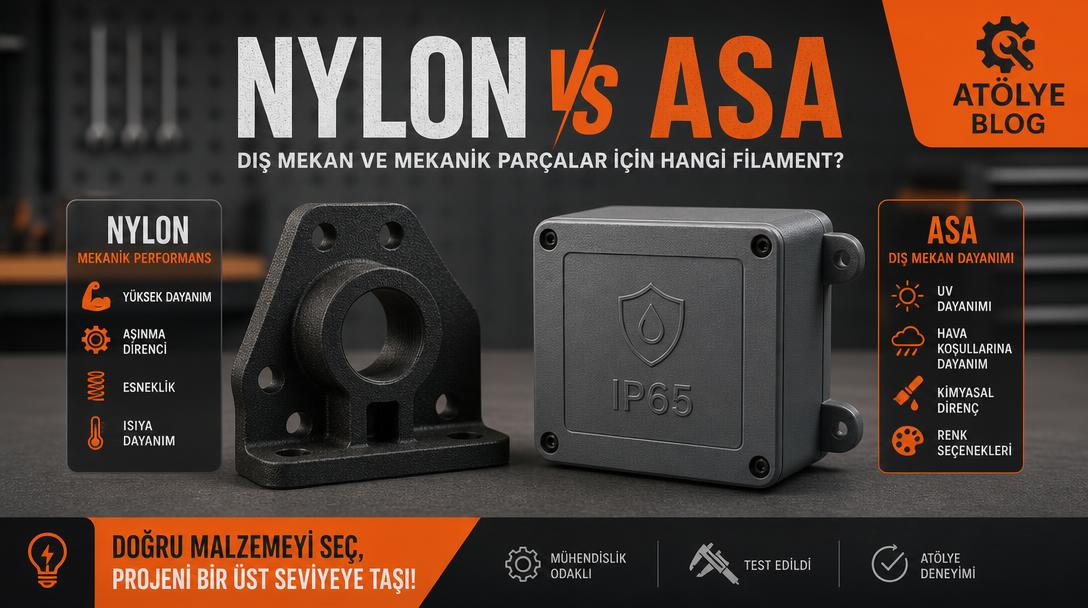

Nylon or ASA? Which Makes More Sense for Outdoor and Mechanical Parts?
In 3D printing, material selection often becomes more critical than the model itself. Especially if the part will both carry load and face harsh conditions, the decision directly affects service life. One of the most common questions at this point is: Nylon (PA) or ASA? The short answer is this: both are strong candidates, but they are not meant for the same job. While Nylon stands out more in terms of wear, impact, and mechanical load, ASA is often the more sensible choice for parts that require outdoor durability, UV resistance, and dimensional stability. If you are unsure, choosing the material based on the part’s use case with a professional 3d printing service is often the safer route.
What is Nylon used for, and what is ASA used for?
Nylon is a strong option for parts that are stressed, exposed to friction, subject to impact, and can tolerate a slight amount of flex. It can be a logical choice for bushing-like parts, clips, load-bearing connectors, and mechanical components used repeatedly. The material behaves in a tough manner; in other words, instead of breaking immediately under sudden impact, it tends to absorb some of the energy.
ASA, on the other hand, stands out in parts that will be visible outdoors, operate under sunlight, go through hot-cold cycles, and need to keep their shape. That is why it is often preferred for boxes, covers, outer housings, fixtures, vehicle-mounted auxiliary parts, and fasteners used in open-air environments. On Ucuz3D’s engineering materials page, it is helpful to compare suitable material families for these types of applications.
In which cases does each one not perform well?
Nylon is not flawless everywhere it is strong. Because it tends to absorb moisture, both the printing process and its behavior in end use require attention. It may not always be the first choice for decorative or cosmetic surface-focused parts that require very precise dimensions and must remain rigid with no flex at all. Also, in outdoor applications exposed to sunlight for long periods, being mechanically strong alone is not enough.
ASA is not the star of every scenario either. Although it is mechanically solid enough, it may not offer as natural an advantage as Nylon in tasks focused on friction, continuous impact, or wear. In other words, for moving, stressed parts that operate under load for long periods, choosing ASA solely because it is weather-resistant does not always lead to the right result.
Differences in outdoor use, heat, and impact
For outdoor use, ASA is generally the safer option. Thanks to its UV resistance and its more stable structure against weather conditions, it is often the more sensible choice for parts operating under sunlight. For a garden equipment attachment, outdoor box, sensor housing, or an auxiliary bracket used near the exterior of a vehicle, ASA will often come out ahead.
On the heat side, it is fair to say that both materials open the door to more demanding applications compared to PLA; however, the real decision depends not only on whether the part will be exposed to heat, but also on how rigid it must remain under that heat. When making this kind of decision, it is healthier to evaluate the overall production approach based on the use case and price per gram logic rather than relying on memorized figures.
In impact resistance and toughness, the advantage often shifts to Nylon. Especially for parts that may be dropped, bumped, tightened and loosened repeatedly, or require slight flex under load, Nylon can be more forgiving. This is an important difference for parts that feel tougher and give some warning before breaking.
Stiffness, flexibility, and ease of printing
ASA generally produces a more settled, dimensionally definite part. For that reason, it can be advantageous when you want a cover to fit properly, a panel to hold its form, or an outer housing to look clean. Nylon, by contrast, works with a slight margin of flex; this can sometimes be an advantage and sometimes a disadvantage. It can perform very well in a clip, while showing unwanted behavior in a completely rigid mounting plate.
In terms of printability, neither is as easygoing as entry-level materials. Nylon requires moisture control, while ASA prefers more controlled printing conditions. For this reason, the decision should be made not only according to material properties, but also according to production discipline. Uploading your file and clarifying which material makes more sense for the part through the online 3d printing workflow can reduce trial and error.
Which one makes more sense for which part?
- Choose Nylon: for worn, load-bearing, impact-prone, clipped, or moving mechanical parts.
- Choose ASA: for housings and fixtures that are exposed to sunlight, remain outdoors, have appearance importance, and need to hold their dimensions.
- Think twice about Nylon: for parts that will stay outdoors for long periods and face high UV exposure.
- Think twice about ASA: if friction and continuous mechanical stress are central to the application.
In short, the question is not which one is better, but what job will your part do? If mechanical load, impact, and wear are the priority, choose Nylon; if you need outdoor durability, UV resistance, and a clean functional body part, ASA is the more sensible choice.


 Türkçe
 العربية
 Русский
 فارسی
فارسی Deutsch