
TPE or TPC? Which Makes More Sense for Flexible but Wear-Prone Parts?
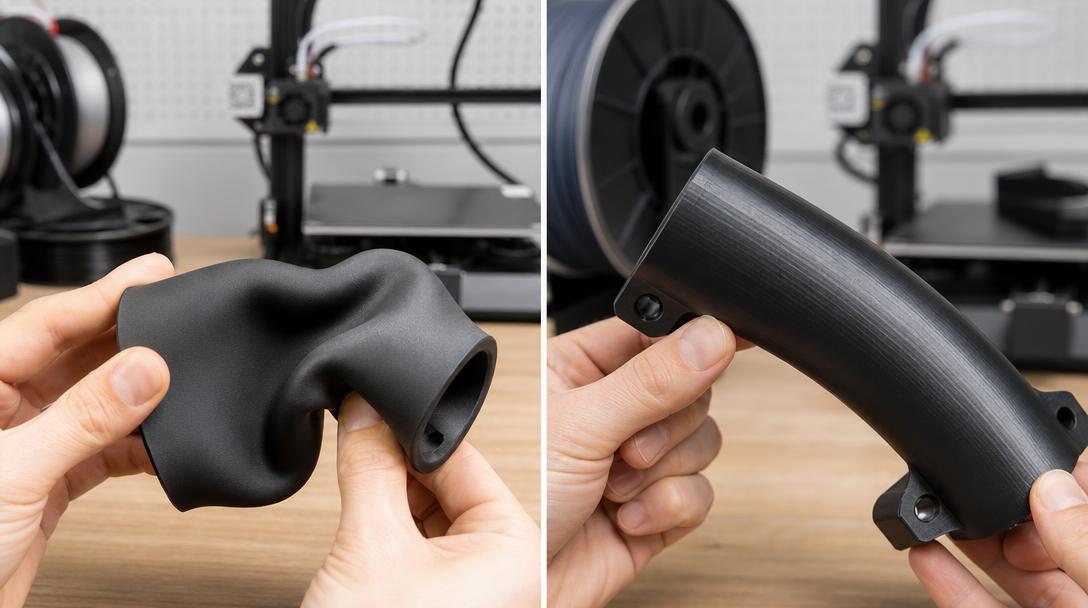
When a flexible part is needed, many people initially think as if there is only a single category. However, in the FDM world, there are materials with different behaviors under the heading of “flexible filament.” TPE and TPC are two of the most commonly confused options in this group. Put simply, TPE generally offers a softer and more flexible character, while TPC stands out in most scenarios as a slightly more controlled, more durable, and more technical alternative. Which material is the better choice depends on how the part is expected to perform.
What is TPE good for, and when does TPC stand out?
TPE can make sense for grip surfaces, soft bumpers, small vibration-damping parts, and product details that feel comfortable in the hand. It offers an advantage in parts that bend more easily and feel more “rubbery” by hand. However, for parts expected to maintain their shape well, work under load for long periods, or wear down through friction, not every TPE will deliver the same performance.
TPC, on the other hand, appeals to a more technical use case in most situations. Although it is flexible, it can be preferred for parts that recover more effectively, remain more balanced against wear, and inspire more confidence in certain outdoor scenarios. Examples include protective sleeves similar to cable sheathing, intermediate parts that need to absorb impact while also keeping their shape, flexible connecting elements, and functional components exposed to repeated use. For choosing a suitable material, the general framework on the mühendislik malzemeleri 3d baskı page can also provide useful guidance.
What are they not suitable for?
Neither material is the natural choice for rigid body parts that require high stiffness. If your goal is metal-like rigidity, very sharp screw holding, or a thin-walled structural part that fully keeps its shape, neither TPE nor TPC may be the right answer on its own. In addition, flexible filaments generally require extra care in very thin and long cantilevers, precision-tolerance locking mechanisms, or products where cosmetic perfection is expected after sanding.
Differences in outdoor use, heat, and impact
When choosing for outdoor use, asking only “is it flexible?” is not enough. Sun exposure, temperature changes, surface fatigue, and friction also matter. Because of its softer structure, TPE may be attractive for absorbing impact; however, for parts working outdoors over long periods, dimensional stability may not always be the main reason to choose it. TPC, by contrast, is often considered a more balanced option in many applications when facing heat fluctuations and mechanical fatigue. Even so, the final decision should be based on the actual filament formulation to be used and the thickness of the part.
On the impact side, this practical distinction is helpful: if the part should compress and recover, provide soft contact, and give a sense of comfort, TPE may be advantageous. If you want the part to flex but also behave in a more controlled way during continuous use, TPC becomes the more sensible option.
Printability and cost logic
In FDM printing, the shared challenge of flexible materials is feed and flow control. For this reason, neither TPE nor TPC is as easy to work with as PLA or PETG. That said, very soft types of TPE generally require more attention during the printing process. TPC, on the other hand, can often behave a little more “predictably,” which may offer an advantage on the production side. Of course, this varies depending on the printer architecture, extruder type, and part geometry.
On the cost side, looking only at spool price can be misleading. The failed print rate, support removal, need for reprinting, and the service life of the part determine the total cost. For that reason, instead of memorizing direct figures, it is healthier to question material suitability when getting a 3d baskı hizmeti, and then review the logic of the gram başı fiyat. If you already have a model, evaluating it through the file-based online 3d baskı workflow can also speed up the decision process.
Which one makes more sense for which part?
- TPE: Soft bumper, grip-enhancing coating, small vibration-absorbing part, protective detail that feels comfortable in the hand.
- TPC: Flexible but more durable cable protector, functional part exposed to repeated bending, protective element subject to friction, technical component working closer to outdoor conditions.
Short decision summary
If your priority is maximum softness and a stronger sense of flexibility, TPE is the better starting point. If the part will not only flex but also be used regularly, retain its shape a bit better, and behave more consistently against wear, TPC is usually the more sensible choice. The best selection is made according to the real use case of the part; in other words, you should look not for the “best flexible filament,” but for the “most suitable flexible filament for this job.”


 Türkçe
 العربية
 Русский
 فارسی
فارسی Deutsch