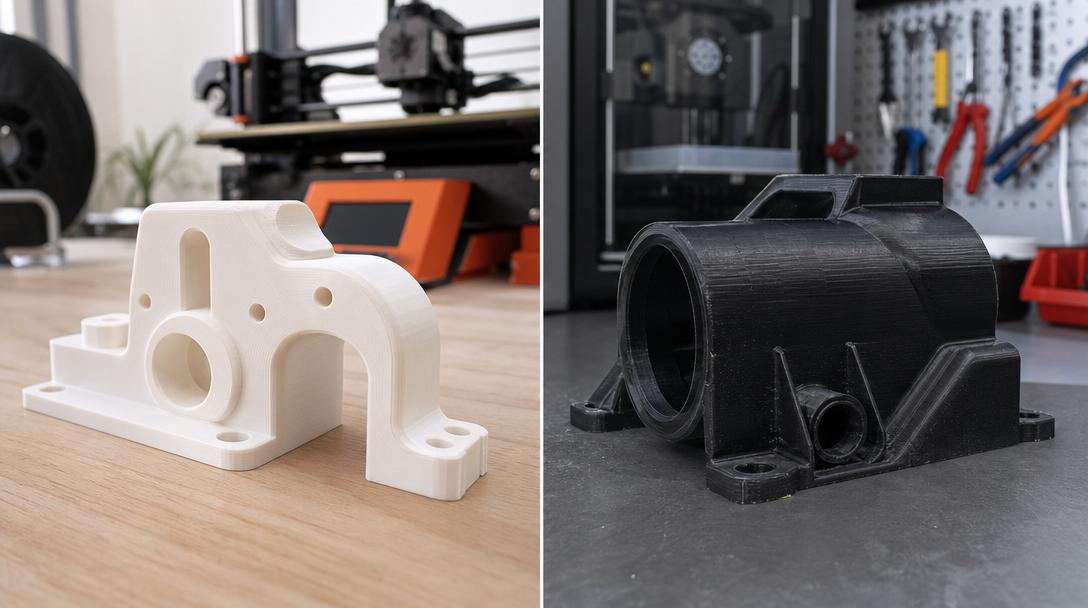

PLA+ or ABS+? Which Makes More Sense for Everyday Functional Parts?
PLA+ and ABS+ are two popular FDM filament options that are expected to behave in a more balanced way than their standard counterparts. So which one makes more sense when producing a part for everyday use? The short answer is this: PLA+ usually stands out for easy printing, a clean surface, and rapid prototyping; ABS+ may be the more sensible choice in hotter environments, where higher impact resistance is expected, and in slightly more technical use scenarios. Of course, the right choice depends on where and how the part will be used.
If you want to turn your design into production, getting professional 3d printing service support to match the material to the part’s use case is often more efficient than trial and error. To see Ucuz3D’s general material options, the our printing materials page is also a good place to start.
When does PLA+ make more sense?
For most users, PLA+ has an advantage when it comes to “getting a trouble-free part.” It is easy to print; its tendency to warp is relatively low, surface quality is usually satisfying, and dimensional consistency is good enough for everyday parts. PLA+ is often preferred for desk organizers, electronics enclosures, indoor fixtures, light-duty holders, or prototypes that are expected to look visually clean.
However, PLA+ is not ideal for every job. You should be cautious with parts exposed to direct sunlight, left inside a vehicle, or constantly subjected to warm conditions. In most cases, its heat resistance is not as strong as ABS+. That is why it is a good candidate for parts where you want a rigid, neat appearance but do not expect high temperatures.
When does ABS+ stand out?
ABS+ is a class of material aimed at reducing some of the challenges of standard ABS; while the formula varies from one manufacturer to another, the goal is usually more balanced print behavior and more practical mechanical performance. It stands out especially in applications where greater heat resistance than PLA+ is expected. ABS+ may be a more sensible option for interior vehicle clips, enclosures exposed to higher temperatures, functional covers that may take impacts, or parts subjected to light mechanical stress.
That said, ABS+ is not a “hassle-free material on every printer” either. In terms of ease of printing, it may not be as forgiving as PLA+. Depending on the geometry, it may require proper bed adhesion, a controlled environment, and careful settings. In other words, even if the part’s needs technically point to ABS+, the printing process must also be ready for it.
Critical differences in the comparison
1) Heat and environmental conditions
If the part will stay inside a hot vehicle, work in areas that heat up such as near a window, or be exposed to environmental temperature fluctuations, ABS+ is often the safer choice. PLA+, on the other hand, performs comfortably indoors and in milder conditions.
2) Impact and everyday use
For parts that take impacts, use snap-fit clips, or are stressed during installation and removal, ABS+ may offer an advantage. PLA+ can also be durable; however, its behavior usually feels more “rigid and clean,” while ABS+ feels more “function-oriented and tolerant.”
3) Rigidity and surface quality
PLA+ is strong for prototypes that feel more solid, have a smooth surface, and create fewer surprises after printing. This is an important advantage for many everyday parts that sit somewhere between a presentation model and a functional prototype.
4) Ease of printing and cost logic
The risk of reprinting directly affects total cost. Looking only at filament price is often misleading. That is why, alongside the price per gram, you should also consider the material’s error risk and how it behaves during print time. For jobs that require fast, trouble-free iteration, PLA+ may be the more economical choice overall; in more demanding use scenarios, ABS+ may look more troublesome at first but can become the better decision for the final part.
Which one should you choose for which part?
- PLA+: indoor fixtures, desktop accessories, prototype bodies, electronics enclosures, organizing parts that carry light loads
- ABS+: interior vehicle parts, enclosures exposed to higher temperatures, clipped connections, functional covers that may take impacts, parts for more technical use
If your file is ready, it is possible to quickly see the right production path for your part size and needs through the online 3d printing system. Especially in cases where you are undecided, evaluating the material not just by name but by the part’s real use scenario leads to healthier results.
In short: PLA+ usually makes more sense for easy printing, a clean look, and indoor use; ABS+ usually makes more sense when you expect a hotter environment, more impact, and more technical use. The best choice, however, comes less from asking “which is stronger?” and more from asking “where will the part work?”


 Türkçe
 العربية
 Русский
 فارسی
فارسی Deutsch