
ASA or Polycarbonate? Which Is the Better Choice for Outdoor and Heat-Exposed Parts?
When producing a functional FDM part, sometimes the question is not simply whether it should be durable or not. Will the part stay under the sun, get close to heat, be exposed to impact, or need to keep its dimensions during assembly? This is exactly where ASA and polycarbonate (PC), although they may seem to belong in the same category, are actually two serious materials optimized for different priorities. If you are having trouble deciding, making this distinction correctly from the start in the professional 3d baskı hizmeti process reduces the need to replace the part later.
Let’s start with the short summary: ASA stands out for outdoor conditions and UV resistance. PC is a strong candidate for parts expected to face higher heat and impact resistance demands. However, this does not mean PC is better in every case, because print difficulty, cost logic, and part geometry all have a serious effect on the final result.
What is it good for, and what is it not good for?
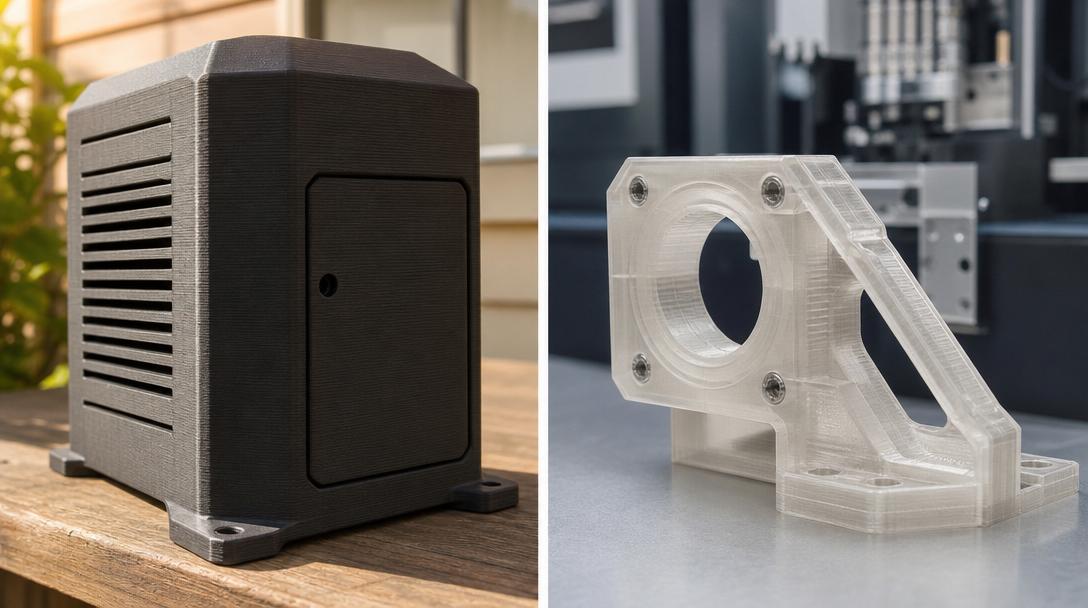
ASA makes sense for sun-exposed enclosures, outdoor fixtures, covers, boxes, mounting brackets, and parts that are also expected to remain visually clean. Under UV exposure, it is generally expected to behave more consistently than ABS. For this reason, it is often preferred for parts used on balconies, in gardens, for exterior vehicle accessories, or in areas close to the outdoors.
PC, on the other hand, is usually considered for engineering parts that are exposed to heat, impact, or higher mechanical demands. When rigidity, impact resistance, and temperature resistance come together, PC draws attention. Still, one small warning is necessary: not every PC part is automatically the best option for outdoor use. In scenarios that require long-term UV exposure, ASA is often the safer choice.
In other words, the areas where ASA may fall short can be very high heat and more aggressive mechanical loads. The weaker side of PC is the fact that the printing process is more sensitive, requires moisture control, and is generally more difficult to manufacture.
Outdoor performance: ASA is usually ahead here
If your part will be exposed to sun, rain, hot-cold cycles, and open-air conditions, ASA is generally the more natural candidate. It is closer to outdoor expectations in terms of preserving color and surface appearance. That is why it stands out for sign connection parts, outdoor boxes, sensor enclosures, or plastic components used near façades.
It would not be correct to say that PC is never used outdoors; however, the selection should not be made only with the logic of choosing the “strongest material.” If long-term visual stability and UV performance matter outdoors, ASA’s advantage becomes clearer. For this type of work, mühendislik malzemeleri 3d baskı options should be evaluated according to the usage scenario.
Heat and impact resistance: Why does PC stand out?
If the part will be used around a motor, in hot airflow, inside an enclosed machine, or in a mechanically demanding hand-operated application, PC may be the more appropriate choice. The main strength of polycarbonate lies in maintaining its shape under high heat and behaving tough under impact. That is why it is considered for protective enclosures, functional connectors, or technical parts under load.
By comparison, ASA is not weak for everyday functional parts either. However, the deciding question here is: “Is sunlight resistance more critical, or are heat and impact more important?” If the answer is the latter, the choice moves toward PC; if it is the former, ASA is usually the more sensible option.
Rigidity, flexibility, and ease of printing
Neither material is an extreme example like PLA or TPU; in other words, it would be wrong to think of one as extremely flexible and the other as extremely brittle. Still, in practice, PC is a more technical and more demanding material. It requires high temperature, a controlled environment, and well-dried filament. For this reason, error tolerance during printing can be lower.
ASA is not considered a completely easy material either; it requires attention in terms of warping and layer adhesion. But compared with PC, it offers a more manageable production balance in many projects. If the goal is not only “the strongest data sheet,” but a part that can be produced smoothly, this difference matters. Before ordering, it is more accurate to consider the gram başı fiyat logic together with material risk, because materials that are harder to print can affect the overall production approach.
Which one for which part?
- Choose ASA: outdoor boxes, UV-exposed covers, mounting parts that remain in open areas, and functional components where visual stability is desired.
- Choose PC: enclosures close to heat, technical parts exposed to impact, and jig- or fixture-like parts with higher mechanical expectations.
- If you are unsure, lean toward ASA: if outdoor use and more balanced production are the priority.
- If you are unsure, lean toward PC: if heat and mechanical stress are more critical than outdoor exposure.
The final decision usually comes not from the material name, but from the real usage scenario of the part. When getting a quick quote in the online 3d baskı workflow for your file, stating where the part will be used makes a big difference in choosing the right material. In short: ASA for outdoor use and UV, PC for high heat and impact is generally the more logical starting point.


 Türkçe
 العربية
 Русский
 فارسی
فارسی Deutsch