
PETG or Polycarbonate? Which Is the Better Choice for Parts Exposed to Heat and Requiring Strength?
In FDM parts, material selection is often not just about finding “the strongest one.” The real question is under what load, at what temperature, and in what operating environment the part will work. That is exactly why PETG and polycarbonate (PC) are often compared. Both are more functional than PLA; however, they do not do the same job.
In short, PETG is a more balanced and accessible option for everyday functional parts. PC stands out in parts exposed to higher heat, higher impact, and more demanding engineering expectations. If you are considering getting a 3d baskı hizmeti for your project, the right decision usually depends more on the use case than on the catalog name of the material.
What is it good for, and what is it not good for?
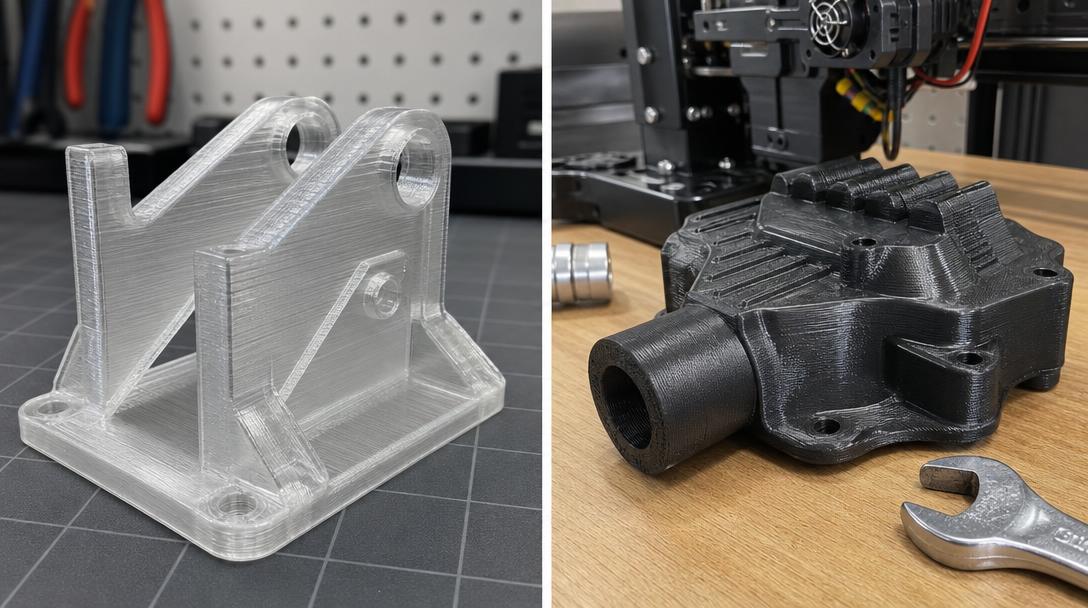
PETG makes a lot of sense for fixtures, enclosures, brackets, light-load connectors, workshop aids, and everyday-use products. Layer adhesion is generally satisfactory, it does not behave in a brittle way thanks to its slight flexibility, and in most projects it does not make the printing process unnecessarily difficult. However, it may not always be right to treat PETG as the default choice for very hot environments, around motors, or in risky areas such as inside a closed car in summer.
Polycarbonate, on the other hand, becomes meaningful in parts with higher performance expectations. Examples include covers exposed to heat, enclosures that may take impact, technical parts that require rigidity, and more demanding service conditions. But it is also not correct to recommend PC for every job. That is because it is harder to print, its cost logic is more selective, and for a simple desktop organizer it is often more material than necessary. This is exactly the approach on Ucuz3D’s mühendislik malzemeleri 3d baskı page: choosing the material according to the application.
The difference in heat and outdoor use
One of the most critical axes of this comparison is heat. PETG is safer against heat than PLA; that is why it is often preferred for functional parts exposed to mild heat. Still, if the part will be exposed to high temperatures for a long time or if maintaining its shape is very important, PC is a stronger candidate.
Outdoors, the picture is a bit more nuanced. PETG is a practical material in terms of moisture and general environmental use. However, outdoors, not only rain matters, but also heating under the sun and long-term service conditions. PC may offer a more technical solution in some applications; however, it would not be correct to call it the single “best” option for outdoor use. Sun exposure, mounting method, and mechanical load should all be evaluated together for the part.
Impact, rigidity, and flexibility
The nice thing about PETG is that it is rigid but not completely brittle. It allows a small amount of flex; this can be an advantage in some clip-like geometries or in daily use with light impacts. On the other hand, in some technical parts where dimensional stability and high rigidity are expected, that flexibility can become a disadvantage.
PC, in most scenarios, serves higher mechanical expectations. It stands out in more demanding functional parts thanks to its impact resistance and its ability to maintain its form under heat. However, in return, it requires a more controlled production process during printing. In other words, PC’s superiority on paper does not mean it will automatically deliver better results in every project.
Printability and cost logic
One of PETG’s biggest advantages is that it offers a good balance between performance and ease of printing. That is why, on the online 3d baskı side, it can be a safe starting point for many customers. When choosing a material, you need to consider not only nominal strength but also production risk and repeatability per part.
On the PC side, production conditions become more critical. It may not be the economical choice for every design and every geometry. For that reason, instead of memorizing exact figures, it is healthier to evaluate the total job through the gram başı fiyat logic. PETG may make more sense for a simple bracket, while in an application where the risk of a failed part is expensive, PC may be the better overall choice.
Which one for which part?
- Choose PETG: Everyday functional parts, workshop fixtures, protective enclosures, and connectors that can tolerate slight flexibility.
- Choose PC: Technical parts exposed to higher heat, applications with higher impact expectations, and engineering jobs where rigidity and service reliability are the priority.
- Avoid PETG: In critical parts that must maintain their shape very well under continuously high temperature.
- Avoid PC: In simple, low-risk parts where it would create unnecessary engineering cost.
For the final decision, the practical summary is this: if your goal is a balanced, economical part that is strong enough for most everyday uses, PETG is generally the more sensible choice. If the part is truly exposed to heat, takes impact, or carries out a technical task with little room for error, polycarbonate may be the better candidate. The right choice comes not from the material’s reputation, but from the part’s real operating conditions.


 Türkçe
 العربية
 Русский
 فارسی
فارسی Deutsch