
Carbon Fiber Reinforced or Nylon (PA)? Which Makes More Sense for Rigid and Wear-Prone Parts?
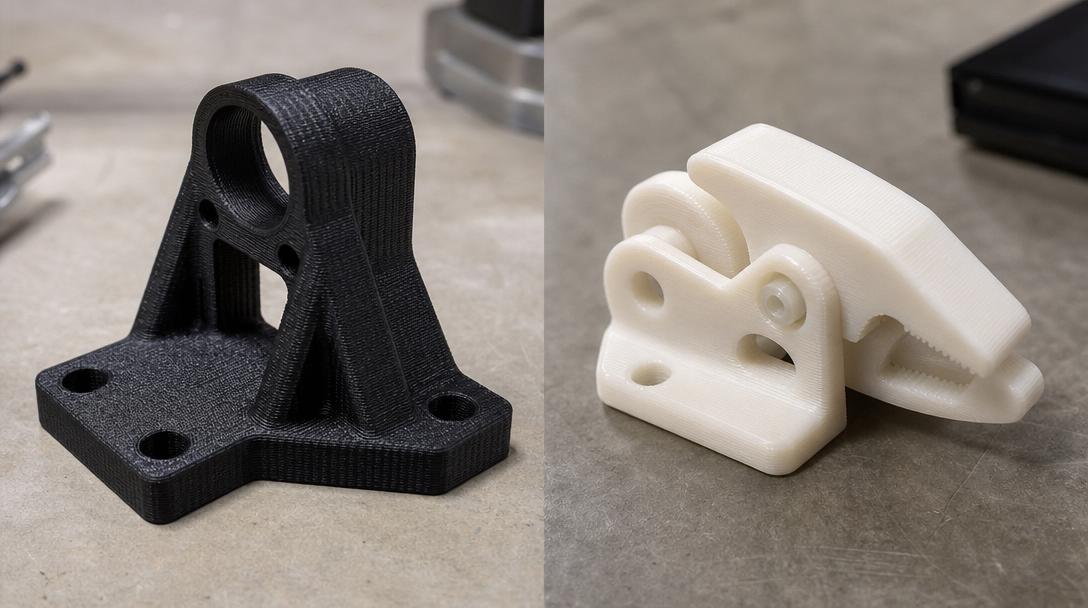
For some parts, the main need is high rigidity; for others, it is more important to operate under friction, withstand impact, and maintain their form over a long period. At this point, carbon fiber reinforced filaments and Nylon (PA) often end up on the same shopping list. However, these two materials do not do the same job. In short, carbon fiber reinforced options stand out not because they are tougher or more flexible, but because they suit parts that need to be more rigid and behave in a more controlled way; nylon, on the other hand, offers a more forgiving character under wear, impact, and mechanical load.
If you want to review the professional 3d printing service workflow before deciding on the right material for your part, it usually leads to better results to evaluate material selection together with the printing process. To see a wider range of technical options on the material side, the engineering materials page is also a good starting point.
What is it good for, and what is it not?
Carbon fiber reinforced filaments make sense especially for parts you do not want to bend, where you want dimensions to feel more stable, and where you expect light but stiff behavior. Fixtures, holders, assembly aids, and structural body-like parts can be given as examples. On the other hand, if a part needs to flex frequently, operate under friction, or absorb energy through impact, carbon fiber reinforcement may not always be the first choice.
Nylon, by contrast, can make more sense for gear-like working parts, bushings, clips, load-bearing connections, and functional components exposed to repeated use. This is because nylon’s strength is not only its durability; it is also its relatively balanced behavior against wear and impact. However, it would not be accurate to say that nylon is ideal for every job. In some parts where very high surface hardness or the highest possible dimensional stability is expected, carbon fiber reinforced materials can feel more advantageous, especially in terms of rigidity.
Differences in heat, outdoor use, and impact
There is no single absolute winner in this comparison. On the heat side, the result can vary depending on which base polymer the carbon fiber is combined with; in other words, “carbon fiber” alone does not define a temperature class. For this reason, it is not correct to decide based only on the reinforcement. Nylon, meanwhile, may be mechanically impressive, but its relationship with moisture and the working environment must always be taken into account.
For parts to be used outdoors, again, the environment is the deciding factor. If sun, humidity, temperature fluctuations, and mechanical load all come together, it is better to think about the part’s real function rather than simply choosing the material that “looks the strongest.” For parts exposed to impact and expected to work without breaking by flexing a little, nylon may make more sense. For parts expected to stay stiff, resist bending, and preserve their geometry better, carbon fiber reinforced options may stand out.
Rigidity, flexibility, and printability
The clearest axis that separates these two is the rigidity-flexibility balance. Carbon fiber reinforced filaments generally give a more rigid feel. This can be an advantage in long-arm fixtures or support parts that you do not want to wobble. Nylon, on the other hand, can behave in a more flexible and forgiving way, so it may offer a durable-use character instead of brittleness.
In terms of printability, neither is considered a “beginner material.” Nylon requires moisture management; carbon fiber reinforced filaments require attention because of their abrasiveness and the need for proper hardware. For this reason, if the only goal is to get the easiest, most trouble-free print, most users first turn to more standard materials. Even so, in professional production, the decision is made not only according to printability, but according to whether the final part does its job properly. At this point, it is more useful to look at the price per gram approach to understand the general cost logic, because the real cost is shaped not only by the filament name, but also by geometry, support requirements, and failed print risks.
Which one for which part?
- Carbon fiber reinforced: Rigid fixture, positioning jig, body part, support element that should not bend.
- Nylon (PA): Clip, load-bearing connection, functional part exposed to friction, component exposed to impact where a bit of flex is beneficial.
If the part must maintain its form under constant load and the main expectation is that it should “stay stiff,” carbon fiber reinforced materials may make more sense. If the part will face friction, impact, and repeated mechanical stress in real use, nylon becomes the safer choice. If your file is ready, evaluating material scenarios together through the online 3d printing workflow is healthier than choosing based only on the material name.
Short conclusion
If rigidity and shape retention are your priority: carbon fiber reinforced filament may make more sense.
If wear, impact, and mechanical use are your priority: Nylon (PA) is the better candidate in most scenarios.
The right choice depends on the balance between how much the part needs to flex and how stiff it needs to remain.



 Türkçe
 العربية
 Русский
 فارسی
فارسی Deutsch