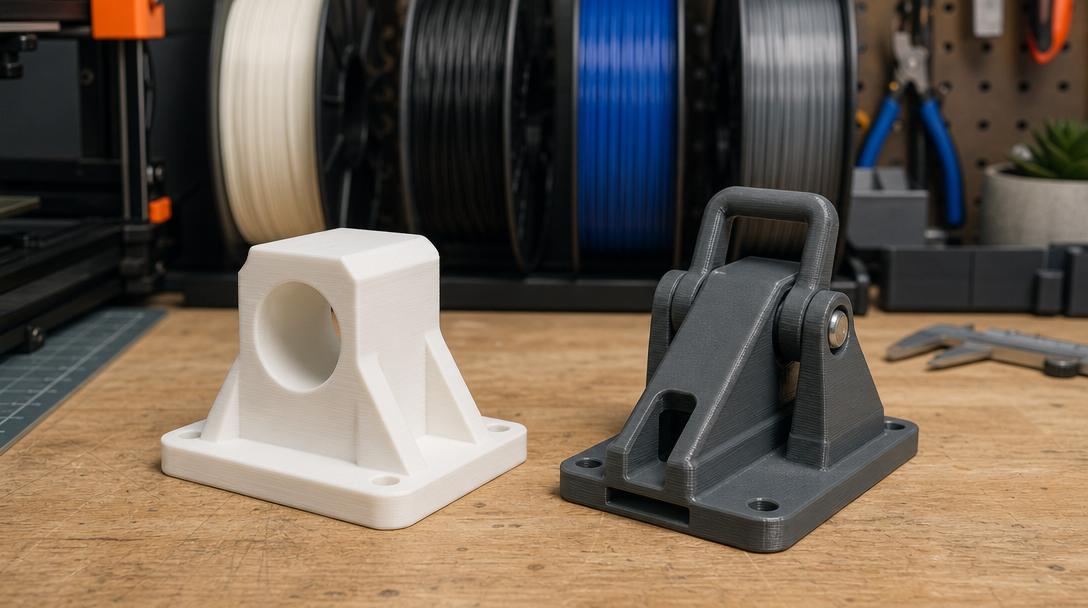

PLA+ or PETG? Which Makes More Sense for Everyday Functional Parts?
The question of PLA+ or PETG often comes up when you move from decorative models to more functional parts. Both filaments are widely used in FDM printing, but your choice should not be based on strength claims alone. Consider the part’s expected temperature, impact exposure, need for flexibility and printing conditions together.
The key difference between the two materials
PLA+ is a general product name used by different manufacturers for their PLA formulations, so its properties can vary from product to product. It may be designed to behave less brittly than standard PLA, but it is not safe to assume that every PLA+ product performs the same way. PETG can be more flexible under impact and is often chosen for everyday-use parts. The result also depends on the part’s geometry and print orientation.
PLA+ is generally known as an easy material to print. It can be suitable for visual prototypes, desktop accessories and covers that will not be exposed to high heat. PETG may be worth considering for housings, holders or protective parts where some flexibility and impact tolerance are useful. These are general tendencies, not guarantees of performance; load-bearing or safety-critical parts should be designed and tested separately.
Consider heat, impact and outdoor exposure
If a part will be left in direct sunlight, inside a vehicle or near a hot machine, its heat resistance matters. The PLA+ label alone does not guarantee heat resistance, so check the product’s technical data sheet. PETG is not suitable for unlimited use at high temperatures either. The actual operating temperature for either material depends on its formulation and the load on the part.
PETG’s greater flexibility may be an advantage for a part exposed to impact. On the other hand, PLA+ can be a good starting point if dimensional stability, sharp details or rapid prototyping are priorities. For parts that will be continuously exposed to UV radiation and weather outdoors, do not automatically assume either option is the right one; consider a more suitable material for the environment.
Printability and geometry
PLA+ may offer more accessible printing conditions on most desktop FDM printers. PETG may require more fine-tuning depending on settings and filament condition, particularly for bed adhesion, stringing and surface marks. These issues are manageable: the right profile, dry filament and a suitable first layer can improve the result.
- Consider PLA+: if rapid prototyping, appearance or use at low temperatures is the priority.
- Consider PETG: if the part needs impact tolerance and controlled flexibility.
- Review the design: wall thickness, corner transitions and print orientation matter as much as the material.
- Define the operating conditions: temperature, outdoor exposure, load and contact surfaces can all affect your choice.
There are situations where neither material is suitable. If a part will be exposed to sustained high temperatures or UV radiation, or will carry repeated heavy loads, do not decide based on the material name alone; assess the technical data and design together.
Choose based on the part
In short, PLA+ can be a good starting point for easy prototyping and everyday parts expected to retain their shape, while PETG may be better suited to applications where some flexibility and impact tolerance are needed. There is no single winner: the best way to choose is to define the part’s function and environment. Explore the general options on our printing materials page, and consider our 3D printing service for your project. To estimate the cost, upload your file using our affordable 3D printing prices calculator, or read our PETG guide to learn about similar materials.


 Türkçe
 العربية
 Русский
 فارسی
فارسی Deutsch