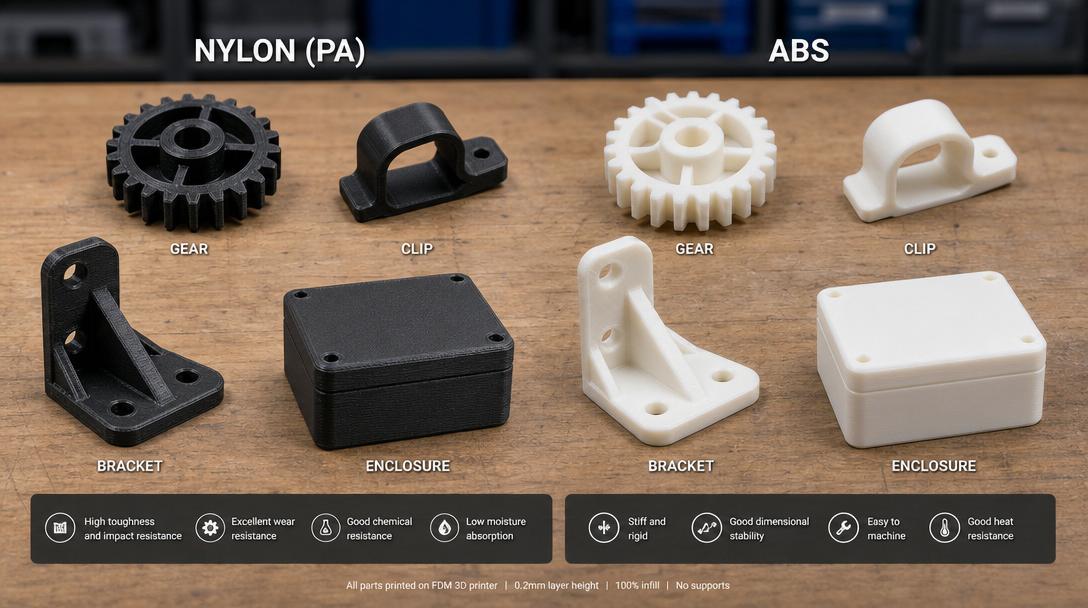

Nylon or ABS? Which Makes More Sense for Functional Parts Subject to Wear and Impact?
One of the most commonly confused choices when ordering a functional FDM part is the difference between Nylon (PA) and ABS. On paper, both appear “durable,” but in real-world use they meet different needs. If the part will be exposed to friction, carry loads, or benefit from slight flexibility, Nylon may stand out. If you are looking for a tough, practical, widely used engineering plastic for everyday use at a measured cost, ABS remains the more practical option for most jobs.
Before deciding on the right material for your part, the most accurate approach in a professional 3d printing service workflow is to choose the material based on the actual use scenario. Simply looking at catalog properties can be misleading, especially for moving parts or parts under stress.
When does Nylon stand out?
Nylon’s strongest advantages are impact strength, wear resistance, and a certain degree of flexibility. That is why it can make sense for low-load mechanical parts such as gear-like components, bushings, clips, friction-based connections, and functional components that are handled continuously. The material is strong, but rather than behaving in a brittle way, it tends to like a little “give” under load. This can be important in some applications because it may reduce sudden breakage.
However, Nylon is not a magic solution for every part. Because it tends to absorb moisture, it can be more sensitive to both printing and usage conditions. For some parts that require very tight dimensional tolerances, where surface appearance is a priority, or where the part must remain completely rigid, it may not be as straightforward a choice as expected. If you want to compare engineering-grade options more broadly, the engineering materials 3d printing page is a good place to start.
When is ABS the more sensible choice?
ABS is a well-balanced option that has been used in functional parts for years. It behaves tougher than PLA against impact, and its heat resistance is often sufficient for everyday-use parts. That is why it is frequently preferred for electronics enclosures, mounting fixtures, machine-adjacent support parts, protective covers, and functional components used indoors.
The advantage of ABS is not only performance; it is also often well balanced in terms of cost and production logic. Compared with Nylon, it may feel more rigid, and its surface character may be more predictable in many applications. This makes decision-making easier, especially in the process from prototype to end use. To see the general cost approach before ordering, it is useful to look at the price per gram logic.
Differences in heat, outdoor use, and impact
In terms of heat, both Nylon and ABS can be considered above the basic PLA level; however, service temperature should not be judged by material name alone. The wall thickness of the part, whether it is under load, and whether the heat exposure is continuous or momentary can significantly change the outcome. As a general tendency, for parts where wear and impact are involved and a certain amount of flexibility is beneficial, Nylon may make more sense; for more balanced, tough, and relatively economical functional parts, ABS may be the better choice.
For outdoor use, choosing between these two materials requires more than simply asking whether the part will be left in the sun. If UV exposure is long-term, neither may be the ideal candidate at first glance; in such cases, other materials may be more appropriate. In other words, this comparison is most meaningful for functional parts used indoors or under controlled conditions.
Which one should you choose for which part?
- Nylon (PA): A stronger candidate for parts that wear, rub, benefit from slight flexibility under load, and may take impacts.
- ABS: A safer choice for general-purpose functional parts where you want rigidity, functionality, and cost balance together.
- Nylon may not be suitable: For some jobs where very precise dimensions are expected or the part must remain completely rigid, due to its sensitivity to moisture.
- ABS may not be suitable: For mechanical parts that operate under constant friction or require the ability to flex rather than break suddenly.
Final short summary before you decide
If the part carries loads, faces impacts, and benefits from being able to flex slightly during use, Nylon is generally the more appropriate option. If your goal is a functional, tough, relatively rigid, and more balanced solution in production terms, ABS remains sufficient and sensible for most projects. To upload your file and quickly see the material scenario, you can get an instant quote from the online 3d printing page, allowing you to evaluate the material logic of the same part more accurately.


 Türkçe
 العربية
 Русский
 فارسی
فارسی Deutsch