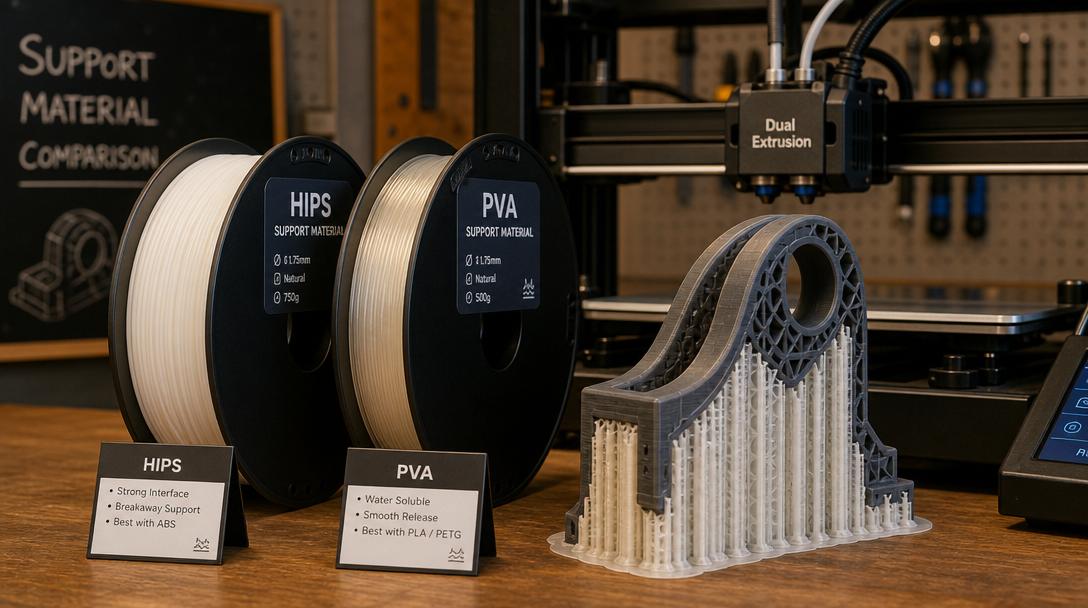

HIPS or PVA? Which One Makes More Sense as a Support Material?
In dual-extrusion FDM prints, the choice of support material can affect the result just as seriously as the main part material. Two of the most commonly confused options are HIPS and PVA. Both are considered for support; however, they do not approach the same job in the same way. Put simply, PVA generally stands out as a water-soluble support, while HIPS is based more on a support approach that is removed with a separate solvent in certain setups. If you are considering having your part produced through a 3d printing service, this difference directly affects surface quality, the cleanliness of the delivered part, and the overall production logic.
First, the basic difference: what are HIPS and PVA used for?
PVA’s strong side is that it allows clean removal in complex internal cavities and hard-to-reach support areas. Dissolving the support structure instead of breaking it away is especially advantageous in finely detailed prototypes. HIPS can likewise be used in a support role; however, in most scenarios it is considered more with specific material combinations. That is why, rather than asking “which is better?”, the more accurate question is “with which main part and which workflow?”
As you will also see when looking at Ucuz3D’s general our printing materials page, support material selection should not be evaluated on its own, but together with the main material and the part geometry.
What does it do well, and what does it not do well?
Jobs where PVA makes sense
- Parts with internal channels
- Fine details with a high risk of marks if supports are broken off
- Prototypes where visual cleanliness matters
- Support areas that are difficult to reach
That said, PVA is not the “automatically best solution” for every project. Because it can be sensitive to moisture, it requires proper storage and printing discipline. In very long and variable production conditions, efficiency can drop if the process is not managed well.
Jobs where HIPS makes sense
- Support needs in certain engineering-type setups
- Some geometries where a more rigid support behavior is desired
- Productions where compatibility with the main material has been tested in advance
Where HIPS falls short is that it is not practical for every user. For those expecting the convenience of simply rinsing the part in water and cleaning it easily, PVA may feel more intuitive. HIPS should be considered with a more controlled workflow rather than a typical desktop-user mindset.
Printability, surface quality, and practical use
In terms of printability, PVA looks very attractive in theory for most users because the support removal stage can be more delicate. However, in practice, moisture management of the material is important. HIPS, on the other hand, may offer more predictable support behavior during printing in some cases, but its post-processing requires a different procedure. In other words, PVA can give you easier support removal, while HIPS can provide a more structural support logic in the right combination.
In terms of surface quality, there is always a risk of marks being left behind when supports are removed by breaking them off. Because dissolvable supports can reduce this risk, PVA stands out in complex prototypes. Especially at the quotation stage, it is a good idea to evaluate the geometric difficulty of the part from the beginning during the online 3d printing process.
Which one stands out in terms of heat, outdoor use, impact, and mechanical expectations?
The critical point here is this: HIPS and PVA are usually meaningful not as end-use part materials, but as support materials. For that reason, factors such as outdoor durability, impact performance, or long-term heat resistance are not as decisive here as they are for the main material. In other words, the fact that a part will be exposed to sunlight by itself does not automatically lead to “let’s choose HIPS for support” or “let’s choose PVA.” The real decision is how the supports will be removed and how print compatibility with the main material will be established.
In short, outdoor, impact, and heat requirements are determined by the main part material; HIPS and PVA affect how cleanly you can support the geometry while producing that part.
Cost logic: which one is smarter, and when?
With support materials, the option that looks cheapest at first is not always the most economical solution overall. If cleaning the part afterward takes too much time, damages the surface, or increases the risk of reprinting, the process becomes more expensive. That is why cost should be considered not only in terms of filament consumption, but also together with labor and error risk. At this point, it is useful to look at the price per gram logic; however, the decision should still be made according to the complexity of the part.
Which one makes more sense for which part?
- In complex prototypes with internal cavities and a need for clean surfaces: PVA may make more sense.
- In more technical support scenarios where compatibility is already known: HIPS may make more sense.
- In parts with simple support needs: Standard supports using the main material may be more efficient, without needing either of these materials.
In summary, PVA generally represents the “clean removal” approach, while HIPS represents the “functional support in the right system” approach. If you are not sure which support strategy is safer for producing your part, the best approach is to evaluate the geometry and use case together and proceed accordingly.


 Türkçe
 العربية
 Русский
 فارسی
فارسی Deutsch