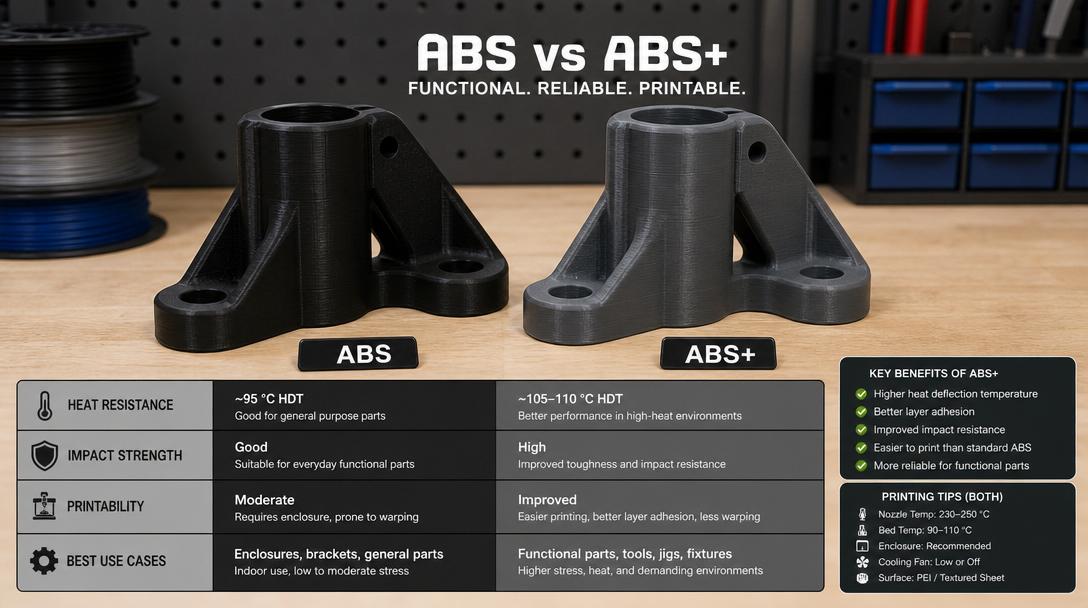

ABS or ABS+? Which Is More Trouble-Free and More Sensible for Functional Parts?
At first glance, ABS and ABS+ may look like two very similar options; in fact, they are two neighboring branches of the same decision tree. But if the part will actually be used in the field, if error tolerance during printing matters, and if you are considering surface quality together with mechanical balance, the difference becomes noticeable in practice. In short, ABS is generally seen as a more traditional and rigid engineering option, while ABS+ can be a slightly more balanced and easier-to-manage alternative for most users.
If you want to clearly determine the right material for your own product, fixtures, or prototypes, making the choice based on part type and use conditions through a professional 3d printing service is often more efficient than trial and error.
What is ABS used for, and what does ABS+ do differently?
ABS has long been a material used for functional FDM parts. Because of its impact resistance, reasonable heat resistance, and machinability, it is often considered for covers, housings, fastening elements, parts close to automotive interior trim, and workshop fixtures. However, ABS also has a clear weak side: compared to PLA or PETG, the risk of warping, layer separation, and cracking during printing can be higher.
Although it can vary by brand, ABS+ is generally positioned as a formula intended to soften some of ABS’s weaker points. It is often preferred for its more controlled print behavior, slightly better layer adhesion, or the expectation of a smoother surface. In other words, it is not a completely different material that changes the character of ABS entirely; it is more accurate to think of it as a more user-friendly variant.
Along which axes do they make a difference?
1) Heat and operating environment
Both materials make more sense for warmer environments than the PLA class. For a decorative part sitting on a desk, this difference may not be critical; but for parts used inside a car, around machinery, or in a closed volume that runs warm, ABS and ABS+ stay on the safer side. Still, if the heat is very high, more advanced engineering materials may need to be considered. At that point, the engineering materials page is a useful starting point.
2) Impact resistance and everyday durability
One of the areas where ABS is strong is impact resistance. It makes sense for screw-on covers, protective housings, and handheld helper parts. ABS+ is also generally considered in a similar class for most scenarios; in fact, in some applications, the practical result may be better because its interlayer consistency is more balanced. So you need to look not only at the raw material name, but also at the part geometry and printing conditions.
3) Printability and error tolerance
This is often where the decision is made. If the goal is production with fewer surprises, ABS+ may be more attractive for most users. That is because with classic ABS, corner lifting, internal stress, and the need for an enclosure are felt more strongly. ABS+ still requires care, but in many cases it is a little more forgiving. For that reason, it can stand out in rapid prototyping, repeat printing, and when cleaner results are expected.
4) Rigidity, surface, and user feel
ABS generally gives a more “industrial” feel. That is why it is often preferred for parts that need sanding, drilling, or post-processing. On the ABS+ side, the expectation of a smoother surface and a more controlled result often comes to the forefront. If surface aesthetics are important but the part will still be functional, ABS+ can offer a more sensible middle ground.
When should you choose ABS, and when should you choose ABS+?
- Choose ABS: If the part will be exposed to heat, will be open to impacts, you want classic engineering behavior, and the printing conditions can be well controlled.
- Choose ABS+: If you want to stay in a similar use class but achieve more trouble-free printing, a more balanced surface, and lower production risk.
- Evaluate both carefully: For parts that will remain outdoors under long-term UV exposure; because in that scenario, alternatives such as ASA can often be a better choice.
Which one makes more sense from a cost perspective?
Deciding only by the spool label is often misleading. The real cost is determined by the risk of failed prints, the need for reproduction, support cleanup, surface correction time, and total efficiency per part. That is why, between two materials that are nominally close in some jobs, the option that prints more smoothly may actually be the more economical one. For an application-based comparison, it is healthier to look at the logic of price per gram and get a preliminary quote with the online 3d printing system based on your file.
Final decision
If the part in your hand will be functional, will see some heat, and will require impact resistance, both materials remain on the table. However, from the perspective of the average user, ABS can be seen as the more traditional option, while ABS+ is often a more balanced and production-friendly choice. Especially if you are looking for a good middle path between print success and functional use, ABS+ may come forward; if you prefer a more traditional and controlled engineering approach, ABS is still a strong option.


 Türkçe
 العربية
 Русский
 فارسی
فارسی Deutsch