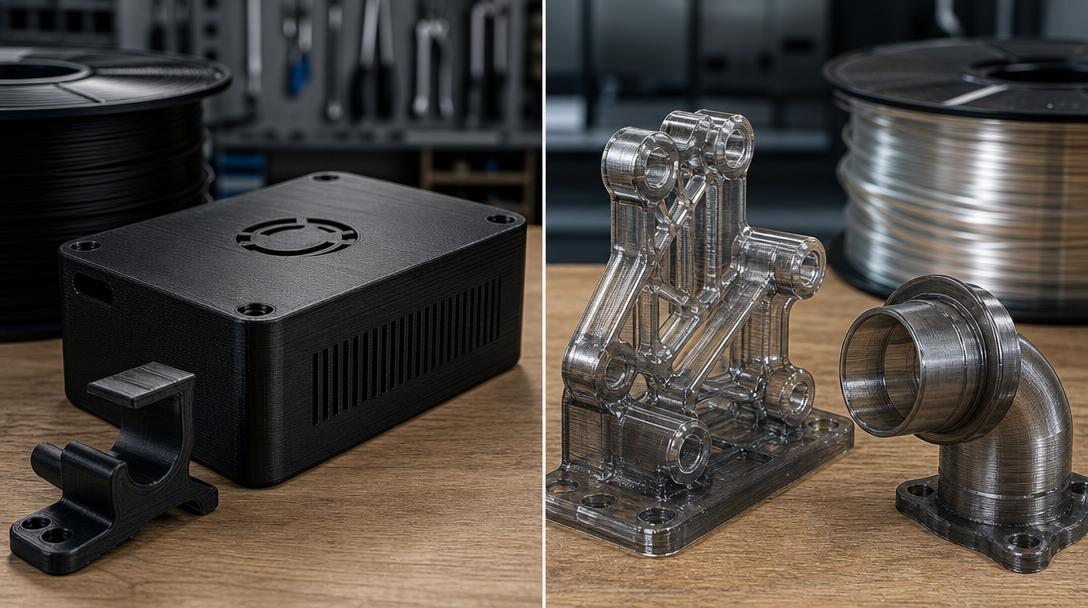

ABS+ or Polycarbonate? Which Is the Better Choice for Parts Exposed to Heat and Impact?
When printing a functional FDM part, one of the hardest questions is this: is ABS+ enough, or should you move directly to polycarbonate? On paper, PC often appears to belong to a higher performance class; however, in real life, not every part needs the highest technical value, but rather the balance that best fits the need. That is why the choice should not be made only by asking ‘which one is stronger?’
When getting 3D printing service from Ucuz3D, these two materials are often compared especially for functional parts such as covers, boxes, fixtures, connectors, and workshop-use components. If you want to see material classes as a whole, the engineering materials page also makes the decision easier.
The basic difference: ABS+ is more balanced, PC is for tougher jobs
Compared with standard ABS, ABS+ is an option aimed at more controlled printing behavior in most scenarios and remains a sensible choice for everyday functional parts. Polycarbonate, on the other hand, stands out in parts where higher heat resistance and strong impact resistance are expected. In short, while ABS+ offers a solution that is ‘good enough and more accessible’ for most workshop parts, PC provides advantages for more critical engineering needs.
The important point here is this: is the part an enclosure that will sit on a desk, a bracket that will face heat inside a vehicle, or a connector that will occasionally take load and impact? The material decision should be tied directly to the usage scenario.
Which one leads in heat resistance and outdoor use?
If the part will be exposed to summer heat inside a closed vehicle, will work in a hot environment even if it is not close to the engine, or if deformation risk under sunlight is a concern, polycarbonate is generally the safer option. ABS+ can also provide more serious performance than basic materials such as PLA and similar options; however, when high heat is involved, PC sets a higher bar.
Outdoors, however, the picture does not end with temperature alone. For UV resistance, other materials may be more suitable in some cases; therefore, choosing PC automatically just because the part will be outdoors is not the right approach. For parts that will stay outside for a long time, sun exposure and aging behavior should be considered as much as heat.
Impact, rigidity, and flex behavior
For parts exposed to impact, both materials are more serious options than the PLA class. ABS+ often delivers a satisfying balance in everyday scenarios involving knocks, drops, and hand use. Polycarbonate, on the other hand, is considered a higher-level option for more demanding impacts and jobs where mechanical safety margin matters.
Although PC may be perceived as more engineering-oriented in terms of rigidity, it may not always be the most practical choice. That is because it is not enough for a part to be simply hard; print quality, layer adhesion, and geometry also determine the result. In snap-fit lids, clip connections, or assembly parts that need slight flex, ABS+ can sometimes behave more forgivingly. For parts that carry very high loads or are expected to hold their shape better under heat, PC becomes the more meaningful option.
Printability: theoretical performance or manufacturing reliability?
One of the most practical differences between ABS+ and polycarbonate is printability. ABS+ still requires attention; however, PC is often a more demanding material. Suitable machine conditions, the correct temperature window, and a controlled process become more important. This means one thing: choosing the technically strongest candidate does not always deliver the smoothest production result.
Especially in batch production or where repeatability matters, the stability of the material during the printing process becomes a serious cost factor. That is why it should be evaluated not only by the material name, but together with part geometry and production risk. When planning an order, instead of memorizing fixed figures, it is healthier to look at the logic of price per gram; because the real cost is shaped together with part volume, support requirements, and production difficulty.
Which one makes more sense for which part?
- ABS+: Workshop fixtures, boxes, enclosures, hand-used functional parts, and connectors exposed to moderate impact.
- Polycarbonate (PC): Parts exposed to higher heat, load-bearing elements that require greater mechanical confidence, and engineering parts approaching harsh working conditions.
- ABS+ may not be suitable: For critical parts that must maintain their form for long periods under high heat.
- PC may not be suitable: For simple everyday parts where it would create an unnecessary technical level and increase cost and production complexity.
Final decision
If your goal is everyday functional use, reasonable durability, and more balanced production, ABS+ is a sensible starting point for most projects. If the part will face a hot environment, high impact, or more critical engineering expectations, polycarbonate may be the better candidate. In short, ABS+ can be seen as the ‘practical option that does the job well’, while PC is the ‘technical option that raises the bar when needed’.
To clarify which material is the right choice for your part and see the production response of your file, you can evaluate your model through instant pricing.


 Türkçe
 العربية
 Русский
 فارسی
فارسی Deutsch