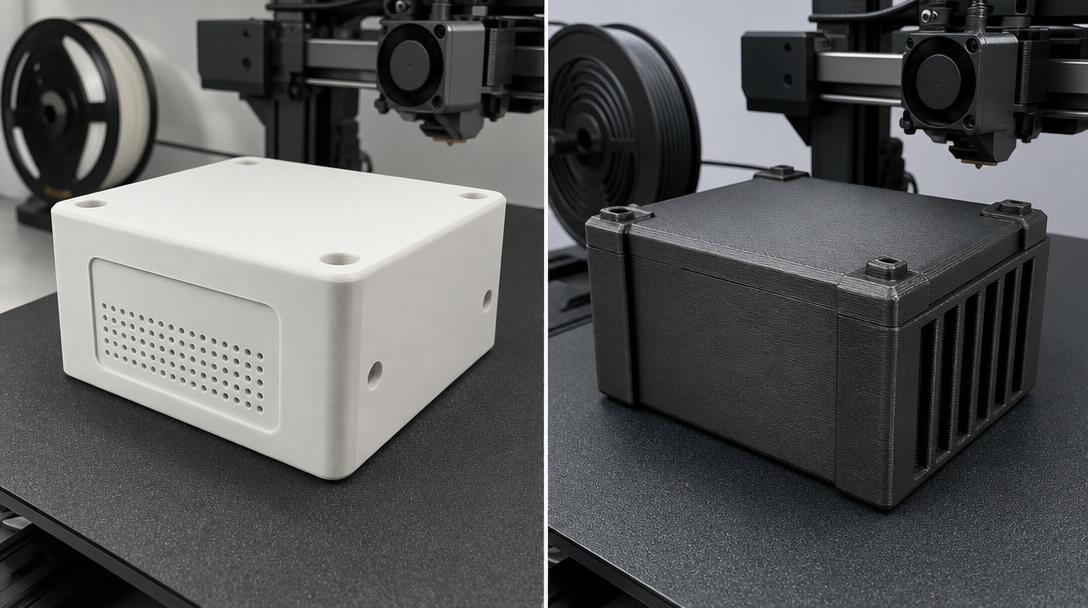

PLA or HIPS? Which Makes More Sense for Prototypes, Boxes, and Parts Exposed to Light Impact?
PLA or HIPS is a question that often comes up, especially when ordering boxes, prototypes, and parts that will face light stress in everyday use. Both materials are useful in FDM printing; however, they do not deliver the same result on the same part. While PLA is an option that is easier to choose and move forward with quickly, HIPS can offer a tougher character in some functional scenarios. When requesting a 3d printing service from Ucuz3D, choosing the right material directly affects not only the surface appearance but also the service life of the part.
What are PLA and HIPS good for, and what are they not good for?
PLA makes a lot of sense for visual prototypes, desktop accessories, models, dimension-check parts, and boxes exposed to low heat. Because the printing process is more predictable, it offers an advantage for jobs where you want results in a short time. On the other hand, it is often not the safest choice for parts left in the sun, used in hot environments, or exposed to constant impact.
HIPS, on the other hand, can be considered for boxes, lids, housings, non-load-bearing parts exposed to light impact, and prototypes where a slightly tougher behavior is desired. It can also be practical in terms of machining and sanding. However, HIPS also has its limits: it is not the first material that comes to mind for long-term UV exposure outdoors, and it is not considered as easy to print as PLA.
Where does the difference appear in heat, impact, and rigidity?
If the part will sit on an office desk, will not carry a constant load, and the ambient temperature is controlled, PLA is often sufficient. It has a strong rigid feel; this gives the user a clean result in simple accessories and visual prototypes. However, in places such as a hot car interior, a windowsill, or around a motor, PLA has a higher risk of losing its shape more easily.
HIPS can be a slightly more sensible middle-ground option here. Compared with PLA, it generally absorbs impact more softly and may have a lower tendency to crack suddenly. There are also scenarios where it can behave more safely than PLA in terms of heat. Still, this difference should not be exaggerated by thinking of HIPS as a high-temperature engineering plastic. If the part will really face tougher conditions, it is also worth looking at PETG, ASA, or more engineering-focused options among our printing materials.
- PLA: high printability, smooth surface, rigid feel, a strong candidate for rapid prototyping
- HIPS: tougher behavior, suitable for light-impact use, a sensible candidate for post-processing and housing-type parts
- PLA’s weak point: it can remain limited in high temperatures and outdoor conditions
- HIPS’s weak point: it may require warping control and a controlled environment during printing
Which one stands out in terms of printability and cost logic?
If your priority is to see a sample quickly, verify dimensions, and reduce unnecessary trial costs, PLA usually stands out. Because its print stability is high, the risk of error is lower; this is especially advantageous in the first iterations. For this reason, when looking at the affordable 3d printing prices page, it is important to think not only about the gram cost but also about the likelihood of smooth production with that material.
On the HIPS side, material selection is not always made based on gram calculation alone. If you want the part not to break under light impact, to feel a bit tougher, or to work in an environment approaching PLA’s temperature limits, the production logic may shift toward HIPS. However, since HIPS may require more controlled printing conditions, it does not automatically deliver a more economical result for every geometry. Depending on your model, it is healthier to make an instant comparison using the online 3d printing tool.
For which parts is PLA better, and for which parts is HIPS better?
To make a short decision; for a presentation prototype, desktop organizer, cable holder, visual model, and low-stress dimension-check part, PLA is generally the more appropriate starting point. For an electronics box, clipless housing, an everyday-use accessory exposed to light impact, or a body part that will be sanded afterward, HIPS may be the more sensible choice.
In short, PLA is a safe choice that delivers easy and fast results; HIPS is a more selective alternative, but one that can behave more functionally in the right part. If you describe not only how your part should look but also where it will be used, the material decision becomes much clearer.


 Türkçe
 العربية
 Русский
 فارسی
فارسی Deutsch