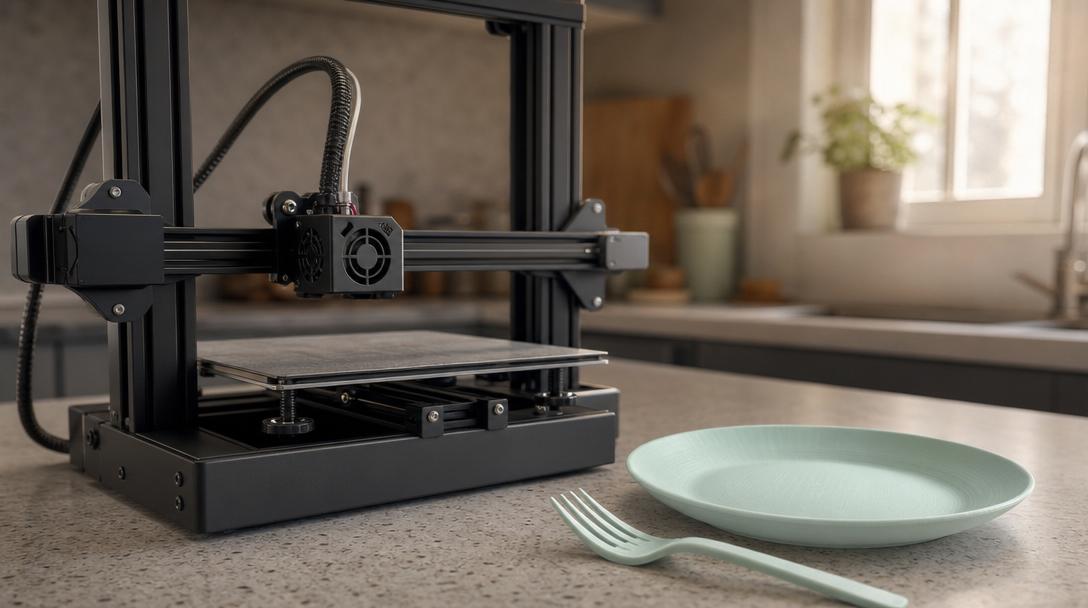

Is 3D Printing Food Safe? Can You Print Parts That Contact Food?
The question of whether 3D printing is food safe comes to mind for anyone who uses a 3D printer in the kitchen or is considering printing parts that will come into contact with food. The short answer is: 3D-printed parts are not ideal for direct food contact, but with the right materials and usage conditions they can be used in certain scenarios. In FDM (filament) printing, the microscopic gaps that remain between layers, residue that accumulates in the nozzle during printing, and the additives inside filaments are the main factors to watch out for from a food-safety perspective.
Why Is Food Contact Risky in FDM Printing?
In a standard FDM print, molten filament is deposited layer by layer. Micro-gaps inevitably remain between layers, creating an ideal environment for bacterial growth. Additionally, the nozzle, print bed, and extruder gradually accumulate residue from various materials. Particles from a carbon-fiber-reinforced or metal-filled filament used in a previous print can transfer into the next one. On top of that, many filaments contain additives — such as color pigments, UV stabilizers, and flame retardants — that have not been approved for food contact. For these reasons, a standard FDM print cannot meet food-safety standards.
Which Filaments Are Partially Suitable?
When food contact is involved, the two most commonly preferred filaments are PLA and PETG:
- PLA: Being corn-starch based, it is the most benign filament. However, pigments in colored PLA and nozzle hygiene still pose risks. When PLA filament properties are examined, it can be seen that it is usable for short-contact items such as single-use serving plates or cookie cutters.
- PETG: PETG has better chemical resistance than PLA and a comparatively smoother surface. Among our 17 material options, PETG is also available. However, the problems of inter-layer gaps and nozzle hygiene persist here as well.
Which Materials Should You Avoid?
Some filament types are not suitable for food contact at all. ABS should not come into contact with food due to the styrene gas released during printing and its additives. Engineering materials such as carbon-fiber-reinforced filaments, nylon, and polycarbonate are designed for industrial parts; their additives and manufacturing processes do not meet food-safety standards. For wood-filled and metal-filled filaments, the source and purity of the filler are uncertain.
Practical Recommendations for Food-Contact Parts
If you still intend to use a 3D-printed part with food, follow these rules:
- Design the part only for single use or very brief contact.
- After printing, sand the surface thoroughly and seal the layer gaps by coating with food-approved epoxy resin.
- Do not wash the part in a dishwasher — heat and detergent weaken the layers.
- Do not put 3D-printed parts in a microwave or oven.
- Whenever possible, prefer printing parts that do not come into direct contact with food (storage container lids, label holders, organizing fixtures).
The true strength of 3D printing shows itself not in food contact but in industrial prototyping, spare-part production, and custom functional part manufacturing. If you have concerns about food safety, your first choice should always be standard food-approved products. For a custom project, you can order online and receive expert material and design consultation.



 Türkçe
 العربية
 Русский
 فارسی
فارسی Deutsch