
Printing Electronics on Living Tissue: A New Method Pushes the Boundaries of Medicine and Bioprinting
Scientists have developed a new 3D printing method that makes it possible to print electronic circuits directly onto living tissue. Published in the journal Science, the research combines bioprinting with electronics manufacturing, opening the door to a new era in medicine.
How Does the New Method Work?
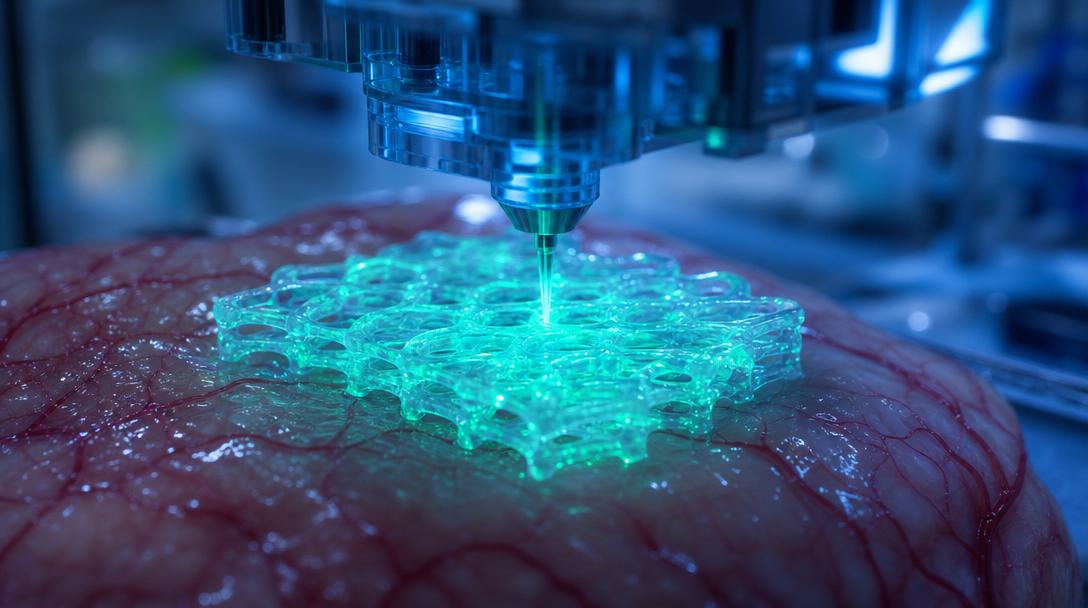
The researchers developed a technique that uses light-based 3D printing to process mechanoluminescent hydrogels onto living tissue. The method relies on a special gel material containing bioluminescent microorganisms known as dinoflagellates. This material remains compatible with living cells during printing, allowing electronic circuits to be printed on top of it.
- Living-cell compatibility: The tissue is not damaged during the printing process and retains its viability.
- Light-based printing: More precise and tissue-friendly than conventional thermal or mechanical printing.
- Bioluminescent imaging: Thanks to the microorganisms they contain, the printed structures emit light and can be visualized.
The Potential for a Revolution in Medicine
This technology could be a game changer, especially for implantable medical devices and biosensors. Today, placing devices such as pacemakers or nerve stimulators requires surgery. With this method, however, electronic circuits can be printed directly onto the tissue surface, enabling solutions that are more body-friendly and less invasive. It also opens the way for innovative applications such as smart bandages that monitor wound healing or biosensors that track organ function.
3D Printing’s Role in Medicine Keeps Growing
While printing on living tissue is still in the research stage, the use of 3D printing in the medical field is increasing every day. Surgical planning models, custom orthoses and prostheses, and even exact replicas of patient tissue can already be produced with FDM 3D printers. Anatomical models used in pre-operative planning, in particular, allow surgeons to rehearse an operation in advance, reducing risks.
Advances like these in bioprinting are accelerating the transition from the lab to the clinic, thanks to the speed and flexibility that 3D printing brings to prototyping. Although printing electronics onto living tissue is a complex biotechnology process, a large share of the fundamental research in this field is carried out with 3D printers. Test setups and prototypes produced with FDM printers allow researchers to test their ideas quickly.
You too can bring your project to life for medical prototypes, surgical models, or custom apparatus by instantly calculating a 3D printing price. With 17 different FDM materials and 1-business-day delivery, Ucuz3D offers fast solutions for your medical and industrial prototyping needs.



 Türkçe
 العربية
 Русский
 فارسی
فارسی Deutsch