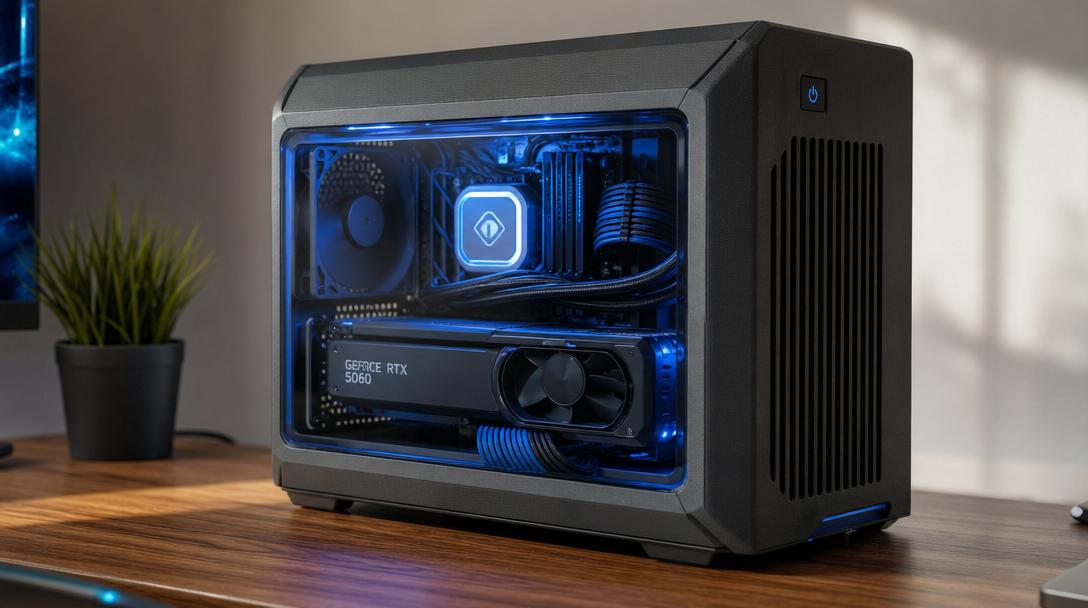

AMD Engineer Produces His Own Gaming Console with 3D Printing: Custom Case with RTX 5060
There’s inspiring news for computer hardware enthusiasts and 3D printing fans. An AMD engineer produced a custom gaming console case from start to finish with 3D printing, based on the RTX 5060 graphics card. The resulting compact Steam Machine-like system once again demonstrates the limits of 3D printing in prototype production.
Idea and Design Process
The project came from an AMD employee who was tired of bulky standard gaming cases that don’t fully match personal tastes. The engineer, who decided to design a case according to his own needs, first drew a compact chassis considering the cooling requirements of the RTX 5060 and other components. This is where the biggest advantage of 3D printing came in: unlike traditional injection molding or CNC methods, you can print directly without the need for expensive molds to produce a single prototype.
Why 3D Printing?
The most practical method for producing a custom gaming console case was FDM 3D printing. The engineer used carbon fiber reinforced PETG filament to obtain a case that is both durable and lightweight. In traditional manufacturing, producing such a customized part for a single unit would either be very expensive or completely impossible. With 3D printing, the transition from design to final product took only a few days.
Cooling and Material Selection
The most critical part of the case was undoubtedly the cooling channels. A high-performance graphics card like the RTX 5060 requires proper design of the internal airflow. The engineer created custom air channels and fan mounting points using the high temperature resistance of PETG filament. This resulted in both a quiet and effective cooling system.
The Role of 3D Printing in Prototyping
This project once again proves why prototype 3D printing is so valuable. Taking an idea and turning it into a physical, working product within a few days provides great flexibility for designers, especially during the product development stage. If there are faulty sections, correcting them in the CAD file and taking a new print is much faster and cheaper than making mold changes.
Projects like this show that 3D printing is not just a hobby, but can be highly effective in industrial prototyping and even end-user products. If you also have a custom case, apparatus, or prototype in mind, you can prepare your STL file and calculate its price instantly, bringing your project to life.
FDM 3D printing is becoming more accessible every day for custom electronics projects, drone parts, or industrial prototypes. From custom case and enclosure production to mechanical parts, you can benefit from the advantages of 3D printing in prototyping across a wide range, and test your designs quickly.


 Türkçe
 العربية
 Русский
 فارسی
فارسی Deutsch