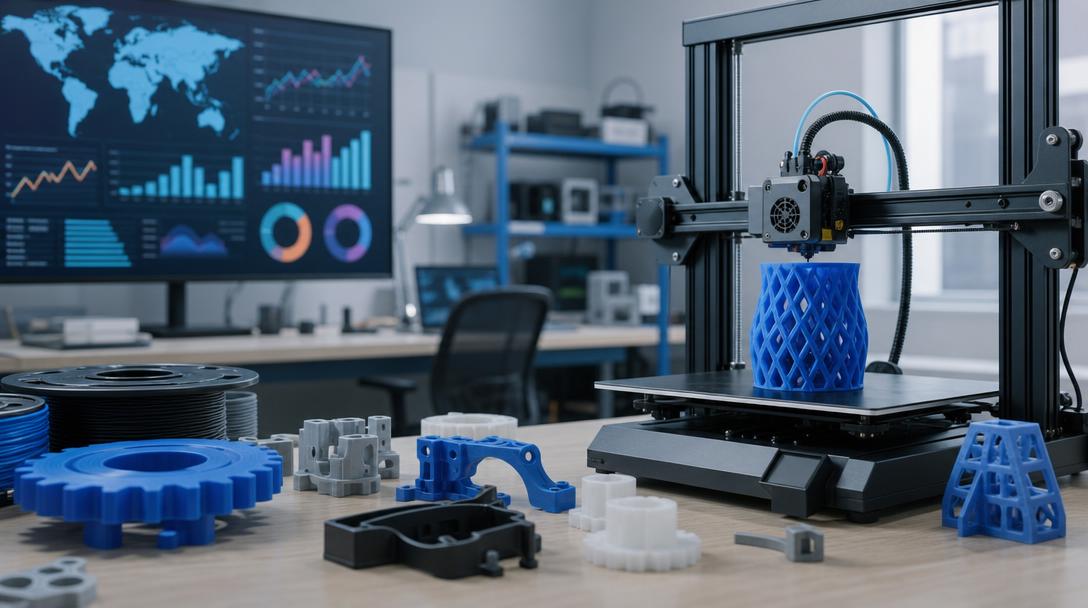
Global 3D Printing Market Grows 12% in Q2: Services Outpace Hardware
The global 3D printing market grew 12% year over year in the second quarter of 2026, reaching $4.5 billion. Quarterly data published by Additive Manufacturing Research (AM Research) shows that growth was not driven solely by new printer sales: printing services and the polymer segment also accounted for a significant share.
Which areas are leading the growth?
In AM Research’s dataset, which tracks metal, polymer, and ceramic printing alongside printer, material, and service revenues, the total market grew from $4.4 billion in the first quarter to $4.5 billion in the second. The polymer segment was the largest, at $2.68 billion, up from $2.42 billion in the same quarter a year earlier. Metal additive manufacturing revenue reached $1.81 billion. No separate figure was reported for ceramics.
Another notable figure in the data is printing services revenue, reported at $2.50 billion for the second quarter. That is higher than the $2.19 billion recorded in the same period last year. The way the figures are presented in the report indicates that service revenue is included in the metal and polymer totals. Therefore, adding it to the segment totals to recalculate the overall market size would be inaccurate.
Buying parts and capacity instead of buying a printer
One possible implication for the industry is that, rather than investing in new machines to meet every need, companies may be turning to external printing services or production capacity. This interpretation is consistent with the growth in services reported, although the data alone does not establish why individual customers make their decisions. AM Research executive Scott Dunham also pointed to the industry’s positive trajectory while highlighting the risk that pressure from interest rates and capital spending could slow investment.
This distinction presents a practical decision for teams developing prototypes or low-volume parts: Is it better to buy and operate a printer, or have the required parts produced as a service? The answer depends on how often the work is needed, the part geometry, the required material, quality-control needs, and in-house expertise. An external service can help you test an idea without taking on equipment investment or machine-use planning; for regular, high-volume work, however, the total cost of ownership should be assessed separately.
What this means for teams using FDM
The report covers all additive manufacturing technologies, so its 12% growth should not be read as a direct increase in FDM printer sales. However, the prominence of polymers in the market highlights the importance of the plastic-part and service ecosystem, which includes filament-based manufacturing. For an FDM part, the design, print orientation, and conditions of use matter just as much as choosing the right material. When deciding on a prototype or functional part, it is useful to assess printing materials against the intended application.
If you are considering having a custom part produced externally, you can explore 3D printing services, learn about affordable 3D printing prices, and get an instant quote for your file. For a basic overview of how costs are determined, the guide to calculating 3D printing costs may also help.
In summary, the second-quarter data shows that the global additive manufacturing market is growing and service revenues remain strong. However, overall market figures do not guarantee growth for any particular technology or company. When making decisions about FDM, you should also weigh your specific part requirements, production frequency, and material needs.



 Türkçe
 العربية
 Русский
 فارسی
فارسی Deutsch